• Log In
  • Log In
Slate (skeleton-v3 PHP 8 prototype)
Slate (skeleton-v3 PHP 8 prototype) Learn · Create · Lead
  • Students
    • Mission and Vision
  • Parents
  • Community
    • Mission and Vision
  • Calendar

Globalization - Laufenberg Public Feed

Create a Post

Egypt Election - Bach | Gina | Fangda

Posted by Bach Tong in Globalization - Laufenberg on Friday, June 1, 2012 at 8:16 am

​About Egypt:

Egypt is located in northern part of Africa known as the Middle East. The country is known for its vast desserts, and its rich ancient history of Kings and Queens with pyramids that still exist. Today, the country is the worlds 6th largest supplier of liquified natural gas and oil is the main export. Although the country's oil and tourism industries are still very prosperous, the recent revolution and overthrowing of former president Hosni Mubarek has left the country's current political state in disarray. 

About Egypt's Election:

Election in Egypt is universal and compulsory to all Egyptian citizen over 18 years of age. Egypt has a two-round system for its presidential election. Previous to the revolution, Egypt's election process included a popular vote by the citizens for the head of state or president of Egypt. The president would be elected for a six year term after being nominated by the People's Assembly and then later confirmed by the popular vote. The People's Assembly is composed of 508 members, 498 of them are elected for a five year term and 10 members are added by the newly elected president each new term. The elections for the People's Assembly are carried out in three phases, in which there are 12 election days held throughout the country. Now that the revolution has occurred, the Egyptian people are currently writing a new legislature to carry out presidential elections.

Candidate Qualification:

- Be born in Egypt to Egyptian parents
- Not holding dual nationality
- Not marriage to a non-Egyptian
- Support of 30000 voters


Now in Egypt the top two candidates have decided to enter the runoff election next month (06/16-06/17). They are Mohamed Morsi from the Muslim Brotherhood and Ahmed Shafik who served under Hosni Mubarak as the prime minister.


Mohamed Morsi has been Chairman of the Freedom and Justice Party(FJP) after the revolution happened in 2011. During 2000 and 2005, he was a Member of Parliament. Before the Freedom and Justice Party was founded, Mohamed Morsi had been a member of the Guidance Office of the Muslim Brotherhood. After that, he was elected by the Muslim Brotherhood's Guidance Office to be the first president of the new party. Mohamed Morsi was at first being nominated as a backup candidate, but later on he took the place of Khairat El-Shater as a formal candidate when the latter was disqualified.

Ahmed Mohamed Shafik was a senior commander in the Egyptian Air Force and later served as Prime Minister of Egypt for a period of 33 days, when Hosni Mubarak was in charge. Ahmed Shafik served in the army as an young officer and had attended the War of Attrition and 1973 October War. Later in 1983, he was appointed a military attaché in the Egyptian Embassy in Rome. In 1991, he had become the Air Force's Chief of Staff, and lasted for 5 years, when he became the Commander of the Egyptian Air Force. Seen as "one of Mubarak's old guard", Shafik became a member of the Supreme Council of the Armed Forces in February 11, 2011. Ahmed announced his candidacy in the Egyptian Presidential Election in November 2011.

We interviewed Mohamed Zayed, who works for the Ministry of Education and was also one of the visitors to SLA during the two weeks of May.
Screen Shot 2012-06-01 at 07.41.08 AM
Screen Shot 2012-06-01 at 07.41.26 AM
Screen Shot 2012-06-01 at 07.41.50 AM
Screen Shot 2012-06-01 at 07.42.00 AM
We also reached out to Sharif Kouddous, who came to our class and spoke as part of the Pulitzer Center. He is now a senior correspondence in the Middle East for Democracy Now.

Here is an interview he did with Democracy Now on the topic of Egypt Presidential Election:

Screen Shot 2012-06-01 at 08.10.09 AM
Reflection:

The process of corresponding with an Egyptian person to interview them about their presidential elections was very long and required patience, however we are glad that we were able to learn something. Our group gained a new insight into this foreign land and was surprised to learn that presidents are elected in Egypt for a longer term than those in the United States and also the People's Assembly of Egypt has almost the same number of members as our American Congress and it functions similarly. We think that this was a good experience. If we were to do this again, we would definitely not procrastinate and spend more time talking to each other about the project. Our advice to others would be to pick a country that you're interested in so that you'll be able to fully appreciate the knowledge given to you in the interview.
Be the first to comment.

Election Project Work

Posted by Tariq Smith in Globalization - Laufenberg on Thursday, May 31, 2012 at 11:31 pm

(Tariq, Sam K., & Sam S)


My Group's election country was Russia. Our Election was in early March and we tried several different ways of coming in contact with someone over there to conduct interviews. We emailed an english speaking school over there, as well as we tried to get in contact with luke van meter's brother who actually taught over there. We tried following up with these actions but they were to no avail.

If we were to do this project over again, we would have tried to physically speak to luke's brother, and go deeper with pursuing someone through Serge's family. We felt that there was hardly any physical connection therefore making it extremely difficult to establish a relationship with a stranger as well as getting them to do a task for us.

Screen Shot 2012-05-31 at 9.24.38 PM

Screen Shot 2012-05-31 at 10.21.32 PM
Be the first to comment.

Election Country- France

Posted by Kate Pepple in Globalization - Laufenberg on Thursday, May 31, 2012 at 9:28 pm

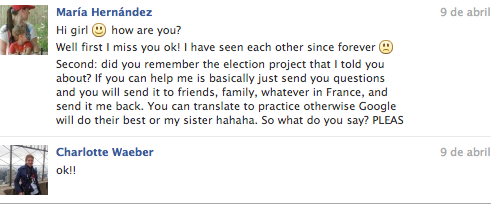
​By: Kate Pepple & Maria Hernandez

Timeline:

  1. We were officially assigned to this project in February, 6th.
  2. By March 5th, we spoke with an exchange friend from France.
  3. On April 9th, we officially talk to her online to plan specifically what she would be doing.

4. Once she agree to do it on April 20th, we sent her the questions.

5. The elections were April 22th.

6. By May 5th we had all the answer from the voters in France.


Questions:
  1. What motivated you to come out and vote?
  2. What would you like to see changed in our political system?
  3. Do you vote in every election? (How regularly do you vote?)
  4. Are you always sure of who you are going to vote for when you walk into the booth or are you still deliberating?
  5. Where have you encountered the highest amount of ad campaigning? Radio, TV, print, internet, other.

Answers:
Nathalie Gabory, 42 years old
  1. It is a civic duty, we fought for the right to vote
  2. That we stop making promises that cannot be held
  3. Yes
  4. No
  5. On the radio

Emmanuel Kinger, 19
  1. Opportunity to express its opinion and hope to see a few changes
  2. I'd like the government to stop paying people who do nothing, do not work. And help those who do not need it.
  3. I’d like more competent people in government and less people who can only talk … And prevent capital flight of large enterprise, and bring back that are in tax havens.
  4. As soon as I get the chance (this is the first time I vote)
  5. Yes, I am sure
  6. Prints, radio, TV, everywhere actually

Zoé Gremillard, 19
  1. Because It is a civic duty to vote
  2. For now the political system right for me as it is, I just wish that all politicians aren’t "people-ized"  (like famous people)
  3. My first election
  4. I know who I will vote in the first round, the second round is going to ask me a little more thought I think.
  5. Election posters are very present, but upon all expectations, young people on facebook, have themselves publicity the candidate they preferred.

Roger Waeber, 56
  1. It’s a duty for the interest of French’s’ economy. To  keep our social rights, social protection that is one of the best in Europe, to keep good relationship the other country in Europe and in the world, and of course our freedom of expression and purchasing power
  2. I’d like more referendums for important decisions
  3. I vote for every elections and referendums
  4. I know who I’m going to vote for.
  5. On TV, with publicity and shows, papers…

Charlotte Waeber, 18
  1. It’s a duty to my country, and a chance we have (French) to express our opinion in order to maintain peace and economy in our country and in Europe.
  2. I would like more involvement of people in government decisions. That elected officials represent more the people than the French upper class. And that the government takes more economic decisions ( like more industries, more competitivity…) instead of social decisions
  3. It’s my first election
  4. I know who I’m voting for in the first round, but not in the second
  5. Mostly on TV and internet.

France & American Election Comparison:
France is similar to America in that they have a representative government, officials are either elected directly by the people or indirectly by officials already elected.  France elects presidents for 5 year terms, they also vote for officials in Parliament.  There are two chambers in Parliament, The National Assembly and The Senate.  French citizens also vote for members in local government and some non political candidates such as judges.  France does not have a strict two party system like that of America, yet they do have two parties that tend to be elected; on the left the Socialist Party and on the right the UMP.  Elections are always held on Sundays in France with the campaign ending the Friday before.  By 8pm on Sunday the results of the voting are starting to be published, before some of France's territories in the Western Hemisphere had even voted.  Because knowing the most likely results before they even vote, some elections in the America's are allowed to be held on the Saturday before. 

Reflection:
This project was an important lesson for everyone because we had the opportunity to interact with a young person like us, but from an other country; at the same time that we learn about their culture, and by comparing with our see how different the process is even when countries are in democracy (like the case of France and US), and just because is different doesn’t have to be bad. Also the exchange of ideas with people from other country makes us value their traditions and appraise more ours.
Be the first to comment.

Globalization Quarter 4 BM

Posted by Delesha Jackson in Globalization - Laufenberg on Wednesday, May 30, 2012 at 8:15 pm

For this quarters benchmark is was sort of tough to do because I didn't really know what to take pictures of as well as the topic I wanted to do. But then as I walked around the city I say a lot of governmental issues at hand so I thought I should talk about them. My favorite image is the construction image because that is something I think is so dumb that the government is doing right now. I feel like it could be avoided and changed in so many ways. I feel like the evidence is relavent Philadelphia because these things are happening here and right now a lot of people are looking at us because a lot s happening in our tri-state area. 
lauf bm
Be the first to comment.

Globalization Qtr 4 Benchmark

Posted by Sekai Gonzalez in Globalization - Laufenberg on Tuesday, May 29, 2012 at 11:07 pm

​Animal Cruelty

Have you ever wondered what life is like for a celebrity's pet? Yes I'm talking about the pampered pooches you see on television and in all the magazines with the designer leashes and matching outfits. Well now take a step down from the glamour and the cameras and think about the animals in your very neighborhoods. Take an even deeper look and think about the animals who have ended up in shelters because of animal cruelty. Many places in Philadelphia have been known for having many untended animals.


  Many of them have become strays. Animal cruelty can start anywhere from not giving your pet the proper amount of food to beating your animal. Overall it still has the same effect on the animal, heartbreak. Yes animals feel it to. Imagine if the person you loved and trusted decided to just hurt you and beat until you could barely move, just because they wanted to. Now for the main question, what exactly is animal cruelty?  Animal cruelty is the infliction of suffering or harm upon animals, other than humans, for purposes other than self defense. Long story short, it means cause some type of pain to an animal other than when you are trying to protect yourself. 


One example of animal cruelty I have was even with my own dog Kujo. When Kujo was two months old he was tied to a fence as the owners moved out of the home and left him there to basically die. When we stumbled upon him, he was very skeletal and very dirty. If you looked into his eyes it was as if his whole body told a story of his pain. As a result of this horrific experience, Kujo now suffers from a dream anxiety disorder. Dream anxiety disorder is a sleep disorder that is characterized by very frequent nightmares. Even though this disorder is usually diagnosed for humans, Kujo has been diagnosed with this because of what the doctor called post traumatic stress. Now Kujo has to be taken care of a little bit more than a regular dog would need to be, but none complains because he is a joy to have. Animal cruelty is something that should be taken very seriously because poor pets like Kujo are the ones who have to deal with the physically torture but the people who are causing the pain will feel the emotional torture. 


Links for more information:
ASPCA
Dream Anxiety Disorder
Animal Legal Defense Fund
PETA
Animal Cruelty
Be the first to comment.

SLA's Amazing Seniors!

Posted by Kyla Carden in Globalization - Laufenberg on Tuesday, May 29, 2012 at 9:27 pm

​I created a news letter for SLAs seniors who are doing amazing things within the school and the community. Many times all of the news we see is broadcasting something negative and I believe it's time we shed some light on young teens doing good!

http://dl.dropbox.com/u/1084751/Q4%20BM%20Lauf.pages

  • What did you find most challenging about this project?
    I honestly found that the most challenging aspect of this project was 
    actually figuring out what kind of story to bring to the light. 

  • How did you go about finding this story?

    I volunteered to help with many capstones and projects and I realized that there is good happening right in my face.

  • Why do you think this story does not receive more attention?
    I think that the story doesn't receive more attention because the media likes to make young black children look like they only know how to cause trouble, which is not true. My report clearly shoes that young, inner city, black youth can do something beyond amazing and positive. 

  • Do you think this story will get more attention over the next few months?  Why?  Why not?

    No, because it's not a story most people care to hear about. If it doesn't involve violence it won't get as much attention.

  • What did you learn?

    I learned that the news doesn't have to be the only outlet for information. I, myself can broadcast the good I see around me to others.
Be the first to comment.

France, By Mike Jesse, and Andre

Posted by Jesse Weinberg in Globalization - Laufenberg on Tuesday, May 29, 2012 at 3:36 pm

The two candidates running for the Presidential Election of France are Nicolas Sarkozy and François Hollande.
Nicolas Sarkozy is [now former] the President of France, Sarkozy is the former leader of Union for a Popular Movement  (UMP) and served as Minister of Interior for Dominique de Villepin's government (2005–2007).

François Hollande- Elected President of France as of May 6 2012, succeeding Nicolas Sarkozy.


1. What does it take to make you feel that a candidate is fit for the job?

2. What prompted you to come out and take part in this election?

3. What would you like to be changed in the way your government is run?

4. Do you feel that your vote will have an influence on who is elected?

Person 1:

#1. President needs to have a specific plan of action in solving
problems such as poverty, education, corruption,etc. He has to work
hard and well to achieve goals of the government. And he also
obviously needs to be intelligent.
 #2. I took part in the election because I wanted to help the right
candidate get elected.
 #3. I think the people should have more of a say in our government
and how it's run.
 #4. Yes, why not? I think everyone's vote counts, an even if the
candidate I want doesn't win, atleast I know I tried.
 #5. Yes I knew who I was going to vote for when I went in. I voted
for Sarkozy, because I really don't agree with Hollande's ideas, but I
don't really like Sarkozy either.
 #6. I try to vote at every election. I think it's important for young
people to vote.


Person 2:

#1. I think a good candidate can inspire unity, trust, and optimism
among the people by being a good and moral leader. I also think that
they are able to make right decisions for the common good, even if the
decision is unpopular.
 #2. I took part in the election because I wanted to show that I care
about my country and it's future and I wanted the right person to get
elected.
#3. I would like more equality, especially between men and women in
the working world. I also would like something to be done about taxes,
but they are only going to go up with Hollande as President. I also
think people should be more involved in governemnt decisions.
 #4. I hope my vote has makes an influence!
 #5. Yes, about a week before voting I didn't though. I kept going
back and fourth between Hollande and Sarkozy. Eventually I ended up
going with Hollande.
 #6. Yes, I vote at every election. I like to be extremely involved in
big decisions that are going to effect my life and my family's life.


Person 3:
#1. I think a president should be able to steer the country towards a
just and humane society, and knows how to get the country there. Also,
honesty is very important. Do what you say you're going to do.
 #2. This is actually the first election I was allowed to take part in
because I am German and so I was a french citizen until now so I'm
very excited for this election.
 #3. Well for me , personally, a big thing is equality. I've been
living in France for 10 years and paying taxes but I couldn't vote, I
don't think that's very fair.
 #4. 100%. I think everyone's vote counts.
 #5. Yes, I'm voting for Sarkozy. I think he's done a fairly good job
these past 5 years and I'd like to see what he will do the next 5.
 #6. No, I couldn't vote befoe but I do intend to vote at every
election now that I'm able to.


Similarities and differences in France and US Government


Both has presidents but serve in different ways

  • Elected every 4 years by the electoral college (which is in turn elected by the popular vote based on state population)
  • Can sign bills into law
  • Can veto bills
  • Is commander-in-chief of the Armed Forces
  • Nominates judges for the Supreme Court
  • Responsible for many Executive Branch Appointments
  • Can grant pardons

  • Elected every 5 years by popular voted (used to have an electoral college, but that has since been dissolved)
  • Announces new laws, but does not create or sign them into law
  • Can dissolve French National Assembly
  • Is commander-in-chief of the Armies
  • Appoints the Prime Minister (but cannot dismiss him)
  • Appoints most officials
  • Can grant pardons
  • The differences between the governments do not stop simply with the heads of state. Both have extremely different basic structures.


What Could have been done differently is that our communication could have been stronger with each other. The collaboration could have gone more smoother. What really worked out was that we stayed in contact with each other for the most part sending emails back and fourth, However that could have gone more smoother then it did.  

One major tip I would give always work with your partners. Don’t let them do the majority of the work. If they end of leaving you for a long period of time do your best to contribute in making sure things go smoothly.


France election 2012: how the presidential poll worksHappens every 5 years
contains two rounds however who ever has the most votes in the 1st round wins
each of the candidates start out with 153, 000 votes from the state


Resources:


http://www.telegraph.co.uk/news/worldnews/europe/france/9209449/France-election-2012-how-the-presidential-poll-works.html

http://www.cosmopolitanservices.com/en/relocating-to-france-governmental-differences-between-france-and-america/menu-id-100044.html


Be the first to comment.

QWhite Q4 bm Inner City violence

Posted by Qyidir White in Globalization - Laufenberg on Tuesday, May 29, 2012 at 1:26 pm

Click link for benchmark: http://dl.dropbox.com/u/326903/Q419123.pdf
Be the first to comment.

Benchmark - Education

Posted by Lauren Gore in Globalization - Laufenberg on Tuesday, May 29, 2012 at 1:25 pm

Lauren (The Word)
I have created a newspaper, and it addresses the education issue and talks about charter schools.

  • What did you find most challenging about this project?
    - I found that making a newspaper is harder than it looks, I tried to organize my thoughts on paper. It was hard. 
  • How did you go about finding this story?
    - I frequently visit a website called The Daily Censored, it's a blog that is full of under reported stories.
  • Why do you think this story does not receive more attention?
    - Because no one really cares about corrupt government and it doesn't impact them so they do not care. But it directly impacts them people seem to care.
  • Do you think this story will get more attention over the next few months?  Why?  Why not?
    - Probably not, because the american people are lazy and couold care less about what is going on
  • What did you learn?
    - I learned how to make a newspaper and more about the corrupt systems in the United States
Be the first to comment.

Benchmark: convention center.

Posted by Gilberto Gonzalez in Globalization - Laufenberg on Tuesday, May 29, 2012 at 11:16 am

The convention center in center city philadelphia shockingly helps the city in many ways. Its a commonly forgotten place by many people within the city, and a hated place by many people in the city due to the fact it is trying to expand into their area. But expanding the convention center wasn’t a bad idea. This past weekend I happened to be down town and saw thousands of people flocking into the convention center I thought i’d check out what was going on.


Once I arrived inside I saw that there were thousands of people there playing yu-gi-oh. I myself play yu-gi-oh and would have never expected this many people in the city to play the game its a child card game and the convention center was filled with countless older men playing. 


So I went around and interviewed the the surrounding stores and interviewed the people that worked there. I went to two McCdonalds, and the gallery and I interviewed them and asked the managers at the McCdonalds about how there weekend has been going at that time they all said amazing because of the fact how many people where there opposed to the regular weekend. One of them said they have a list of events that the convention center has and what event it is, he said “I didn’t think a kids game would bring us so much business.” this was actually at the McCdonalds on 10th street which was 5 blocks away from the event.


The manager then went into that the events at the convention center actually bring all of the public businesses even the businesses in chinatown get more business so the convention center brings a lot of business to the city.         


While at the convention I actually met people from other countries. I made trades with these really nice guys from germany. They traded english cards for german cards which have more values and I actually made a lot of money in that day.


Overall the city benefits at least center city benefits from it, people fly in brining the air port money, places get more business because there are more people. The convention center is a great thing for the city.


What did you find most challenging about this project?

I found that the most challenging part about this project was finding a story.

How did you go about finding this story?

I actually just did what I usually do on my normal weekend and found something interesting that I enjoy.

Why do you think this story does not receive more attention?

People never actually talk about the good of it when people think of the convention center they usually think about how its trying to grow into chinatown.

Do you think this story will get more attention over the next few months?  Why?  Why not?

No. Because it’s not something people think about.

What did you learn?

That the convention center plays a big role in the city.

Be the first to comment.
82 posts:
← Prev
  1. 1
  2. 2
  3. 3
  4. 4
  5. 5
  6. 6
  7. 7
  8. 8
  9. 9
Next →
RSS

GLOBAL-003

Term
2011-12.S2

Blog Tags

  • Science Leadership Academy 1
  • Maurice Kabangai 1
  • Theophilus Kabangai 1
  • Andrew Kabangai 1
  • James Kabangai 1
See all See less
  • West Africa
  • Rosaline Kabangai
  • Mount Zion united African Church
  • Joseph C Abu
  • Kentucky
  • samuel
  • donna cole
  • mbalu kamara
  • augusta kamara
  • abdul kamara
  • sierra leone
  • GHTC
  • Africa
  • charity for Africa
  • give hope to children
  • Children in Africa
  • war in africa
  • poverty in

Teacher

  • Diana Laufenberg
Slate (skeleton-v3 PHP 8 prototype) · Location: 1482 Green St · Shipping: 550 N. Broad St Suite 202 · Philadelphia, PA 19130 · (215) 400-7830 (phone)
×

Log In