• Log In
  • Log In
Slate (skeleton-v3 PHP 8 prototype)
Slate (skeleton-v3 PHP 8 prototype) Learn · Create · Lead
  • Students
    • Mission and Vision
  • Parents
  • Community
    • Mission and Vision
  • Calendar

English 3 - Block - D Public Feed

Create a Post

Advanced Essay 4: Alexander Hamilton, the Hero of our Nation

Posted by Gabrielle Kreidie in English 3 - Block - D on Monday, March 21, 2016 at 1:29 pm

Alexander Hamilton is the most important founding father in creating the future of our country, in my view. Hamilton believed that it was important to look to the future , not only the present, when creating our brand new nation. I am a big fan of Hamilton's and appreciate all he has given the country. I think he needs to be remembered. The Broadway musical surely does that but I wanted to dig deeper into his views on the military and how important it is to the US. Even though I am not a supporter of the intense funds given to the military, I think it's also important to realize the arguments speculating the importance of putting money into the military. It's important to question what would happen in the world and the US' stance in the world if we didn't prospect a strong military. The world would be different and Hamilton's views at the time expand on why it's important for the US to have a powerful military in order to succeed in the world. 


Alexander Hamilton, the man made famous in the 21st Century by a Broadway show. He was the man that documented the Coast Guard, was the top aide to George Washington, created our financial system, and embodied the influence and power of chance that our country holds for so many. When Hamilton first entered the borders of the United States to study in New York, the Revolutionary War was on the verge of beginning. The Revolutionary War was the armed conflict between the 13 colonies of North America (later to be known as the United States) and Great Britain. With the help of allies, the colonies ended up winning in 1783, after a eight year war filled with deaths and terror, and the United States became free formally in 1783 with the signing of the Treaty of Paris.


Alexander Hamilton was born in the West Indies, a top export to Britain in the 18th Century. He was “a bastard, orphan, son of a whore”, who conquered all the stereotypes to become one of the top political advisers in the late 18th Century to the 19th Century. His mother was divorced before meeting Alexander’s father and through that, Alexander was immediately seen as less than other kids his age. He immigrated to the colonies with the funds of a scholarship created by his neighbors who saw strong potential in the book obsessed, intelligent young man. From then on he was an immigrant also, beginning his studies at King's College. In 1775, he became a member of a militia company.


By 1776, he was appointed as captain to his company, a group of other army folk from across the 13 colonies. The company he inspired, is the longest consecutively serving company in the US Army. Soon afterwards, he became the top aide to George Washington. Hamilton was put in charge of a wide range of military conflicts and intel as one of the most important confidants of the army general. Hamilton was the first person to make contact with British troops during the battle of Yorktown. He was on the front line and captivated a daring personality during the battle that ultimately designed our country. After Yorktown, with the exception of Washington, Hamilton was the most popular figure in the 13 colonies. Washington trusted Hamilton’s opinion during intel conversations greater than anyone else. From that, Hamilton played a top settler on militarial intelligence and participated in top communications during battles. Hamilton played a key role in Yorktown and other conflicts.


Washington and Hamilton were adoringly close. Their relationship was admired as a father and son relationship, one filled with trust, admiration, and grit. Considering that Hamilton had never had an acquaintance with his father, Washington became the father like figure of the young scholar. In a famous picture, on a battleground stand the two. With Washington being much taller than Hamilton, he stands tall and confident with his hand placed admirably on his beloved horse. Hamilton with his shorter and prouder manner, stands in a insightful fashion near his adored friend. The two prop on a battlefield, the area where the two of them became close and joined together in a mission to acquire their joint country (or adopted country in the case of Hamilton) to create the greatest United States of America that was possible.


Hamilton’s views were transferred and created by his role in the army, playing a deep root in his values as he grew to become a political top aide. Hamilton understood the importance of the army but also the importance of valuing human life and creating a cap to place war as the last resort. His close relationship with a military hero, George Washington, had deep meaning for the rest of his life. His time in the military changed him and history. From a review of the 1999 book, Republican Empire: Alexander Hamilton on War and Free Government, by the Independent Review “The greatest differences between Hamilton and his political opponents involved war. Distrusting the intentions of all the great powers of Europe, Hamilton feared that war was right around the corner and that a responsible administration had to prepare the country for it. His opponents were less fearful of war and more trusting of European intentions. By the end of the 1790s, those opponents included not only Jefferson and Madison, but also President John Adams, who resented Washington’s insistence that Hamilton be commissioned a major general and made inspector-general, akin to today’s army chief of staff, during the quasi-war with France.”


Without Hamilton’s views and inputs in the early years of our country, our country would not be the same. Hamilton believed that putting funds and intelligence into defense for the United States would allow us to become the most powerful nation on earth. As we see now, just under a third of our country’s budget goes to the military and it was due to Hamilton who advocated for that to be done. During the times of Hamilton this could have been more useful, considering there were many more reasons to have input in the defense of a brand new country. Hamilton changed the role of the US and its military in the world.  


Hamilton believed in the United States of America and all it could achieve. Through his outspoken values and his creative, non stop writings, Hamilton established his name in the history books of our country. Yet, through remembering all that he achieved to create the country that now stands above all in terms of economic and military power, Hamilton helped make this country. Without Hamilton our military wouldn’t be the same. Our stance in the world wouldn’t be the same. And by God, our country would not be the same.


Hamilton changed history. Without Hamilton our country would be different. There would not be such an input in our countries military and intelligence. The US became the greatest world power in World War One, in many ways due to the influence of its military in domestic and international affairs. Without Hamilton’s input to get to that point of putting the military over many other domestic issues, our country wouldn’t be the same it is now. The US is powerful (whether you like it or not) due in part of the funds to the military. To get rid of those ideas would be to get rid of Hamilton. Our idea of a free press would hold no truth without his intense writings that captivated citizens. Without Hamilton, our country wouldn’t be the way it is. Hamilton created the United States of America and he should be remembered as more than a $10 bill. He deserves the respect that we accomplish to all other founding fathers. His mark is strong. Hamilton is the one that made the US and the world what it is.


"ALEXANDER HAMILTON." ALEXANDER HAMILTON. N.p., n.d. Web. 21 Mar. 2016.  http://www.history.army.mil/books/revwar/ss/hamilton.htm


"Alexander Hamilton." Ushistory.org. Independence Hall Association, n.d. Web. 21 Mar. 2016.  http://www.ushistory.org/brandywine/special/art08.htm

"Book Review: Republican Empire: Alexander Hamilton on War and Free Government." The Independent Institute. N.p., n.d. Web. 21 Mar. 2016.  
http://www.independent.org/publications/tir/article.asp?a=202


"H-Net Reviews." H-Net Reviews. N.p., n.d. Web. 21 Mar. 2016.
http://www.h-net.org/reviews/showrev.php?id=5061
Be the first to comment.

Advance Essay #4 Innocent people and Violence

Posted by Liliana Guercio in English 3 - Block - D on Monday, March 21, 2016 at 10:22 am

My goal for this paper was to find out the answer to my question that I had which was how do innocent people respond to violence. I came to a conclusion that there was no answer to this question. This was because people have different perspectives to say what an innocent person is. You may think one thing and another person may think another and it keeps going. No one can really tell how an innocent handles violence unless you are basing it off your own perspective of how you see that person.


Violence is a behavior that involves physical force that intends to hurt, damage, or kill someone or something. Depending on the person will depend on how bad a person handles a situation with violence. For example A guilty person or a person who has anger issues may handle a bad argument with violence and physically hurt someone so bad that they might kill them. So what about the innocent and/or the /good people, how do they respond to violence? Catherine Le Magueresse who is a researcher on the subject states,  “Everyone in feminist circles and in the justice system were not at ease with this case, because when you are a victim of physical abuse and you kill your abuser, you become like him in a way — you choose violence.” I believe she is trying to say that even if the other person was evil for what they did, a good person becomes evil like that person when you do something violent back to them.

Violence is always going to happen. It doesn’t make a person good or evil because good  and evil are the same words to describe people that  are nice and mean. Someone who is good is usually the nice person and whoever is evil is the mean person. But in the ted talk called The Psychology of evil stated that “the line between good vs evil is moveable” which is the truth because people all have different perspectives of what is good and what is evil. Their is many things a person can say that a person is good as well as evil. Someone may think someone is still good even if they did bad/evil things just like someone can say someone is evil for doing something bad but they do good things.

People often think violence solves everything. For example when a child may get into a fist fight in school. The fight might have started from one child  bullying or doing something wrong to an innocent child.  The innocent child would then  think he needs to hit the child who started it all to show he is tough. In his mind he believes he has to because if he doesn’t prove himself then the other children at school will think he is a wimp or weak. Even though the child who started it can be considered evil, the child who then raised their hand to the other child will be equally as evil because he physically hurt that child.


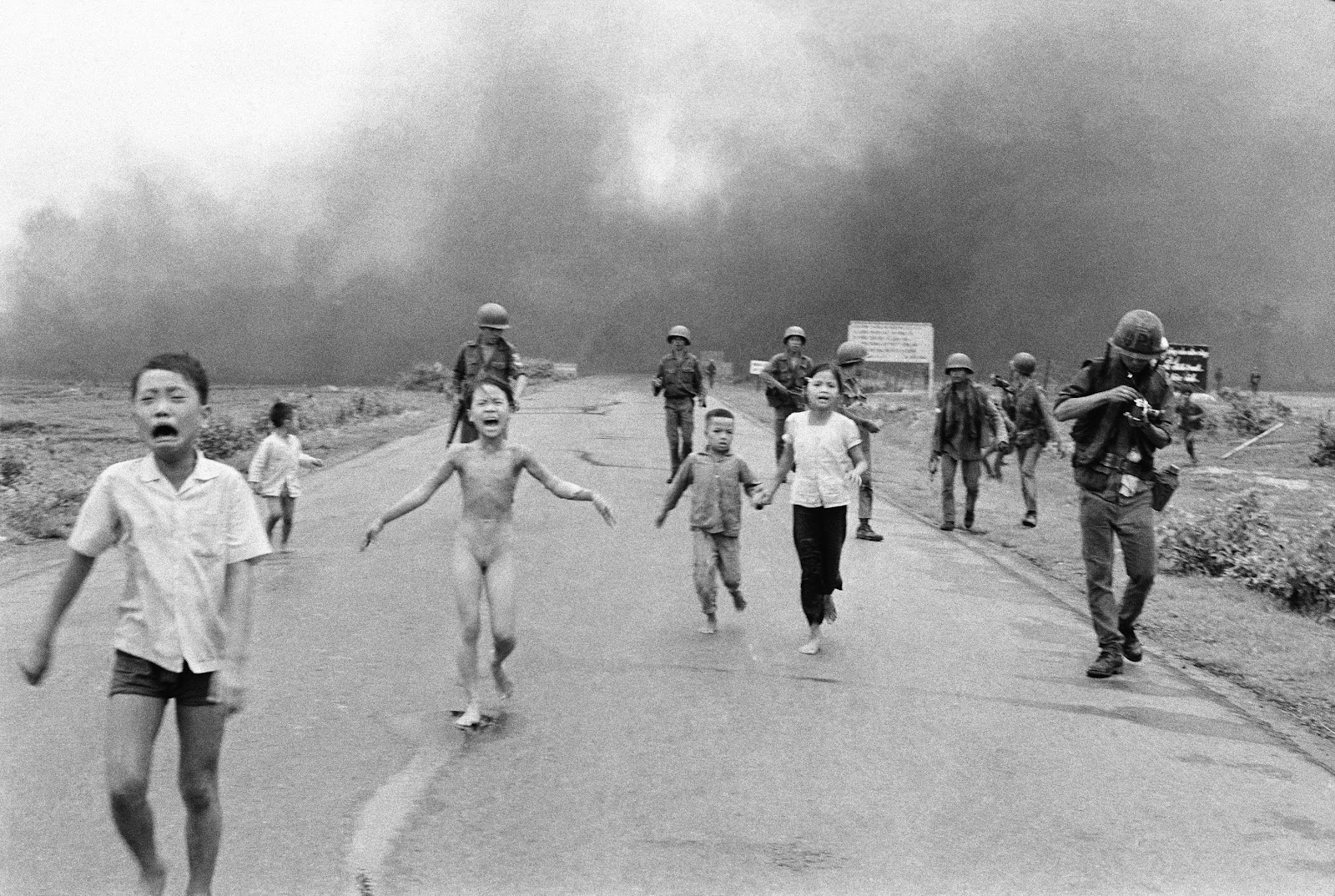
In Vietnam, followed by soldiers, the young children were walking away from their village   and the looks on their faces gave off they were crying, upset, and devastated by their homes  burned down in flames. Not many children can be seen, it’s possible that the village was either small or the children were shot and killed.The website, “War children”, talks about what children go through in any war. Children are usually innocent and do not have any part of what goes on in their village. They are not the ones causing the problems, so it makes me wonder why are they being killed or physically hurt and it makes me wonder why won’t they  do anything about it. This website states “Millions of children and young people worldwide are affected by armed conflict. They are confronted with physical harm, violence, danger, exploitation, fear and loss. Many children are forced to flee. Some witness the death of loved ones. Some are forced to pull the trigger themselves.”  In Martin Luther King Jr.’s speech he talked about how terrible it was for vietnam to go through what they did in the war. America is suppose to be free and show the image of freedom but that all changed because the people who weren’t enemies before became their enemy and kill many of their people and destroyed their homes. Martin Luther King stated ” The image of America will never again be the image of revolution, freedom, and democracy, but the image of violence and militarism.” I believe he said this because seeing what the people did to the Vietnamese people who were innocent, lose so many love ones, and material things in their life; he wants us to back at this. He hopes for us to see that soldiers for the U.S who are suppose to be good, helped the bad and did bad things to Vietnam and its people. As we look deeper into this, it was all violence created by bad people to good people. The Vietnam responded back by fighting in which they also killed many people, but that doesn’t make them evil because if they didn’t stand up for their village, everyone would haved died.


veitnam war essay pic.jpg

This Vietnam War picture shows  how innocent people were being attacked and killed in their own home. All people respond to violence differently regardless if they are innocent or not. One innocent person may get physically hurt by someone else and not do anything about it. The other innocent person may get physically hurt and do something back which would not be wrong for them to do because it is self defense. Although you could say they would be evil as well because they are still hurting someone back.

Their are too many perspectives to say what an innocent person is because you may think that person is innocent and the other person may think that person is not innocent. No one can really tell how an innocent handles violence unless you are basing it off your perspective.


Work cited:

  1. Blaise, Lilia. "He Abused Her for Years. She Shot Him. France Asks: Is It Self-Defense?" The New York Times. The New York Times, 11 Mar. 2016. Web. 21 Mar. 2016. <http://www.nytimes.com/2016/03/12/world/europe/murder-of-abusive-husband-casts-stark-light-on-domestic-violence-in-france.html?hp&action=click&pgtype=Homepage&clickSource=story-heading&module=first-column-region®ion=top-news&WT.nav=top-news&_r=1>.


  1. "Beyond Vietnam**." Beyond Vietnam**. Stanford University, n.d. Web. 16 Mar. 2016. <http://kingencyclopedia.stanford.edu/encyclopedia/documentsentry/doc_beyond_vietnam/>.

  2. Holland, War Child. "EFFECTS OF WAR ON CHILDREN."Warchildholland.org. War Child Holland, n.d. Web. 15 Mar. 2015. <http://www.warchildholland.org/effects-war-children>.

Be the first to comment.

Advanced Essay #4_ Environment and Change

Posted by Chiara Nemati in English 3 - Block - D on Monday, March 21, 2016 at 9:13 am

My goal for this paper was to explore in depth my question which was, how does a world different from our norm compel us to commit violent acts? I was curious to explore other ways other than soldiers changing. This is one goal that I was able to accomplish. I was able to read an article on feminism which held the same ideas that I had developed after watching Zimbardo's TED talk. I think I was able to go through this piece with a lot of organization. I was able to fully understand how I could connect all of my research to my piece and from there I chose the strongest sources and quotes. I believe that through the peer-editing process I was able to get even more analysis out of my piece. I decided to end my piece with the story of the image because I had gotten really caught up in making a story with the image and it had helped me build my thesis for this paper.


As the war continues, two brothers take cover. They hide in their home, watching through the crack in the door. Hoping and waiting for the day when the war will end. They wait for the time they will be safe. The older brother positions himself in front of the younger brother, shielding him from any harm that may come. Their eyes tell a story. A story of loss, a loss of family and a loss of hope. They watch with saddened eyes as their home get torn apart by the soldiers and rebels. The younger brother is filled with more hope than his older brother. The younger brother is still innocent and does not understand what the war means or what is occurring. The older brother is weighed down by the reality of this war and has trouble seeing the light at the end of the tunnel. As each second passes we can see them age. Each bullet fired adds a year to their age.   

On March 2003, United States soldiers in a prison in Abu Ghraib, Iraq began to torture and abuse the Iraqi detainees. Images were released in January of 2004 and an investigation was underway to determine who the abusers were. Some of these graphic images depicted a woman soldier holding a prison with a dog leash. What caused these seven soldiers to commit such violent acts cannot be explained. Susan Sontag writes “No: the horror of what is shown in the photographs cannot be separated from the horror that the photographs were taken -- with the perpetrators posing, gloating, over their helpless captives.”

Sontag brings up a key point, the horror not only was in the image but the fact that these soldiers took these photographs and posed for them. Humans can be thought of as sculptures made of clay. Everywhere we go and everything we do and see done changes our shape. Environment molds us into a different shape. Humans are very influential and easily misguided to do things they would not do in their “natural habitat.” Abu Ghraib was an environment that challenged these seven soldiers and challenged who they were and their morals. It only took one to change for the rest of them to succumb to the environments changes. We see many instances where people change their environment and often turn out happier and prosper in this new environment. So it’s shocking for us to hear and see an environment break a person. What’s most shocking however is the degree at which Abu Ghraib changed these soldiers.

Abu Ghraib is only one of many examples of environments changing us and our natural sense of right and wrong. Kim Turcot DiFruscia wrote a piece on feminism and spoke about the same issues that we see occur in war. However, the war she writes about is not a war fought with weapons like guns and explosives, this war is fought with words of hate and oppression of the opposite sex. DiFruscia writes “In many situations you cannot decipher which particular individual has this specific responsibility because it is the coming together of various forces that produces a particular action.” She states that “various forces” cause a “particular action” to occur. We cannot determine how an individual will react to a situation. We do not know what has occurred previous to this action therefore we cannot determine the outcome of their reaction. We cannot determine how they will be forever changed. Later on in her article she writes “Not by escaping, but by assimilating the violence and weaving your life in it.” One never gets rid of all the violence and pain they have endured. Instead they learn to live with this pain and they learn to mold it into something that is beneficial to them. How one takes this violence and how they mold it is completely dependent on the “coming together of various forces.” In some ways this relates to post traumatic stress disorder, PTSD, something very common among soldiers coming back from war. We cannot always point out who suffers from PTSD but this is because there are varying degrees of this disorder. Some soldiers learn to weave this disorder into their life and others try to escape it.

Our surroundings affect us and who we become more than we tend to realize. People who grow up in and move to war zones change and become shaped by their environment. We hear many stories about soldiers doing things that are not what we would consider normal., such as the horrifying acts committed by the soldiers in charge of the prison in Abu Ghraib. We tend to ask ourselves how can this occur? We know these people and know their characters. They could never commit such acts. But a world so different from our norms can compel us to commit these violent and sometimes horrifying act. If a place can change you for the better, can’t it also change you for the worse?

The younger brother, Armin had fallen asleep, on the cold stone floor. None of their beds were left. Covers were a luxury they could not afford. He watched his younger brother as he slept, as he did every night. He listened to Armin’s soft snores which the older brother, Arya was glad for. He slept so peacefully, almost as if the world they lived in did not exist and as if Arya was the one trapped in a nightmare. Armin turned in his sleep and Arya felt a sinking feeling in his chest when he saw his brothers face. The smooth curve of his nose, the long, dark eyelashes, and the thick eyebrows. All replicas of his own facial features. The only difference between the two brothers was their hair. Armin had short straight hair that barely reached his eyebrows. Arya had thick curly hair that was growing long, almost covering his eyes. Arya was grateful for the home they had left. But he was also left to think about his brother’s innocence and how this war would affect him.  


Work Cited:


DiFruscia, Kim Turcot. Listening to Voices. An Interview with Veena Das(n.d.): n. pag. Web. 10 Mar.

2016. <http://www.alterites.ca/vol7no1/pdf/71_TurcotDiFruscia_Das_2010.pdf>.


Sontag, Susan. "Regarding The Torture Of Others." The New York Times. The New York Times, 22

May 2004. Web. 10 Mar. 2016. <http://www.nytimes.com/2004/05/23/magazine/regarding-the-torture-of-others.html?_r=1>.


Be the first to comment.

Advanced Essay #4: Guilt and Its Lasting Affect . . .

Posted by Kayla Cassumba in English 3 - Block - D on Sunday, March 20, 2016 at 9:06 pm

My goal for this paper is to analyze the way that guilt influences a soldier’s life. Throughout the process of the paper I have learned that the majority, if not all, soldiers suffer from this emotion whether they admit it or not. However, even if soldiers see their time serving this country as a privilege or not, they can all admit that war changes people and the way they think. A new perspective arises and it adds to the person that they are.


Above is a picture of the Vietnam Memorial Wall located in Washington, D.C. A middle aged white male has his hand placed on a wall that states the names of all the soldiers that died during the Vietnam War. The man is looking down toward the floor, his briefcase beside him. On the wall there is a reflection of about five soldiers standing up and one kneeling down, soldiers whose lives were lost staring back at the man. He is on his from work and he has his sleeves rolled up and his suit jacket sits beside him on top of his briefcase. A small American flag is planted into to ground and it hangs low. The man’s face is scrunched up as if he is starting to get emotional and is trying to prevent tears from running down his face. War is an unique concept of conflict that people who have not experienced it can only sympathize and not empathize.


An essay written by Kevin Sites states that ,“Combat is almost always the shortest and smallest part of any conflict, while collateral damage or civil destruction is war’s most enduring legacy.” The guilt that soldier feels will be carried with them forever.  Although they might have pride and have seen it as a privilege to serve their country, it does not take away from the fact that on that journey sacrifices are made not only with your internal being but with the people around you, the people you love the most.


A CBS NEWS article titled I can’t forgive myself states that ,“Like other officers who've spoken about moral injuries, he also feels responsible for deaths that resulted from orders he gave in other missions. The hardest part, Kudo says, is that "nobody talks about it.” This thought goes along with a book titled The Things They Carried  and how they avoided talking about death even though they faced it everyday. The characters in the book would desensitize the tragedies they had to deal with. Humor was often used to downplay the circumstances that they have endured. They used multiple methods in order to avert their thoughts from the adversities that have occurred.  Despite the various methods used, aren’t they all coping mechanisms?

Regardless of the coping mechanism that is used by an individual, if you do not talk about it then it will start haunting you inside. Our soldiers have “wounded souls,” in accordance with the CBS NEWS article mentioned above. Although these “souls” might be repaired they will never return to being the same as they were before. When they leave the war a part of themselves is lost and it can never be recovered. Many people, especially doctors and other medical advisors,  just lump soldiers into the PTSD category but in reality who wouldn’t suffer from that “illness”  if they were not in war, witnessing the deaths of both civilians and criminals everyday and having to be watching it all, if not actually partaking in those actions? No one is fully capable to dismiss those images from their head. These soldiers might not actually be sick, but they are just the product of the wicked environment they have been placed in. A system which undoubtedly causes these effects on them.

 Now what outlets are available in order for people to repair their wounded souls? In article titled Coping with Survivor Guilt & Grief it is reported that, “Guilt is a common reaction to loss and it can ultimately be part of the healing process. However, if it is not addressed, excessive guilt can lead to psychological health concerns, such as depression, apathy or generalized anxiety.” While guilt is usually the emotional reaction to a traumatic event, grief is the actual healing process. When lives are lost , the feeling of one’s humanity automatically decreases.  There needs to be more organizations that promote this healing process in a healthy way that gives drugs as a last resort instead of the first. It becomes difficult to empathize with someone if you never lived through the situation that they have faced. Nevertheless, that does not mean that we should stop trying. We need to understand that this guilt travels with them from war to home to carrying out their daily activities. Most of this guilt is due to the responsibility that soldiers feel for the lives lost both during the war and when they return home and lose contact with other soldiers they have served with. Still, we need to see these emotions as  Mike Felker, Veteran of the U.S. Navy does, he says, “Guilt is the driving force.” Guilt prompts us to continue to discover who we are and helps us stay in tune with our emotions. The acknowledgment of  guilt being present in our minds and hearts helps us grow through self-reflection.


Works Cited


"Coping with Survivor Guilt & Grief." Real Warriors. Defense Centers of Excellence. Web. 17 Mar. 2016. <http://www.realwarriors.net/active/treatment/survivorguilt.php >.


“ ‘I Can't Forgive Myself'': U.S. Veterans Suffering Alone in Guilt over Wartime Events." CBSNews. CBS Interactive, 22 Feb. 2013. Web. 16 Mar. 2016. <http://www.cbsnews.com/news/i-cant-forgive-myself-us-veterans-suffering-alone-in-guilt-over-wartime-events/ >.


Kevin Sites. "How Do Soldiers Live with Their Feelings of Guilt? - Kevin Sites - Aeon Essays." Aeon. Aeon Essays, 09 Apr. 2014. Web. 16 Mar. 2016. <https://aeon.co/essays/how-do-soldiers-live-with-their-feelings-of-guilt >.


Major Rebecca Lange. "Service Before Self: Reflections on Military and Civilian Service." The Huffington Post. TheHuffingtonPost.com, 10 Nov. 2014. Web. 17 Mar. 2016. <http://www.huffingtonpost.com/major-rebecca-lange/service-before-self-refle_b_6135730.html >.


Be the first to comment.

Under Which Circumstances Does Discrimination Lead To Acts of Violence?

Posted by Aaron Watson-Sharer in English 3 - Block - D on Sunday, March 20, 2016 at 8:38 pm

​

I was anticipating a topic like this for our class. I came up with the idea of "does discrimination cause violence" to being and I wanted to write an informative essay, in the form of an editorial. One goal I had was to sue current and past events that covered a wide spectrum of discrimination that led to acts of violence and cover what forms of discrimination were used and specifically how people were manipulated into violent acts. Knowing these events all changed the course of history, I knew that discrimination was the root for their downfalls.


Throughout the history of our world, there have been social outcasts. Social outcasts are groups like your nationality, race or gender where they’re believed to be beneath the other groups. Every society has always had some form of structural discrimination. The problem with discrimination is not just the rise in hate itself, but the brutality that follows. There are hundreds of societies and civilizations that could show how if you don’t fit the profile, expect harm to be done onto you. Discrimination leads to acts of violence under the circumstances of fear, hate, faith, and a structural system which has bent the minds of the oppressors to commit senseless acts of violence.


During the thirty-one year rule of Rafael Trujillo, the Dominican Republic became a very violent place where one man controlled the voices of millions. Trujillo was determined to make his country great, but in his image. His image was being “diminished” by his neighbors in Haiti. At this time, the border between the countries was bending. In order to take complete control of his nation he ordered the execution of all Haitians residing in the Dominican Republic. In order to prove your nationality, people were forced to pronounce the word “Parsley” in Spanish. The hate spun by Rafael Trujillo killed almost 20,000 people. The circumstances that led to this act of violence was a corrupt structured system that ensured this dictator could remain in power.


Worldwide, there is a group that has been discriminated against in the name of fear and faith. Since civilization had begun, being gay was condemned, often by those who believe that being gay is “immoral.” Worldwide the act of homosexuality has been scrutinized to the point where a person’s sexual orientation has led to attacks, imprisonment, killings and discrimination. In our own country, over 15% of registered hate crimes are for homosexuality. In our own city, the stance inherited from hate led to two gay men being attacked in 2015. Up until 1973, those were who were gay were labeled as mentally ill; which led to “curing and treatments” to remove your sexuality. Some treatments featured electrical shock and prayer. It is a shame that we live in a world where some find happiness and that happiness is labeled as an illness. In many nations, acts of homosexuality are crimes, which have led to gays remaining silent. In Uganda, acts of homosexuality leave you with long prison sentences, life in prison, you can even be charged with the death penalty. Concerning homosexuality, hate, fear, faith and the system have led to discrimination of gays which has led to generations of violence for equal rights.


The United States was founded with a disgraceful institution by the name of slavery. Slavery had a successor, segregation. Segregation was an institution that built a privilege for whites and discriminated persons of color. Equal rights were not present in this time if in the means of access to services or in the justice system. This form of discrimination was dismissed legally which led to violent acts that were often also dismissed. Lynching was a form of killing violently used by the public to often prove a point. Lynchings happened for rape, murder and even something as little as an insult. Lynching became an epidemic, used for petty rseason which left thousands dead, mostly blacks. Nearly 73% of people lynched before it was outlawed were black. This form of violence came under the circumstances of hate and a system that promoted this form of violence. When you don’t enforce the law it is exploited and it was done during the lynching era.


Discrimination exists today, there are countless modern examples but none hit as close to home as Donald Trump. Donald Trump is a famous businessman for his antics and has a reckless reputation. He carries that same rap on his campaign trail, where his unique stances on various demographic and political issues have raised an eyebrow. He has many many critics who oppose him. In Chicago, there were tens of thousands who successfully shut his rally down chanting “We Stumped Trump.” But his momentum grows despite the violence he has brought. There have been brawls, threats and a stalemate from his following and foes. Donald Trump has used fear to incite violence. How? He says he would attack his protesters, and threatening that Americans are endangered unless they believe in his cause. In a democracy, violence can’t be promoted by leadership.


When fear, hate, faith and a failing system permit and ignore discrimination, people lead into actions of violence. Acts of violence are built up inside somebody from these factions, in a society that too often disregards discrimination. To use false rhetoric and allow discrimination, we can do nothing but expect heinous acts of violence. These acts change society because when you release this discrimination we restrict everyone’s ability to think and speak freely, which means we are no longer working towards a peaceful world.


MLA Cites:
""I Have a Dream"" Archives. Government. Web. 10 Mar. 2016. <https://www.archives.gov/press/exhibits/dream-speech.pdf>.
Lynching Statistics." Chestnut Archive. Charles Chestnut Digital Archive, 29 Jan. 1999. Web. 10 Mar. 2016.
"Transcript: Hear Harvey Milk's The Hope Speech." Museum of Fine Arts, Boston. Museum of Fine Arts. Web. 10 Mar. 2016.
"Trujillo." Trujillo. Web. 10 Mar. 2016. <https://www.mtholyoke.edu/~nunez20y/worldpolitics/who was rafael leonidas trujillo.html>.
Be the first to comment.

Podcast of identity- Noah W.

Posted by Noah Weinberger in English 3 - Block - D on Sunday, February 7, 2016 at 10:36 pm

My podcast is of me interviewing my aunt. I asked her questions according to the guide, but near the end, we shifted focus into some other questions related to the topic that popped into mind. My overall goal for this project was to define what my Aunt’s opinion on identity was and I feel that this procedure went really well. I was actually very worried at first, but concentrating on the task at hand made this assignment less difficult


I feel that my strengths were in the recording portion and my drawbacks were mostly in the editing . I knew the perfect person to find and also knew just when it would be a good time to record. My podcast skills are also rusty as I don’t edit voice memos often. This made the assignment unnerving at first because it was something I have never taken part in. Now I am much more experienced for future assignments.
Noah's podcast (1)
Be the first to comment.

Views From Society

Posted by Pedro Castillo in English 3 - Block - D on Monday, February 1, 2016 at 7:34 am

​My podcast is just raw opinion about the people of society today in age. I interviewed two poeple who gave me their honest opinion about society, gender roles, people, religion, etc. I would say that overall, I rached my goal with the type of answers that I wanted and I really appreciate the fact that they were just being honest and true to themselves. 

The road to finishing this podcast was a stressful one. Throughout the work process I hit many road blocks and had to do many things from scratch again so that pushed me behind in the end. Overall this was a difficult thing to pull of being that we had to juggle two projects in one class. It was difficult getting people to interview, it was difficult editing, and it was difficult making something I was proud of. But in the end I overcame what stood in my way and got the podcast done and I would like to say that I am proud of the work I produced. 
Pedro's Urban Jungle- Views From Society
7 Comments

Monarchy

Posted by Gabrielle Kreidie in English 3 - Block - D on Saturday, January 30, 2016 at 8:24 pm

I had much trouble with this topic, mostly due to thinking of the identity as a small part of what I wanted to say. The examples given in my class involving the topic were not values or instances that I necessarily cared about. I wanted to connect the idea of monarchy having to be judged by society in order to be acknowledged and valued for their identity. With the grade I received in my paper, I see that I didn't connect that strongly enough. Hopefully enough, in the podcast I focused on that more. ​

My podcast had to do with the idea of monarchy and identity. Living in the US, I am someone that is not for the idea of a monarchy run government in the 21st Century. With the increase of press revolving around royal families (mostly the Windsors), I have asked why we still praise the ground they walk on, even in the US. This conversation with my family acknowledges that and the problems that young kids face with, regarding the love of monarchy. Enjoy! 
Podcast
1 Comment

Essay advanced #3

Posted by Ishmael Brown in English 3 - Block - D on Friday, January 29, 2016 at 10:57 pm

Be the first to comment.

Podcast

Posted by Ishmael Brown in English 3 - Block - D on Friday, January 29, 2016 at 10:56 pm

w
Be the first to comment.
115 posts:
← Prev
  1. 1
  2. 2
  3. 3
  4. 4
  5. 5
  6. 6
  7. 7
  8. 8
  9. 9
  10. 10
  11. 11
  12. 12
Next →
RSS

ENG3-1

Term
2015-16

Other Websites

Launch Canvas

Blog Tags

  • block english 1
  • #english #SLA #Block 1
  • Advanced Essay 1

Teacher

  • Joshua Block
Slate (skeleton-v3 PHP 8 prototype) · Location: 1482 Green St · Shipping: 550 N. Broad St Suite 202 · Philadelphia, PA 19130 · (215) 400-7830 (phone)
×

Log In