• Log In
  • Log In
Slate (skeleton-v3 PHP 8 prototype)
Slate (skeleton-v3 PHP 8 prototype) Learn · Create · Lead
  • Students
    • Mission and Vision
  • Parents
  • Community
    • Mission and Vision
  • Calendar

English 3 - Block - D Public Feed

Create a Post

Advanced Essay #4 Motivation of Violence

Posted by Lewis Ford in English 3 - Block - D on Monday, March 21, 2016 at 11:24 pm

Reflecting on my paper, I believe I picked specific points to focus on which made analyzing it pretty easily. I thought it'd be unique to have two different pictures that backed up the two themes I had. My sources were pretty diverse also.


ChildSoldiers
ChildSoldiers

Agunya, 15 (On the right), teaches his little brother Mumbri, 13 (On the left) how to load and aim a semi-automatic weapon after finding their entire family slaughtered by an Angolan terrorist group. “Eu quero matar cada governante Angolano que vejo…” I want to kill every Angolan official I see. Mumbri’s life changed forever after this moment…

Experiencing the annihilation of loved ones changes you in all aspects of life. The feelings of hatred, ignorance, sadness, and reminiscing all brewed together is a recipe for disaster in the streets of Chicago and in the battlefields of Angola. To experience the same tragedy Agunya and Mumbri have and not want to retaliate with the same force or more, takes a very noble and conscientious being. German psychological scientist, Mario Gollwitzer conducted a study where people were partnered up with another person anonymously in different rooms. The partners were asked a series of trivia questions and for every question they got right, they’d win tickets. At the end, the scientist divided the tickets up evenly but told partner #1 that that partner #2 opted to take all of the tickets. The scientist gave the partner #1 the chance to either opt to take all the tickets or split them after finding out what partner #2 decided to do. 60% decided they wanted all of the tickets because partner #2 wasn’t planning on sharing. That same 60% decided to write  notes to their anonymous partners all with smart comments like “You didn’t want to split the tickets so I’m be selfish back and take all of the tickets for myself.” This experiment showed that when people feel unappreciated, retaliation  is a very technique used as an attempt to restore that feeling of appreciation. Agunya and Mumbri suffer from a feeling not being valued. The fact that their family was slaughtered and no one answered for it will evoke this feeling. So as a result of this, the two brothers are on the hunt to retaliate with the same amount or more force to restore that feeling of mattering. Retaliating also provides them with the opportunity to make the Angolans feel the pain that they feel or worst; which is also a desired goal.


GenerationOfSoldiers

Experiencing the annihilation of loved ones changes you in all aspects of life. This change is physical, emotional and most of all mental. The feelings of hatred, ignorance, sadness, and reminiscing all brewed together is a recipe for disaster in the streets of Chicago and in the battlefields of Angola. Martin Luther King once said “As I have walked among the desperate, rejected, and angry young men, I have told them that Molotov cocktails and rifles would not solve their problems. I have tried to offer them my deepest compassion while maintaining my conviction that social change comes most meaningfully through nonviolent action. But they asked, and rightfully so, “What about war?” They asked if our own nation wasn’t using massive doses of violence to solve its problems, to bring about the changes it wanted. Their questions hit home, and I knew that I could never again raise my voice against the violence of the oppressed in the ghettos without having first spoken clearly to the greatest purveyor of violence in the world today: my own government. For the sake of those boys, for the sake of this government, for the sake of the hundreds of thousands trembling under our violence, I cannot be silent.” This quote addresses the most important reason people become numb to violence in mass numbers. To know that policeman and soldiers are awarded medals like distinguished shooters badge, and expert rifleman badges on a consistent basis for honestly killing people brings a sort of positive vibe to violence as a whole. So for a kid in Chicago to murder someone who sells drugs in his neighborhood and be prosecuted for it, is really hypocritical. He eliminated someone that was a threat to the well-being of his community. Isn’t that the same thing soldiers do and police officers do? Yes it is.


Zulifikar Ali Butto, the Prime Minister of Pakistan once said ““We(Pakistan) will eat grass, even go hungry, but we will get one of our own (Atom bomb).... We have no other choice!” Now let’s think about this… The Prime Minister of an entire country feels as though there is no other way to survive in this world but to acquire something with the power to wipe out a whole city.  If  someone with the power of a Prime Minister believes that surviving in this world is only realistic if you’re able to conduct your own amount of violence, what are people in Chicago who live in poverty supposed to think?


Work Cited:

"Quotes About Retaliation." (24 Quotes). Web. 21 Mar. 2016.

"Military Ranks." Military Ranks. Web. 21 Mar. 2016.

"Military Awards, Medals, & Decorations." Military.com. Web. 21 Mar. 2016.

Wikipedia. Wikimedia Foundation. Web. 21 Mar. 2016.

"The Complicated Psychology of Revenge." Association for Psychological Science RSS. Web. 21 Mar. 2016.

"The Law of Retaliation." The Law of Retaliation. Web. 21 Mar. 2016.
Be the first to comment.

Advanced Essay #4: War Literature

Posted by Isabel Medlock in English 3 - Block - D on Monday, March 21, 2016 at 11:16 pm

I focused on war literature for this paper. I wanted to explore the different facets of war literature and also the importance of war literature. During the research process I read a couple of interesting articles that really informed and shaped my opinion on the importance of war literature. The peer review process was especially helpful for this essay because I was initially unsure of what I wanted my larger idea to be. It was difficult to find a specific focus for this essay but I am proud of the final result.

Two children stand in front of a tank. The eldest, a girl a of about nine or ten with short black hair, carries her little brother, who cannot be more than three years old, on her back and they both look directly at the camera. They seem to be standing in a hot desert so they both wear loose light clothing. The tank seems to be going the same direction in which they are walking. We can picture this war scene clearly in our minds through this description in words. Even though we can never truly understand what it’s like to be in the midst of a war unless we have actually experienced it, words, stories, and pictures can help us begin to understand. In his essay titled, “The Extremes of Conflict in Literature: Violence, Homicide, and War”, Joseph Carroll says:

Literature depicts such emotions, evokes them, and makes them available to readers, who experience them vicariously.

To help others understand the horrible truth of war, authors like Tim O’Brien, Kurt Vonnegut, and Ernest Hemingway write novels about the subject. Like Carroll says, this literature allows readers to experience emotions that they’d never have the opportunity to experience otherwise. In experiencing those feelings they begin to understand the emotions of those who have been involved in war.  They begin to understand what it is like to know that at any second you could die and they begin to understand what loss of human life really means. The literature of war not only aims to foster understanding of war, it also attempts to argue for peace. Kate Scheel, a professor of English studies writes:

War literature…warns against pursuing armed conflict, exposes its atrocities, and argues for peace. It records the acts of war with as much accuracy as is possible, and it memorializes the dead. It is voyeuristic, exploitative, and sadistic; it is also tender, selfless, and comforting. It is gleeful and angry; inflammatory and cathartic; propagandist, passionate, and clinical. It is funny and sad.

Good war literature forces us to experience the emotion of war and inspires us to believe that there are other options. Good war literature exposes the truth and explains to us why it is necessary to find alternatives to violence. It reveals the atrocities that occur during war and it reminds us why human life is something to be valued and cherished.

War literature creates a complex relationship between author and reader. Because of the subject readers expect a certain degree of truthfulness in war literature. In this case we expect truthfulness to mean reality; we expect that everything that the author writes actually happened. As readers we expect honesty and loyalty. In The Things They Carried, by Tim O’Brien, we are led to believe that the story and all the characters are real but halfway through the book O’Brien reveals that all the stories and characters are fictitious. Through that experience we learn that truthfulness doesn’t have to mean reality. O’Brien states:

A thing may happen and be a total lie; another thing may not happen and be truer than the truth.

Meaning that even though something doesn’t actually happen it doesn’t mean it’s not true. What is more important when it comes to the truth is the emotion and sentiment behind it. So, even though we feel betrayed when we learn that the events in The Things They Carried did not actually happen our relationship with the author eventually emerges stronger at the end of the book when we come to the realization that when it comes to truth we need to look beyond the surface, look past the superficial details, and examine the things that really matter. War literature reminds us that life, death, and emotion are more important than small, insignificant details.

War literature is necessary. Not only because it helps civilians understand war but also because it helps soldiers deal with their experiences. Soldiers need to be able to express themselves somehow and they need to be able to write the truth of what they experience. Soldiers need to know that somebody cares enough to read their stories and maybe even take action. War literature is one of the most important methods for understanding war and violence. Candid accounts of what really happens during war through novels explain exactly what happens during war and also deliver these explanations in a medium that is accessible and interesting to most people. War literature needs to be something that everybody is familiar with. It’s easy to ignore violence and human weakness. We need war literature to remind us of all the problems in the world. We need it to inspire us to action and to hold us accountable for the needless loss of life that war brings. War literature is essential to any push for anti war mentality.  It is the proof that war is evil. If we ever want to live in a society that does not depend of war, militarism, and violence as solutions we must ensure that everyone reads and understands war literature so they understand the truth of war.


Scheel, Kate. "Violence and the Literature of War." N.p., Spring 2004. Web. 21 Mar. 2016.


Carroll, Joseph. "The Extremes of Conflict in Literature: Violence, Homicide, and War." The Extremes of Conflict in Literature: Violence, Homicide, and War. N.p., 22 Mar. 2012. Web. 21 Mar. 2016.


O'Brien, Tim. The Things They Carried: A Work of Fiction. New York: Broadway, 1998. Print.


Be the first to comment.

Advanced Essay #4: The Healing of Pain

Posted by Hanna Dunakin in English 3 - Block - D on Monday, March 21, 2016 at 10:02 pm

A lot of research went into writing this essay. After reading 'The Things They Carry', I wanted to explore the deeper meaning of pain and the way each and every person experiences it. It was hard to find the perfect resources for my essay, but I ended up finding two perfect interviews, and a great image reflecting my words. I spent a long time trying to word my thoughts in a way people would understand, and although it was a challenge, I was able to use suggestion from my peers to write a piece I am proud of. I made sure not just to discuss the single meaning of pain, but the general meaning, so basically every single type of pain, whether it be physical, emotional, mental, etc..

powerful-photos-29.jpg

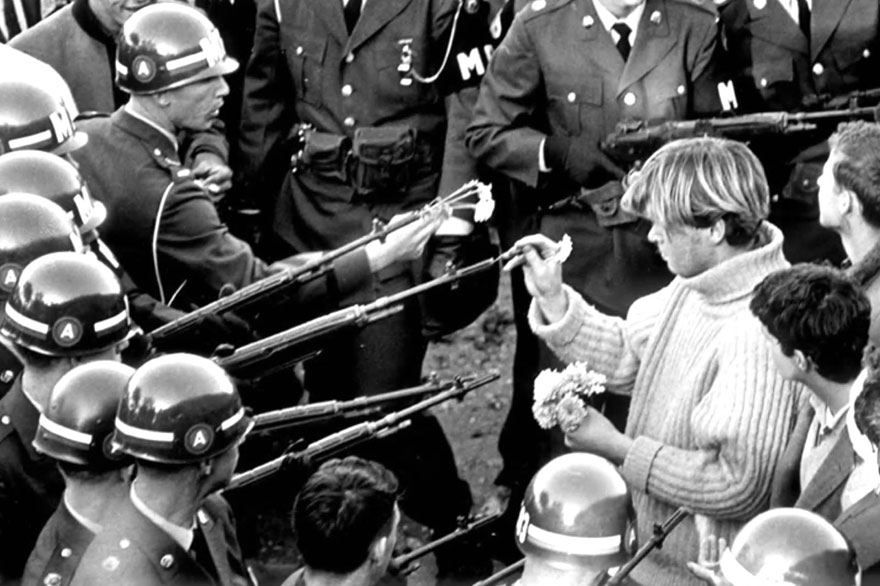
Imagine being surrounded by an entire army, pointing all their guns at you. Unarmed civilians also surround you, fearing their lives, but knowing that they can’t back down because it’s a sign of weakness. One man steps up, knowing that there could be consequences, he decides to make peace between the army and the civilians, so he steps up, and all the guns are pointed at him, not you, yet you still fear. He places flowers in the gun, and no one makes a move or a sound, as if the man was now surrounded by the dead. He shows no signs of stopping, and as his bouquet of flowers becomes one single flower, you realize that it wasn’t fear of death you were feeling, it was fear of tyranny, and this man had just proven to you and everyone else there, the hypocrisy of pain and violence. One might think the previous statement was created to get them thinking of a somewhat realistic situation to better explain the healing of pain. It is anything but fictional, it’s an image of truth. The truth may be dreadful and uncomfortable, but this image expresses the tenderness of pain and its remedy. This is an image of life, a life put through violence and war, yet effectively reacts to a situation with the power of silence and influence.

Healing of agony can be conceived through an action, a memory, a statement, an image, or in better terms, it can be formulated in different ways, but as stated by Veena Das, a theoretician and ethnographer, there are two things that all healing has in common. “The notion of healing carried two ideas: the idea of endurance, and the idea of the capacity to establish a particular relationship to death….” One has to be willing to accept the pain they suffer to be able to alleviate the pain. In this way, not only is their acceptance, but realization that the pain will never go away, but awareness that mending pain is much stronger than any kind of pain itself.  “But I was very struck by the ways in which pain does write itself enduringly on people’s lives. It was not about a thunderous voice of pain, but about the manners in which pain was woven into the patterns of life.” You have to be open to all pain, to the consequences, or else healing will never happen, and only pain would ever exist. The thing is though, that without pain, life would be nothing. We would never experience reality, and we’d be selfish because without pain, we would get everything we wanted and thought we deserved. Pain draws a fairly clear line between selfishness and selflessness.

There is a single word that can bring terror and pain to many in an instant, a word so powerful that the meaning is pointless because it is nothing compared to the suffering and suffocation one is already in from just hearing the word. War...the word is war. As clearly stated by author Chris Hedges, “Yes. I think for those who are in combat, it very swiftly can become an addiction. War is its own subculture. It can create a landscape of the grotesque that is, perhaps, unlike anything else created by human beings.” Experiencing war in any way is a very difficult and uncomfortable experience that no one should go through. For soldiers, it’s as though war is a separate world, a separate language, or a separate life. Once in a war, you can never get out, even if the war is officially over. You become so intimate with it, that you can never forget about it. The horror will always be in your dreams, and the pain will always be crawling up your spine, and to your head, where you always remember every dreadful moment. War is something so unique and spectacular, that it is almost a mystery to the human race. We still explore war and it’s many characteristics, that is why war still exists and will never go away. There’s no meaning of war yet because we still don’t understand it, and there will never be one single clear definition. It’s existed for hundreds of years, yet it’s still something new and fresh that is somewhat unknown to our race.

A life with no pain, is a life not lived to the fullest. We suffer and always find a way to blame someone, yet the only one to blame should be ourselves, for not allowing leeway for reflecting on the good. Pain is different for everyone. Some might experience it through violence or war, and others might experience it from love, or hate, or even just life itself. Healing is a reflection of pain, and that is what needs to be understood to be able to live on, not move on, but to live your actual life, the life you grew up living. We must understand the difference between all pain, whether physical, mental, or emotional. As human beings, we have the right to express our pain, our anger, and our fight to healing. As human beings, we have the right to live.

WORK CITED

"Listening to Voices. An Interview with Veena Das." Interview by Kim Turcot DiFruscia. 2010. Web. 15 Mar. 2016. <http://www.alterites.ca/vol7no1/pdf/71_TurcotDiFruscia_Das_2010.pdf>

Abernethy, Bob. "Interview: Chris Hedges." PBS. PBS, 2003. Web. 15 Mar. 2016. <http://www.pbs.org/wnet/religionandethics/2003/01/31/january-31-2003-interview-chris-hedges/13987/>.
Be the first to comment.

Advanced Essay 4: The Mystery Of Anonymity

Posted by Pedro Castillo in English 3 - Block - D on Monday, March 21, 2016 at 7:35 pm

​ The topic of anonymity can stretch as far as the mind can think in every direction. I decided to try and help people by giving them a starting point in order to begin to think about the different sides of people. In this essay I talk about the way people act differently when they are anonymous versus when they are just themselves, their identified selves. I also talked about different way that people become anonymous both literally and figuratively. My main goal is just to get people to think more about this subject. I hope you enjoy. 


There are always two sides to everyone. The identified side and the anonymous side. The identified side being the side that they show to everyone; the regular side of themselves. The anonymous side is the side that people do not see in each other; the side in which people take their deepest feelings and thoughts and express them. Although it is, most times, not a bad side of people, there are always the people who like to show their dark sides when they are anonymous in a sense.

Philip Zimbardo is an expert psychologist as well as the former leader of the widely known Stanford Prison Experiment that took place in 1971. The experiment was a test of good vs evil. Philip Zimbardo used students from Stanford University and made some of them prison guards and other prisoners. After time passed they psychologists noticed the students who were prison guards were getting really into their roles. They were getting harsher since they were in a position of power. I believe that even with the power, the students who played the prison guards wouldn’t have acted brutally to the students who played the prisoners. So what was it? The students who played the guards were in some way shape or form anonymous.

“You want to say that again boy?!” Says the police officer to the young man in front of him. The man is as close now as he can get. His balled fists are cut out of the photo though you can tell by his battle ready face that he won’t take anymore of the unnecessary bullshit the cop is coming to him with. The cop is as battle ready as the young man as he steps closer to him ready to take the young man away after any action out of line. Immediately the cop reacts and beats the young man. Why? He is a cop, his job is to keep order. Does he put the uniform on in order to gain authority over civilians or to keep the peace? Who knows, his uniform automatically gives him more power, he is a cop… a cookie that was created for and by the city he lives in.

Uniforms play a big role in the topic of anonymity. When I say uniforms, I mean it in a literal and figurative sense. When having to do with anonymity in a literal sense, uniforms are disguises, masks, and even regular uniforms. But if you look at a uniform in a figurative way, you realize that people are just playing a role. They are the dough under the cookie cutter. Something happens in people’s minds when they know they are just ‘doing their job’. That is what happened to the students who were the prison guards during the notorious Stanford Experiment. I have good reason to believe that the students who were the guards felt a sense of anonymity when they put on the uniforms because at the end of the day, they were only playing a role. They were anonymous and that is when they started showing the darker side of themselves. Ball players have to play ball because that is their role, it is their job. There are some cases when people gain authority and take that to another level though, just like the student guards in the experiment. Even if they don’t want to, police have to arrest people who commit crimes because that is their role in society when they put on the uniform. A soldier has to fight for his country because that is his job when he puts on the uniform, he knows it is kill or be killed.

The military is another world in itself. There are so many different factors that go into the relationship between the uniform, the soldier, and the future soldier. The future soldier is the youth, the kids who look up to these heroes. Today in age, many kids submerge themselves in the world of video games. Violent games are the top sellers these days which is extremely important when thinking about the next generations. The military has been taking advantage of these violent video games and they give the future soldier a glimpse into the world of the military. The future soldier is obviously going to be starstruck because it is just the world we live in. So now we have these non violent kids playing violent video games all day; doing things that they know they will not do in real life (most kids). Why do they do it? They do it because they are (like the student guards in uniforms) anonymous. They do not consider themselves as them when playing these games, they are playing a role and the character is their uniform. What they do in the game will not impact their real lives therefore they feel like they have the freedom to fight other characters, harass other characters, to kill other characters. This is a serious problem because it can affect the way the child grows. The military uses these violent and militaristic games in order to recruit these kids because if you give kids a glimpse of what this is and they (for some reason) enjoy it, then that is automatic recruits in the future.

No one can ever see the anonymous side of someone until they show it. That is why the idea of anonymity is such a mystery because it can play into so many aspects of society. Everyone has the potential to be good and evil, it’s just up to them to decide what side to show. But from Town Devils to cookie cut villains, this world is truly filled with a variety of personalities and voices that are all just waiting to be seen and heard.


Sources:


RT Editors. "'Justice for Everyone!' Thousands Stand up against Police Brutality in Ferguson, St. Louis." RT International. RT, 07 Aug. 2015. Web. <https://www.rt.com/usa/195212-rally-ferguson-police-violence/>.


Maraniss, David. "FBI Agent Uncovers the Truth of Prison Brutality."Washington Post. The Washington Post, 06 Nov. 2014. Web. <https://www.washingtonpost.com/politics/federal_government/fbi-agent-uncovers-the-truth-of-prison-brutality/2014/11/06/f65e3e58-6604-11e4-9fdc-d43b053ecb4d_story.html>.


Witness Media Lab Editors. "Caught on Camera: Police Abuse in the U.S."WITNESS Media Lab. WITNESS, 08 Sept. 2015. Web. <https://lab.witness.org/caught-on-camera-police-abuse-in-the-u-s/>.


PBS Editors. "The Army Experience Center." PBS. PBS, n.d. Web. <http://www.pbs.org/wgbh/pages/frontline/digitalnation/waging-war/a-new-generation/the-army-experience-center.html>.


Zimbardo, Philip. "The Psychology of Evil." Philip Zimbardo:. TED Talk, Feb. 2008. Web. <https://www.ted.com/talks/philip_zimbardo_on_the_psychology_of_evil?language=en>.


Be the first to comment.

Advanced Essay #4: Blissfully Violent

Posted by Michaela Peterson in English 3 - Block - D on Monday, March 21, 2016 at 5:59 pm

My goal for this paper was to explore the cause for gun violence in cities, and what ignorance and privilege has to do with that violence. I chose to focus on gun violence in big cities for two reasons: 1) gun violence is one of the most common forms of violence in big cities, and 2) it seems to disproportionately affect minorities in cities. I wanted to make sure that this paper addressed an issue that I see in a lot of white people. We carry this sense of separation from the violence, despite the fact that it is often happening inside our own cities. 

In 2013, Chestnut Hill Presbyterian Church covered the entirety of their lawn in crosses. They were fashioned out of PVC piping and each had a white, red, orange, or beige t-shirt on it. Each shirt had the name of a gun violence victim on it, as well as their age and the day they died. In front of all of these crosses was a sign that read “Philadelphia- highest major-city gun death rate. Where are you, Mayor Nutter?” Each crosses represented one of the 331 people who died because of gun violence in Philadelphia in 2012.


I was thirteen when I drove past this display on my way to my church. I haven’t been able to shake that image from my head. I always knew that Philadelphia is a violent city but I’d been sheltered from just how violent it is. Though I regularly watched the news at night, and I saw the reports about murders in the city, I’d always felt disconnected. I didn’t know anyone from those parts of the city, they didn’t even seem like part of the city I grew up in. I was allowed blissful ignorance because, for the most part, people who looked like me weren’t affected.


I used to go to a private Catholic school outside the city. I was lucky, in that regard. I was never sent to one of Philadelphia’s numerous underperforming neighborhood schools. However, because I was sent to Waldron Mercy Academy,  a private school, I was only ever really exposed to the life of people living in the Main Line. I was never exposed to the harsh reality that so many people in this city live every day. This began to change as I entered SLA, especially during the beginning of my sophomore year, with death of Michael Brown in Ferguson. The more evidence of police brutality that came out, the more determined I was to rid myself of my ignorance. As Madeleine Bair from WITNESS has said, “With all the videos that have flooded our news feeds and turned names of victims into hashtags of a social movement, how many videos have we not seen?” How many videos are out there that we haven’t seen because of the almost willful ignorance to this topic. And how many of these incidences have happened with no one there to record what was happening. How many people, how many cops, have gotten off because no one wants to believe a cop is capable of something this terrible.


People, especially people uneffected by it, have a way of trivializing violence. We find ways to make it seem like it isn’t such a big deal, and that it doesn’t affect many people. I was one of those people. I let myself be blinded by the privilege I held, and if I wasn’t going to SLA, I most likely still would be. I can see the posts that my friends from my middle school put up on Facebook, and I don’t know how to react. They trivialize the Black Lives Matter movement and don’t want to acknowledge the systematic oppression that extends into every aspect of our country. And they certainly aren’t the only ones. According to a survey conducted by PBS NewsHour and Marist College, “59 percent of whites described the [Black Lives Matter] movement as a distraction from the real issues, whereas only 26 percent of African Americans felt this way.”


At this point, we’ve accepted gun violence as a part of life. We certainly don’t want it to be something we regularly hear about on the news, but the way we see it, there is nothing we can do. While this idea is beginning to change, especially in the African American community, one of the communities most affected by violence, this change is facing an uphill battle. Ignorance is indeed bliss, and that comfort is not something many people want to leave behind. We, as people with privilege, do not want to acknowledge this privilege, because than it means that we acknowledge that change needs to happen, and that is something we don’t want to do. The system as it is works incredibly well for us, but only because the system is rigged that way. We have an advantage solely because others do not.


And we, people with privilege, go out of our way to excuse that privilege. We try to talk our way out of the privilege we hold. And we do the same with regards to gun violence. As essayist Susan Sontag has said, “Words alter, words add, words subtract.” Words can be used to change a horrible situation that needs attention to an issue for other people to deal with. One of the only ways to combat this is to use photographic evidence. We might try to trivialize photos and videos, but seeing a horrible truth is different than hearing about it. In the same essay as above, Sontag also said, “The horror of what is shown in the photographs cannot be separated from the horror that the photographs were taken.” Although Sontag was talking about the images from Abu Ghraib in Iraq, her argument could easily be about police brutality and gun violence. Both situations were and are perpetrated by people we are supposed to trust. People who are supposed to protect us. And both situations are and were enacted on people they felt superior to. This is the definition of privilege.


In the end, this resignation surrounding gun violence stems from our ignorance and the ignorance of the people in charge, and that ignorance comes from the arrogance and unwillingness to admit to flaws that privilege provides. Privilege, especially white privilege, allows for people who have it to run away from the problems they created. It’s a proverbial ‘get out of jail free’ card. And it is only given to certain people for arbitrary things like gender and race. We need to learn to let go of privilege. It is a weapon no one should be able to use. Maybe we can’t get rid of it, but acknowledging it and the issues that it creates is the first step to taking away its power.

Works Cited

"'Black Lives Matter' Confounds White People | DiversityInc." DiversityInc. 25 Sept. 2015. Web. 21 Mar. 2016.

<http://www.diversityinc.com/news/black-lives-matter-confounds-white-people/>

"Caught on Camera: Police Abuse in the U.S." WITNESS Media Lab. 08 Sept. 2015. Web. 21 Mar. 2016.

<https://lab.witness.org/caught-on-camera-police-abuse-in-the-u-s/>

Sontag, Susan. "Regarding The Torture Of Others." The New York Times. The New York Times, 22 May 2004. Web. 21 Mar. 2016.

<http://www.nytimes.com/2004/05/23/magazine/regarding-the-torture-of-others.html?_r=0>

Be the first to comment.

Advance Essay #4: Video Evidence Against Violence

Posted by Imani Weeks in English 3 - Block - D on Monday, March 21, 2016 at 5:11 pm

My goals for this paper were to show that video evidence of violence needs to be used to ensure that problems of violence aren't ignored. I tried to convey this goal by describing different organizations that have programs created to teach people how to use cameras to record violent acts. I also described why recording violence is an essential part make sure those who conduct violent acts are prosecuted accordingly. 

What’s going on in this picture? Look closely at the image above or view it in a <a href="http://graphics8.nytimes.com/images/2016/01/21/learning/VTS01-25-16LN/VTS01-25-16LN-superJumbo.jpg">larger size</a>, then tell us what you see by posting a comment. On Friday, we will reveal more about the image and its origins at the bottom of this post.

With the increase of violent acts by the police on innocent citizens, there has been and still is a call for more police cameras and dash cams, cameras placed on the dashboards of police cars, to catch the police in the act or prevent them with the thought of being watched over. Videos serve as evidence for the public, for the rest of the world. Though not everyone has these cameras, videos are still recorded in hopes that there is no denying what happened. The Guardian describes the moments that led Feiden Santana to record the chase and unnecessary shooting of Walter Scott.

“Santana followed the chase for a few yards to a deserted patch of lawn behind a pawn shop and a car dealership. Here the officer caught up with the man, and ended up on top of him. Watching from behind a chainlink fence, Santana instinctively reached for his phone and pressed record…….Santana had hoped he might be noticed. “I believed my presence would prevent something,” he says softly, his voice almost drowned by the hum of cicadas. “But it didn’t happen that way.””  

There may be hope for evidence but circumstances stops these videos from being able to bring justice to current events in America. There is a low chance of the videos, recorded with phones, being used as evidence in courts. In many courts, phone recordings cannot be accepted as evidence in a trial. This shouldn’t be acceptable, with visual evidence of the events there should be a definite ruling against the defendant.

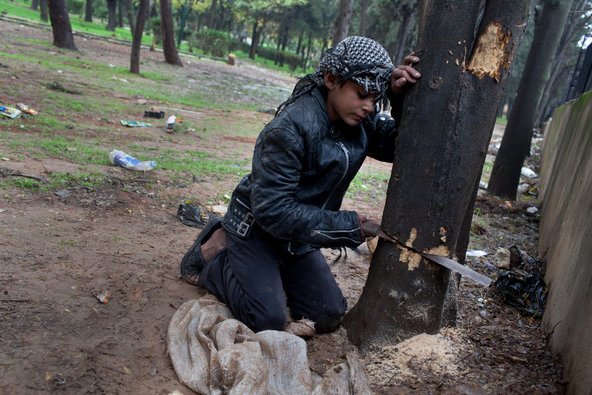
A younger boy with a cloth wrapped around his head is cutting away at the trunk of a tree. He is also in a leather jacket with black/dark blue pants with sandals. He is kneeling in the dirt to cut a lower section of the tree. You know the boy is in a forest because there are other trees in the background. There is also trash littered on the ground such as plastic bottles and abandoned towels. The boy’s face seem a calm with what he’s doing, his actions aren’t rushed. In countries such as Syria, the location of the above image, and even our own country, we need to provide video evidence to make people accountable for their actions.

As a result, programs are created to train people on how to record with camcorders and regular cameras. The training allows people to provide proper videos of violence and have evidence when reporting people conducting in violent acts. These programs, such as B'Tselem Camera Project have been set up to give the voiceless a way to speak out on unfair treatment. Before these programs were set up,there wasn’t a sure enough way that others would see the actions of others and would be able to stop what was happening in war torn countries and regions. The video recording programs and even recording on your own gives the backing that the human rights organizations need to showcase there is a serious problem that needs to be fixed so that people are able to live their daily lives without being faced with extreme acts of violence.

If these videos were piled together, the world can get a full view of places where conflict is common pace. The compilation of these videos also changes the world’s view on violence, they will be able to see for themselves what some people have to go through everyday. People don’t think about the certain violations that occur during wars. When there are cameras that actually film these events so that people can see what happens in other areas around the world, they put more effort into trying to stop these forces.

People view recordings as a way to cause more people to get involved in an issue. With visual proof of events that occurred, that person can’t deny what they have done and can get properly prosecuted. This is something you want to believe but a lot of the time people are still let free or never charged, such as officers timothy Loehmann and Frank Garmback who shot and killed 12 year old Tamir Rice in Cleveland in 2014. The rise in unrest in the race issues in America causes people to call for cameras on police officers to record their actions. There were already videos taken by bystanders in previous occurrences but that didn’t stop the violence and it didn’t stop the officer from being let go.

These are the reasons why we need to let it be known of cases where violence is unnecessarily used and frequently used. Violence problems across the world can no longer be ignored. The general public needs to let their opinion be known and informed through records videos so that they can help with the problems we face as a modern world. We can no longer ignore the violence acted onto those who can't defend themselves.


Works Cited:


"Human Rights Campaigns & Projects from WITNESS." WITNESS. Witness.org. Web. 21 Mar. 2016. <https://witness.org/our-work/>.


Laughland, Oliver, and Jon Swaine. "'I Dream about It Every Night': What Happens to Americans Who Film Police Violence?" The Guardian. Guardian News and Media, 2015. Web. 21 Mar. 2016. <http://www.theguardian.com/us-news/2015/aug/15/filming-police-violence-walter-scott-michael-brown-shooting>.


"B'Tselem's Camera Project." B'Tselem Video. Web. 21 Mar. 2016.  <http://www.btselem.org/video/cdp_background>.

Be the first to comment.

Advanced essay #4: Technology Changes Everything..

Posted by Fodie Camara in English 3 - Block - D on Monday, March 21, 2016 at 3:47 pm

​My goal for this paper is to answer the question "what is the difference between the "truth" and the "story"? I used many sources and quotes to try to answer this question. When I finally answered the question, I came with all of these other answer like race, technology, story and truth. Writing this paper made me think a lot of this question and all these other topics. It really made me think and think. Same thing that happen to Trayvon Martin can happen to anyone included myself. I think this piece was the best piece that I wrote. I can feel it. I took my time and made sure everything is perfect as I see it. 

Truth is a fact or something stated that is accepted as true. A story is an account of past events in someone’s life. The truth can’t always be true and a story can’t always be true. Technology can help us support stories and the truth but even technology doesn’t show hundred percent of the story. What is the actually difference between the truth and the story?

For example from witness.org, "What WITNESS does is create, support, and sustain a global network of people who use video as their tool, as their weapon. This network reminds us that we are not a single voice; we are not alone." Another example is “WITNESS identifies ways for citizens to capture and preserve footage to improve its chances of it being used in the courtroom. Through tools, training, and advocacy efforts, we aim to help activists capture and use video as evidentiary material.” Another example was “The WITNESS Media Lab is dedicated to addressing the challenges of sourcing, verifying, and contextualizing eyewitness video to advance its use as a powerful tool for human rights documentation and advocacy. Visit the Lab for curated footage, analysis, cases studies, and resources.” The last example is “WITNESS responds to crisis situations around the globe by providing on the ground trainings, coordinating with local citizens and organizations, and making online resources available in multiple languages. Our aim is to help human rights defenders film more safely and effectively in dangerous and unpredictable environments.”

Technology can sometimes be usefully by showing video evidence of what happened during an incident. Other times technology isn’t as useful. It wouldn't be useful in a situation where it only shows one or a single part of video footage of an incident. Video footage doesn’t always tell the full story or the truth. That’s why technology including cameras outside in the streets or in stores shows some evidence but don’t at the same time.

Screenshot 2016-03-18 at 1.07.34 PM - Edited.png

Here is a young African American male. This young African American male is about 17 years old. He is taking a picture and looking directly into the camera. He has a white hoodie on top of his head. His name is Trayvon Martin. As Trayvon looks into this picture his eyes look like he has fear and innocence in them. Martin facial expression makes him seem like he is a little bit angry or upset about something.

Technology was a big key in the Trayvon Martin case. Trayvon Martin was walking back from the store going back to his location when George Zimmerman, the neighborhood watchman, claims Trayvon had his hoodie on and was high. He called 9/11 and said something about African American being high walking around in the rain and he thought Trayvon was up to something. The cops told him not to follow Trayvon but he followed Trayvon anyways and then claimed they began arguing and then started fighting. After, he claimed Trayvon tried to grab his gun and then he pulled out his gun and shot Trayvon Martin in the chest.

CNN website gave us the whole story and everything with details including phone calls, maps, and more. CNN stated “The same analysis also didn't reach conclusions as to whether Zimmerman used a racial epithet to describe Martin on his own 911 call, as some have alleged. Martin's family have said they believe Zimmerman, a white Hispanic, profiled the African-American teen.” Another example is Zimmerman's voice, meanwhile, comes through on a 911 call he made around that time, telling a dispatcher about "a real suspicious guy." "This guy looks like he's up to no good, or he's on drugs or something. It's raining, and he's just walking around." Another example is “The dispatcher asked Zimmerman, who'd called 911 at least four times previously for other incidents, if he was following the person. He replies, We don't need you to do that," the dispatcher responded. But Zimmerman followed him anyway.” Last quote is “Federal civil rights charges are difficult to press, let alone get convictions for. In its press release about the decision, the lack of charges against Zimmerman are said to be a result of being unable to meet the standard of proving that the "defendant knew his acts were unlawful, and committed those acts in open defiance of the law. DOJ officials said they would have had to have proven that Zimmerman approached Martin in a threatening manner before the fatal shooting because of Martin's race.”

Technology helped us know where Trayvon was coming from and all the extra details. He don’t know if George Zimmerman shot him because he was a young African American male with a hoodie on. Even the police calls when George Zimmerman called the cops of him talking to them that part even helped the case out by the cell phones. We don’t know if this was the full story or if it was even the full truth. George Zimmerman got charged for murder that he committed. Then later on they released him because they didn’t have a whole lot of evidence to charge him with murder. People till this day still talk about this case because this wasn’t right and they let a guilty man let go.

Technology was also a big key in the Kevin Garner case. Kevin Garner was 43 African American male. Kevin Garner was a front of a store. A fight broke out with two other males. New York City Police put him in a chokehold and slamming his head to the pavement. He keep telling them he couldn’t breathe but they didn’t listen at all. He continued to choke him. They claim he was selling untaxed cigarette which is illegal. There is still a question if he was selling cigarettes or not? The police say yes and some of the witness say no. People say the police are saying yes because they would have a reason to arrest him and by killing him that they don’t get in trouble.. After all this talk the police officers were never charged. Technology played a role in this case, it didn’t give us the outcome that we wanted but in our heads we know the truth.

Simple Justice gave us the whole story with updates and a full video of what happen with police and Garner asking them multiple times to stop. Simple Justice stated “New York City police officers killed a man Thursday after he had broken up a fight between two other men, insisting on placing him in a chokehold and slamming his head to the pavement, piling on top of him as he gasped for air and as he continually told the cops he couldn’t breathe.” Another example from the website is “I can’t breathe! I can’t breathe!” Eric Garner, 43, repeatedly screamed after at least five NYPD officers took him down in front of a Tompkinsville beauty supply store when he resisted being handcuffed.” The website also stated “The entire incident was caught on video from a witness who kept telling the cops that the man had not committed a crime.” Another example is “Within moments Garner, a married father of six children with two grandchildren, ceased struggling and appeared to become unconscious as police called paramedics to the scene. An angry crowd gathered, some recording with smartphones.” They stated “He referred to police rules that forbid chokeholds and define them as including “any pressure to the throat or windpipe, which may prevent or hinder breathing or reduce intake of air.”

Technology helped us by giving us a clear view. It had recorded full video from witness smartphones of police going over to Kevin Garner getting choked up and getting over abused by officers. The smartphone video also helped us by giving us a story about what happen. It also had the part when Garner pleading to the cops that he couldn’t breathe at all. Did the officer do this because his skin color?

What is the difference between “story” and “truth”? Race, technology, story and truth all comes together as one big topic. By using technology like cell phones videos, store camera videos, police officer body camera videos, cop car dash cameras videos, we can actually see what is happening than someone saying their side of the story and some of the truth and not the full truth. With the world advancing we can catch the little stuff now and now days everyone records everything and anything. We can catch abuse from officer or any abuse or anything now days just because of the improvement of technology. We can catch on video racist acts happening to any skin color by another person. We can use the video to help us in court or anything to watch what happen but sometimes we don’t get the full video of what actually happen and the full thing. We can capture moments of the video but we probably wouldn’t get the full video.

Work cited used:

  • "NYPD Kills Eric Garner on Video (Update)." Simple Justice. 2014. Web. 21 Mar. 2016.

  • "Human Rights Campaigns & Projects from WITNESS." WITNESS. Web. 21 Mar. 2016.

  • CNN. Cable News Network. Web. 21 Mar. 2016.

Tags: Advanced Essay, block english
Be the first to comment.

Advanced essay #4, Noah Weinberger.

Posted by Noah Weinberger in English 3 - Block - D on Monday, March 21, 2016 at 2:56 pm

​
     In this essay, I address my personal view on violence and nonviolence and how we should strive to be non violent through our hardships with our enemies. My goal is for the reader to understand my point of view and get a general idea of why I believe they should support nonviolence. I hope that I can do a good job of convincing the reader why violence is not always the answer for conflicts with other people, and that there's a nicer, happier, and safer solution to said conflicts. In addition, I hope this essay is informative to give people an insight on how violence and nonviolence works. I hope you enjoy this essay, cheers.

There is a black handgun. The gun has been bent and twisted into a knot so it is not possible to shoot anyone with it. At the bottom is a message that promotes non violence. The letters are big and bold so they can stand out to the viewer. This image encourages people to take action in nonviolence and nonviolent activities.


In our society today, we come across many challenges that can cause people to become aggressive. We encounter many people who usually have the same idea as we do, and that is to excel in life and accomplish the many things they see fit. But not all of these plans are remotely friendly to our own plans. Some of these ideas are backed by huge amounts of power or energy that comes from a corporation or organization. However, despite this, the danger is truly present when an individual idea or multiple ideas are backed by a Nation when other Nations don’t see fit. The danger derives from violence, which can cause many horrible actions to be taken by the people who are encouraged to use it as a solution to their problems and disagreements. These actions can fall along the lines of heated arguments with a failure of two or more individuals and/or nations seeing eye to eye which leads to fighting breaking out between them, and even killing when it goes far enough. Violence is the solution nobody should aim towards, or at least, the solution everyone should turn to lastly when nothing else is working. Despite this, our country turns to violence and warfare as a solution in most situations. In fact, most of the United State’s past and present accomplishments were through warfare, such as the Revolutionary war, the Civil war, the Mexican war, the Spanish American war and many more.


Now that you have a general insight into Violence, you may be asking; “What’s so wrong with violence? When other countries come to fight, we fight back and win. In addition, violence has solved our problems countless times.” Well while this is all true in it’s own respect, we can solve our problems in a more pacifist manner that will allow us to build on our social ability to conversate with others by seeking a non violent route in a conflict that won’t cost the lives of possibly hundreds of people. While there are people truly evil at heart, most people who back a general idea that was spread, usually feel as if they were doing the right thing. People pick sides but not because they want to be “bad.” In fact, it’s most likely that the opposing side that one fights against might feel that they are good in their own sense. To back this up further,  Martin Luther King Jr. shares his thoughts by saying; “The nonviolent resister is just as opposed to the evil that he is standing against as the violent resister but he resists without violence.” Despite all this, we are never informed or even think about the other side most of the time when conflicts arise, and therefore, we are led to believe by other individuals, our world leaders, and our own assumptions that we are the “good” and that the opposing side are the “bad.” You can even pull the world wars into this line of view about who is really the enemy. One man, Adolf Hitler, somehow appealed to the majority of Germany’s population, and the Nazis who backed him most likely believed he was right. The people who supported the morally corrupt ideas of this truly wicked man at heart, were convinced that what he said was true. They didn’t view themselves as “evil”, they thought that his line of thought was “right” and by supporting him, they thought that what they were doing was “good” even though it wasn’t.


Since we now know about Non-Violence, you may be wondering; “So What causes violence to be the first solution? Well, we need to take a look into the origin of where all violence derives from. To do this, we would have to know what causes violent actions to take place. If we were to observe, we would know that violence comes from two key features, fear and anger. In Scilla Elworthy’s TED talk, she explains the following: “Anger is like gasoline. When you have too much, it spreads around, and when somebody lights a match, you got an inferno.” She further states; “My fear grows fat on the energy I feed it.” From this, we break the text down and analyze it. The text’s meaning is telling of how violence derives from anger and fear. When you let your anger take control of you, then you will be at loss for control over the actions you take from that point on until all the anger recedes. In today’s society, how many times have we let anger control us? Lots of times, we let anger do the talking when we get angry at another individual. Sometimes, in similar situations, anger can lead us to get upset over something stupid. Anger can even lead us to do dangerous things, such as driving when angry, to even attacking others. When one is too angry to control themselves, they can end up seriously injuring and/or kill themselves in the event that they were careless in the action they were taking part in. However, when it comes to the entire nation, anger can result in a violent war against the other nation that started the anger to rise in particular. In addition to this, fear also plays a big role in violence as well. When we fear of something, it’s usually for the reason of something horrible we are believing to encounter. We are genuinely afraid of many things, such as our house, our money, our Job, our life, and that’s okay. It’s okay to be afraid, but we must not dwell on it or we will never overcome it. Just like anger, too much fear can harm you and the others around you. Once you become too afraid by constantly feeding your fear with the horrors of your mind, fear will engulf you and take complete control of your life until the day comes where you will face that fear. The day you face that fear will have a different outcome determined from how much your fear grew. And it’s because of fear that one may make hasty decisions and choose to try and hide from the responsibilities in life that lead up to this fear. A life constantly lived in fear from an undetermined outcome is one most likely wasted. Why wasted you may ask, because on your deathbed, you will most likely regret the fear you didn’t face. This rule of thumb for fear can be applied to great nations as well, which can result in many wars as an outcome. When one nation becomes afraid of another, they may try to stay on the one nation’s “good side” by constantly supporting them. Some nations will not fight back against an invading nation if they know the odds are against them and either surrender early or let the invasion go on. Some nations who own a strong military but weak economy fear for failure of the nation opposed to the other nation who may have a weak military but a strong economy (Such as North and South Korea, where North Korea has a small economy compared to south Korea. This leads to North Korea attacking South Korea to try and take their economy). This fear could lead to invasions to overtake the other nation to prevent a possible failure in the economy.


Non violence would offer a solution to all of these conflicts, however. If we could all remain nonviolent and seek friendship through the enemy, we could possibly go to greater lengths as nations. Martin Luther King said himself that “the nonviolent resister does not seek to humiliate or defeat the opponent but to win his friendship and understanding.” If we befriended all of our allies and foes, then we would have minimal conflict and more focus directed towards helping each other excel in life with what we have already accomplished so far. After all, who deserves to die over a simple disagreement?


King, Martin Luther, Jr. "The Power of Nonviolence."Teachingamericanhistory.org. Teachingamericanhistory.org, 4 June 1957. Web. 21 Mar. 2016.

Elworthy, Scilla. "Fighting with Nonviolence." Scilla Elworthy:. TED.com, Apr. 2012. Web. 21 Mar. 2016.

Foundation_NVPLogoBlack
Be the first to comment.

Advanced Essay #4: How social media and technology affect violence?

Posted by Jun-Jie Zou in English 3 - Block - D on Monday, March 21, 2016 at 2:42 pm

​          A lot of the process parts of this paper was about patience because there was a lot of research that went into this piece. It was very surprising to see how many of this violence actually occur in our everyday lives. One of the things that I struggled on was to retell the incident in my essay without no plagiarism notice. I think one of my weaknesses is to rewrite a story differently without losing any meaning or lesson coming out of it. Besides that, I thought that I did a good job with delivering the message of my writing; I thought that the thesis was very clear. 

Technology have controlled how we do things in society today. In the last 30 year, internet have been invented and it has revolutionized many forms of communication. People have no problem contacting their relatives from all over the world. There are many benefits to this creation, but there are also many consequence that come with it. For the years that technology has changed our lives for the better, it also increased the rate of violence in our society.

I have a friend that likes to spend her time on social media posting pictures and tweets about what she is thinking, where she is at, what she is doing at the moment, etc. I received the news one night when talking to my cousin that she got into a severe argument because of a social media interaction that she had with another girl. Apparently, the girl commented on one of her photos intruding her business, then my friend got mad and got into an argument with that girl in private message. The time and date was noon at Love Park. They decided to bring that small situation to the actual world. My cousin and I knew that this will turn into a fight and we did not think that it was necessary at all. We were able to convince her into not showing up. The moral of my personal experience is that because of another person clicking the send button from their phone, it triggered someone else on the other side of the channel. From that point on, it can turn into an argument that can end up like my experience and turn really physical and violent.

With domestic violence being everywhere in the United States, the city of Chicago is specifically known to be a dangerous city. With many people living in the ghetto, you have many really menacing communities and neighborhoods. Many of those locations in Chicago contain dangerous gangs, illegal drug transactions, many weapon misuses, etc. With that, having the power of technology and advanced communication techniques, it made everything a lot more efficient. That make everything a lot more dangerous for those neighborhoods and it made it a lot more complicated for the police department to track down. Relating back to the thesis, because of the advance technology that is available to almost everyone, they were able to use that to their advantage and create a easier way of communication for themselves. With that, it increased the rate of overall violence, and most importantly, for the people that are natives to Chicago.

Violence is occurring because of the advance technologies that we create everyday. Looking at it from another domestic perspective: on December 3 of 2015, a teenager from Olney Charter High School was arrested because of a threatening post online. The teenager posted on social media saying that he is intending to shoot up the school. That message was apparently sent to a young teenage girl from his school. The mother saw the message and it triggered her into calling the police department. The teenage boy was then arrested a couple days after; the police found a semi automatic pistol in his house. This shows the great matter of what social media can do to individuals like the teenage girl and her mother.

On the other hand, there was two students arrested on November 11 of 2015 because they also posted a threatening post on social media. The two student, from University of Missouri, posted saying that they will shoot any Black person in their sight when they come into class tomorrow and warns everyone to be ready. They got arrested 3 hours after they posted online. This enhance my argument of technology and social media making violence a lot more revealing through our blurry vision in society.

Speaking of vision, there are many things that people, especially teenagers, are not careful of. People have two sides and we tend to forget that sometimes when we become their friend. The teenagers that have been arrested might have friends that never thought that they would do such thing, but coming to realize that, they really did commit something like that. The picture below explains a lot about what I am talking about, and that is why I chose it. This explain the different sides that people have, and you should always be cautious about who you hang out with. download.png


I only provided three examples regarding mostly social media violence, but there are most definitely more examples out there in the world. It is sad to say that, some of these posts actually lead to the physical violence phase, and people get severely hurt. With that, this does not mean that you stop using social media or technology in general, in fact, be cautious about what you are posting online and who you choose to hang out with because all of it have an impact on your safety.


Bibliography:

"Olney Student Arrested after Alleged Threats of Violence on Social Media."PhillyVoice. N.p., n.d. Web. 10 Mar. 2016. <http://www.phillyvoice.com/olney-student-arrested-threats-violence-social-media/>.

This source talks about an incident in Olney Charter High School. Because of a post on social media, it triggered a mother of a young teenage girl to call the police. The social media post said something about a 16 year old that is planning to shoot up his school. I can use this as an example of my thesis.


"Social Media Transforms the Way Chicago Fights Gang Violence." Social Media Transforms the Way Chicago Fights Gang Violence. N.p., n.d. Web. 10 Mar. 2016. <http://www.governing.com/topics/urban/gov-social-media-transforms-chicago-policing.html>.

This website talks about the violence that happen in chicago and how social media changes it for the better or for the worst. Because Chicago has one of the highest rate of violence in its city, I decided to research on how social media impacted that rate.


"Is Our Addiction to Social Media Inspiring Violence?" Is Our Addiction to Social Media Inspiring Violence? N.p., n.d. Web. 10 Mar. 2016. <http://www.debate.org/opinions/is-our-addiction-to-social-media-inspiring-violence>.

On this website, there is a question regarding violence that is put up. Everybody around the world is able to answer and debate about that question. I thought that it was interesting to study on what other people think about the topic of violence. This also gave me other inspiring topics to research about.


Alcindor, Yamiche, and Doug Stanglin. "2 Suspects Arrested in Social Media Threats at Missouri Campuses." USA Today. Gannett, 11 Nov. 2015. Web. 10 Mar. 2016. <http://www.usatoday.com/story/news/2015/11/11/some-at-u-of-missouri-on-edge-after-social-media-threats-of-violence/75559034/>.

Like my first source, this is an example for my thesis. There were two suspects caught in a college in Missouri. The two suspects posted on social media about shooting any black person they encounter. This became and threat and they were eventually arrested because of it.

Be the first to comment.

Advanced Essay 4: The World is a Tree

Posted by Siawale Vesslee in English 3 - Block - D on Monday, March 21, 2016 at 2:37 pm

​

In this unit, we were going over how violence is incorporated in today's society. From all of our discussions, I decided to write about if we, as human beings, could live in a utopia, which is an absence of violence. My goal was to look towards the future and empower individuals. I use the stories of people who have been involved in wars in order to show how these violent situations can destroy the innocence of people and it starts with ourselves to have a utopia.


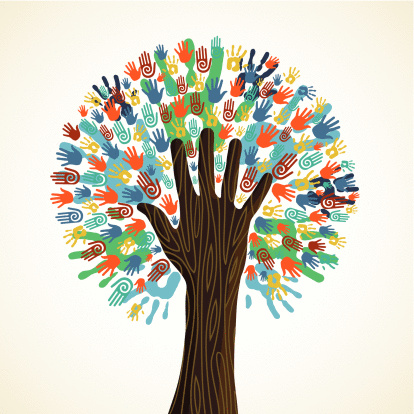
The world is a tree. It stands with strong roots built throughout the evolution of humans. In addition to building roots, human beings are the bark and stem of this tree. We have made societies that help make a strong system in order to exist in a world together. At the top half of this tree, the leaves are made up of the individual people of the world. The world is one big tree, but from the very beginning, this tree was always destined to have an ugly side. The side that is always shown is the side where it looks like every single person is able to receive the necessities and every person connected to the tree faces no type of traumatizing events.

Utopia.jpg


This idea of the world being a tree is is presented in the above picture. The picture is made of  hands. It is a representation of the world and the countries that make up the world. There are seven bigger hands in the back of the smaller hands. This could be a representation of the 7 continents of the world. The entire picture is of hands, making it show humans make up everything given to us in this world. Throughout the history of the world, humans have found a way to adapt to certain situations and environments and this has helped us evolve overtime. The picture shows that everyone is born with an acceptance of every person no matter who they are and where they are from and this allows us to build a strong rooted tree, or just a strong society.

The idea of a world in which everyone happy and nobody experiences pain is something that would be ideal, but could we, as human beings, live in a society rooted in nonviolence? The real question is could human beings live in a utopia? The simple answer is no. The evolution of human beings has had tremendous bloodshed and with that bloodshed, people have held ideas that keep them from accepting others. This is just the unfortunate truth as to why humans couldn’t live in a utopia. But how does violence make a society unable to be in harmony?

In many instances through history, when a problem between two countries, groups, or people occurs, violence is the first solution often looked upon. As defined by Google, violence is behavior involving physical force intended to hurt, damage, or kill someone or something. When applied to conflicts between countries, these acts of violence lead to war. War is somethings that has heavily influenced the reason why humans beings wouldn’t be able to live in a utopia. For instance, Michael Abbatello joined the Marines and after coming home, he describes how his whole mindset changed. “Something is changed. You know, you feel down to your spirit. You know that you’re different now. You know, we don’t really have a consciousness of our own spirit until it’s wounded, and then it needs help” (PBS 2010). Micheal Abbatello is a real life example of of how war can destroy a person. When someone is placed into a very raw situation, such as war, the mindset of a perfect world is destroyed. As a result, as the idea of a peaceful world is destroyed and the world becomes a dog eat dog place.

In addition to Micheal Abbatello, many other people who are in war, whether they are civilians or soldiers, end up having their minds, morals, and outlook changed to a more negative perspective. Veterans came to our school and one of them named John Graham stated that “ war is easy to start, but hard to finish”. This is something that is true because no human being is born with an understanding on misery. Humans are born in an innocent state and this mindset is ruined because nothing in war is innocent.

Even though human beings could not live in the utopia anytime soon, there is still hope for the distant generations to live in a utopia. Right now, the world has a lot of violence penetrating the everyday lives and minds of innocent people. From the Syrian refugee crisis to the police brutality in the United States, violence in today's society is so prevalent that the current generation on the verge of living more into a dystopian society. However, the answer of how can this change lies within each individual. As Scilla Elworthy states, “It’s my response, my attitude towards oppression that I have control over… And what I need to do is to develop self-knowledge” (Fighting with Nonviolence, April 2012). This self knowledge is the realization that violent acts like war happen when humans let emotion overtake their thoughts and actions. In a situation,  Elworthy states, “That means I need to know how I tick, when I collapse, where my formidable points are, where my weaker points are. When do I give in? What will I stand up for?”. By being in control of our emotions, humans are in control of the world.

So the world tree that is in a wiltering state is able to stand upright once more again if people are aware of the power their emotions have in this world. “The only thing you can do is get up, make a cup of tea, and sit with that fear…...and anger is like gasoline and if you throw it around and someone lights a match, you have an inferno”. Controlling emotions is a major key in order for the world tree to go back into its original state: a utopia.


Works Cited:


  • Elworthy, Scilla. "Fighting with Nonviolence." TED. Apr. 2012. Web. 21 Mar. 2016.


  • Severson, Lucky. "Moral Wounds of War." PBS. PBS, 28 May 2010. Web. 21 Mar. 2016.


  • Gregory, Sam. "Images of Horror: Whose Roles and What Responsibilities? - WITNESS Blog." WITNESS Blog. 2014. Web. 21 Mar. 2016.
Be the first to comment.
115 posts:
← Prev
  1. 1
  2. 2
  3. 3
  4. 4
  5. 5
  6. 6
  7. 7
  8. 8
  9. 9
  10. 10
  11. 11
  12. 12
Next →
RSS

ENG3-1

Term
2015-16

Other Websites

Launch Canvas

Blog Tags

  • block english 1
  • #english #SLA #Block 1
  • Advanced Essay 1

Teacher

  • Joshua Block
Slate (skeleton-v3 PHP 8 prototype) · Location: 1482 Green St · Shipping: 550 N. Broad St Suite 202 · Philadelphia, PA 19130 · (215) 400-7830 (phone)
×

Log In