• Log In
  • Log In
Slate (skeleton-v3 PHP 8 prototype)
Slate (skeleton-v3 PHP 8 prototype) Learn · Create · Lead
  • Students
    • Mission and Vision
  • Parents
  • Community
    • Mission and Vision
  • Calendar

English 3 · Pahomov · B Band Public Feed

Create a Post

A Not So Clueless Shrew

Posted by Lauren Nicolella in English 3 · Pahomov · B Band on Sunday, April 15, 2018 at 9:29 pm


A Not So Clueless Shrew

Comparing “The Taming of the Shrew” to “Clueless”


In William Shakespeare’s “The Taming of the Shrew” it proves that there is a high level of expectations that lies within a relationship, and it is seen through the characters getting married within the book. Between both couples Bianca and Lucentio and Katherine and Petruchio, the man was expecting some kind of money to be provided by the father of the wife. In “Clueless”, the audience is shown that your reputation and popularity relies on being in a relationship and how wealthy you are. While having a lens on Cher and Dionne during the film, there is difficulty for them to gain a proper amount of respect from the boys at their school. These texts reflect that there is a higher level of physical and reputation expectations rather than mental and emotional worth. This is due to the social belief that men are always looking for more or even the wrong thing from women when trying to get in a relationship.


"Petruchio: Come, come you wasp! I' faith, you are too angry. Katherine: If I be waspish, best beware my sting. Petruchio: My remedy is then to pluck it out."

(Act II, Scene i, 222-224)


In this scene from “Shrew,” it was a part of the conversation Petruchio and Katherine were having when they first met. Both characters are quick to respond with intense and meaningful banter in order to allow their relationship to be able to move forward in a way to get to know and understand each other. It allows room for there to be a line drawn of where their comedy lies without making the other offended.


Cher and Dionne are showing their new friend Tai around the school, and Dionne’s boyfriend Murray comes up to greet her in a way that is not what she wants.


In this scene from “Clueless,” Murray comes up behind Dionne saying “Woman, lend me five dollars,” and she instantly rolls her eyes and tells him that she repeatedly told him to not call her that since she wanted to be called by her name. Throughout the film, Murray then respects his girlfriend and is shown to be more caring than the audience may have thought due to what she expected out of him. Although this scene connects to Katherine’s ways in the beginning Act II of where she was introduced in “Shrew,” it contrasts towards the end of the book when she becomes submissive and obedient towards Petruchio.


“Katherine: Thy husband is thy lord, thy life, thy keeper, thy head, thy sovereign, one that cares for thee, and for maintenance commits his body to painful labor both by sea and land.”

(Act V, Scene ii, 162-165)


This scene is from the end of “Shrew,” Petruchio convinces Katherine to be completely devoted to him, and there is no longer a sense of self worth; Petruchio was able to succeed at “taming” his newly wedded wife.


Cher’s friend Elton insisted on giving her a ride home since he was into her, but the audience were the only ones who were aware of it. He admits her feelings and Cher responds back.


In this clip from “Clueless” Elton was clearly looking to get a lot more out of Cher sexually, and did not expect to be just friends since he was taking her acts of politeness out of context. Both women developed throughout the texts: Katherine realized she needed a man to keep her physically and mentally satisfied while Cher became not only self-dependant, but found a way to help her reputation without the need of a man to belong with her. It became the perfect combination to keep her from becoming completely dependant on what she thought mattered the most .


Expectations have become a way that relationships have been able to become functional or not, and with that it shows how society has different approaches towards dating depending on the time period. It reflects that Cher and Dionne are able to gain boyfriends while setting them straight in order to benefit themselves, and Katherine felt that she needed to change all of her ways in order to please her new husband. These texts show the audience of how there is a less traditional way of entering relationships concerning money and has evolved into caring more about mental and emotional worth and importance instead.

Works Cited:

- Heckerling, Amy, director. Clueless. 1995.

- 
Shakespeare, William, and D. J. Donovan. The Taming of the Shrew: Shakespeare. W. B. Clive, University Tutorial Press, 1929.
1 Comment

Social Relationship Status

Posted by Brendan Hall in English 3 · Pahomov · B Band on Sunday, April 15, 2018 at 9:13 pm

Social Relationship Status: What “Superbad” and “Taming of The Shrew” tell us about clout chasing

“The Taming of the Shrew” is a Shakespeare written play that depicts a harsh reality of marriages at that time period. It mainly revolves around the marriage between Katherine and Petruchio. They are forced into a marriage where Katherine is expected to be controlled by Petruchio because she is a woman. It can be implied that Petruchio enjoys marriage for the control more than for the love between a man and a woman. The 2007 film Superbad has a similar take on sexual intercourse within the movie. This film mostly revolves around Seth and Evan who are trying to lose their virginity before they finish high school. However, the main reason for Seth’s sexual desires is due to the fact he wants a higher social status.Both “The Taming of the Shrew” and Superbad present worlds   where individuals pursue both sexual experiences and relationships as a way to improve their social status and become more popular.

“Superbad” and “The Taming of the Shrew” both reflect how relationships, specifically romantic ones, can be used for superficial personal satisfaction. In The Taming of the Shrew every male character in the play does not consider women’s thoughts and feelings towards marriage. Those men had an expectation for women to follow all of their orders and marry whoever was assigned to them no matter the cost. Occasionally men from this book would use marriage as a way to show a luxurious lifestyle, or boost their social status. It allowed men of that time period to appear successful towards other men.

Petruchio: “To me she’s married not unto my clothes Could I repair what she will wear in me, As I can change these poor accoutrements.”

(Act 3 Sc. 2 119-121)

This quote “The Taming of the Shrew” when Petruchio dressed in a ridiculous outfit at his wedding with Katherine. Petruchio did this to make a point about how Katherine would marry him no matter what he did in order to boost his own ego. That action also models how Petruchio lacks empathy towards Katherine because he did not restrain from embarrassing her to make himself appear in full control. The movie “Superbad” puts a similar emphasis into sexual intercourse and dating that “The Taming of the Shrew” put into marriage.

“Are you insane?! Look at Jules's dating record, she dated Dan Remmeck who's had a six pack since like kindergarten. Jason Stone who looks like Zack Morris, and Matt Muer he's the sweetest guy! Have you ever stared into his eyes? It was like the first time I heard the Beatles.”

-Seth

One of the main characters Seth implied in the beginning stages that he felt worthless due to the fact that he is a virgin and less sexually desirable to women than his peers. His best friend Evan tried to cheer him up by bringing up his crush Jules and saying that Seth had a chance to get in a relationship with her. At first Seth was discouraged because he noticed how many men Jules dated prior were much more physically and emotionally appealing. However, later in the movie he gets invited to a party by Jules which makes him believe that she has mutual feelings for him. Despite this opportunity Seth only had sex on his mind instead of trying to get in a relationship with Jules. This is similar to the way marriage was viewed in “The Taming of the Shrew”. Instead of being a gesture made by love it was one indulged with selfish intentions to fulfill one’s ego. Seth’s main reason for wanting to have sex with his crush Jules was because he wanted to feel an accomplishment from a task. He initially preferred this over any type of emotional connection and initially only saw her as an opportunity to boost his social status.

Despite the similarities between The Taming of the Shrew and Superbad there are certain drastic differences. The most crucial difference is the overall presence of men in each story. In The Taming of the Shrew just about every male character has the same views towards women as Petruchio Their philosophy was that women should always sacrifice themselves to men, especially in marriage.

“Hortensio: Yea, and to marry her, if her dowry please.”

(Act 1. Sc. 2 186)

This quote shows how women were auctioned off for marriage and treated as a product to men. The lack of remorse for their situation displays how embedded this mentality was within their time period and reflects of most men from that era.

However, in Superbad there are characters to balance out Seth’s lust driven mentality. The most notable character with a different view from Seth was his best friend, Evan. Throughout the film Evan is also pursuing a romantic encounter with a girl named Becca. He has a different mentality towards Seth because he is open towards having sexual intercourse, but he does not let it become his main focus. His main focus was trying to connect to her as a person in order to eventually have a successful relationship with her. At one point in the movie Evan refuses to have sex with Becca because he did not want to take advantage of her while she was intoxicated. This action is gigantically unlike the men from The Taming of the Shrew, as they would often force sex upon their wives and other women throughout the play. Finally, the last way Superbad and The Taming of the Shrew and Superbad differ is because of the character growth, or lack thereof.

At the end of Superbad Seth runs into Jules at a mall after failing to hook up with her at party the previous night. Instead of continuing his immature tendencies he decided to grow as a person and admit his mistakes. Seth apologized to Jules for being shallow towards her and he offered to buy her makeup to cover the black eye he had caused from the party. That moment implied that Seth began to realize there is more to romantic relationship than sex and status symbols. In The Taming of the Shrew Petruchio did not become a less abusive person than the reader was first introduced to in the play. Petruchio remained the twisted person he was from start to finish.


Work cited:

Rogen, Seth, and Evan Goldberg. “Superbad” . Performance by Jonah Hill, and Michael Cera, 2007.

Shakespeare, William. “The Taming of the Shrew”. Dover Publications , 1770.


Be the first to comment.

Shaming of the Taming

Posted by Weston Matthews in English 3 · Pahomov · B Band on Sunday, April 15, 2018 at 6:14 pm

How Michelle in Southside with You and Katherine in The Taming of the Shrew show a major shift in relationship and gender dynamics

How Michelle in Southside with You and Katherine in The Taming of the Shrew show a major shift in relationship and gender dynamics


Though William Shakespeare’s play The Taming of the Shrew has been celebrated as an early example of romantic comedy, it has also garnered plenty of criticism from literary scholars and modern audiences for its seemingly misogynistic politics with women and courtship. In the play, a man named Petruchio tries to win both the heart and submission of his romantic partner, Katherine, the titular “shrew” of the play. Though Katherine is rather resistant to Petruchio’s efforts, he eventually converts Katherine from a headstrong and asocial woman to a overly obedient housewife by depriving her of necessities, such as food and sleep.

The 2016 drama film Southside With You displays a more modern and reformed idea of courtship. In the movie, a 28 year-old Barack Obama attempts to woo his colleague, Michelle Robinson, on an innocent summer date in the South Side of Chicago. Though Michelle is also rather resistant to Barack’s advances, his charisma and ebullient personality eventually win her over by the end of the date.

Though Barack and Petruchio may have similar goals in mind, their tactics are markedly different, and that is indicative of a major shift in worldview. They both want to win over a woman’s heart, but while Petruchio finds it perfectly fine to force Katherine into showing him affection through inhumane means, Barack is much more respectful of Michelle’s discretionary freedom. He is understanding of her reluctance and acknowledges that it would be abusive to use coercion tactics to achieve his end goal. This shows that though the concept of male pursuit is still very much alive, coercion is now generally looked down upon while the personal freedom of romantic partners is championed.


Petruchio: Come, come, you wasp; i' faith, you are too angry.

Katherine: If I be waspish, best beware my sting.

Petruchio: My remedy is then, to pluck it out.

(Act 2, Scene 1, Lines 222-225)

In this scene, Petruchio and Katherine are arguing somewhat comically as Petruchio plots his “taming” of her. He tells Katherine that she is too angry and compares her to a wasp. In response, Katherine says that Petruchio should then fear her sting, and Petruchio says that he will pluck her stinger out. This is Petruchio’s way of asserting that Katherine is powerless against him because he will always find ways to control her and stifle her disobedience.

In all likelihood, Shakespearean audiences would have laughed heartily at this scene, and it would not have offended many or garnered much controversy. This is because it was normal for men at the time to assert conjugal control, even if that meant threatening violence to their partner. This scene is a key example of the overbearing tendencies of men at the time of Shakespeare. Women were scorned and punished for trying to declare any type of control, just as Katherine is here.


Many modern romance movies are on the complete opposite end of the spectrum.


In Southside with You, Michelle Obama is depicted as a strong-willed woman, similar to Katherine in The Taming of the Shrew. One of the main differences between the two is how their willfulness is perceived. In this scene, Michelle, maddened by the fear that the date will cost her her job, fires up at Barack, saying that he should have been more respectful of her request to keep everything professional. Barack is silent the whole time Michelle is talking, carefully listening to her without trying to shoot her down, as Petruchio does to Katherine. Viewers of the film can see that Barack has is doing his best to understand Michelle’s point of view, though he may not agree with it. This major difference reflects a more modernized perception of how women should be treated—with unwavering respect as a peer and not property. Unlike the play, the film does not celebrate taming, but rather it seeks to put the lead male character and lead female character on a more equal level of control.


No shame but mine. I must forsooth be forc’d

To give my hand oppos’d against my heart

(Act 3, Scene 2, Lines 8-9)

This line comes from Katherine on the day of her wedding, shortly before Petruchio’s arrival. Petruchio’s tardiness to his own wedding makes Katherine go into a fit of both anger and sadness, as she mourns the fact that she is being forced by her father to marry a man that she does not have romantic feelings for. This is reflective of the marriage regime at the time of Shakespeare. Marriage was an extremely important cornerstone of societal structure, and unfortunately, women were often left disenfranchised from the process of courtship and marriage. Many women, like Katherine in this scene, were forced to marry men whom they did not love.

While this line may have been dismissed by the Shakespearean audiences as normal, audiences today would likely have much more empathy for Katherine. Marriage now is more of a consensual covenant, usually involving vows and legal documents. This alone shows a societal leap in ideology: women are now expected to have dominion over their own romantic affairs. This means that, in most cases, a father no longer decides whom his daughter marries, like Katherine’s father does for her.


The new system of courtship surfaces notably in Southside with You.


In this scene from the beginning of the movie, Michelle expresses her reluctance to Barack about going on a date, saying that it would make her look bad if she dates her coworker. Barack, understanding of her situation, then eases her angst by telling her that it is not officially a date until she wants it to be. Unlike Petruchio, he is considerate of Michelle’s disinterest and his pursuit subsides a bit. The mere fact that Michelle is able to express her disinterest to Barack shows a huge difference in power structure from Shakespeare’s time. Had Katherine told Petruchio she does not care for him, she likely would have been dismissed or perhaps even violently punished. Here, Barack is able to relent pretty quickly, without so much as a heated argument. Viewers should take close notice to this small scene because it illustrates the modern customs surrounding relationships: women have a much more prominent role in the courtship process, as they are more easily able to reject suitors without major backlash.


“Now, go thy ways, thou hast tamed a curst shrew”

(Act 5, Scene 2, Line 205)

This line is spoken by Hortensio at the very end of the play, as all the male characters feast cheerfully and commend Petruchio on his successful taming of Katherine. The most important detail modern audiences will notice in this scene is how Petruchio’s coercive abuse has earned him acclaim among all the men, as if he had proved himself a valiant and respectable man. The scene is communicative of the history of marital coercion, and how it was not uncommon for men to find coercion perfectly fine in a relationship. This play is an example of a larger historical pattern: love being won not with the heart, but with the fist.


Romance has conceptually changed for the better in this regard.


Unlike Taming of the Shrew, Southside with You ends on a precious note of romance and the power of wooing with charm and chemistry. There are very few words in the last scenes, allowing room for body language to come to the forefront. After a long date with ups and downs, Michelle and Barack share a special moment after he buys her chocolate ice cream, which she mentioned was her favorite dessert earlier in the date. Though Michelle’s infatuation with Barack had become gradually more evident throughout the course of the date, this act is the one that finally wins Michelle over. It is important to note how Barack did not use any type of coercion to romance Michelle. Instead, he used his naturally alluring personality, which distinctly sets his actions apart from that of Petruchio, who does not even seem to have a genial conversation with Katherine throughout the whole play. In the end, things work out favorably for both Barack, the pursuer, and Michelle, the pursuee, which truly highlights the contrast in what 21st century movie-goers want to see in a romance film: gentle courtship that ends in consensual happiness.


Both of these works can be interpreted as romanticized capsules of real-life attitudes when it comes to love. While it tends to be very easy to overlook entertainment history, by analyzing the romantic works of a time period, one may arrive at a deep understanding of how relationship ideals and gender roles have evolved over the course of time. Truth be told, The Taming of the Shrew and Southside with You are not that different in that they both use the plot device of a man pursuing a woman. However, with the rise of modern feminism and an always maturing civil culture, these movies offer two opposing archetypes of how that should be done. The ideological divergence here is evident, and it may be a guide in objectively studying where the impressive change has come and where change is due next.


Works

Kidnie, Margaret Jane. The Taming of the Shrew. Palgrave Macmillan, 2006.


Tanne, Richard, director. Southside with You. Miramax, 2016


Be the first to comment.

Love a Game Changer

Posted by Javier Chueca Bosch in English 3 · Pahomov · B Band on Sunday, April 15, 2018 at 5:13 pm

The book “The Taming of the Shrew” reflects how romantic relationships between man and woman were in the past. Petruchio, one of the main character of the play who is arrogant, confident and, a man who sees himself as a superior over the other people and even more over woman who he  claim to love. With the romantic love story of love at first sight such as Lucentio and Bianca who fall in love and both of them abandon the standard relationship ideas of the time period . It’s possible to appreciate these two situations, in the movie, “ Crazy, Stupid, Love” where The Character Jacob has in a way really similar values to Petruchio's. However, this values seem to be forgotten when he meets Hannah a young woman who, he seems to love at first sight. She isn’t delighted by Jacobs’ tactics initially and forced to turn around Jacobs ideas of what a relationship is. As the text and the movie show, man ideas on relationships had been and still are stereotyped as the males are supposed to be the Alpha of the couple and even more they are supposed to be always self- confident . However, when love is involved  it changes the way both member of a relationship behave and the stereotypes that are normally put into play disappear.


"Petruchio:

You knew my father well, and in him me,

Left solely heir, to all his lands and goods,

Which I have bettered rather than decreas'd.

Then tell me, if I get your daughter's love,

What dowry shall I have with her to wife?"


(Act 2, Scene 1, 960)


At this specific moment of the play, Petruchio is fighting and negotiating with to get Katherines handIn this quote and earlier in the text, we can see how he is justifying his possible marriage with Bianca showing his amount in power and richness as if he was supposed to show his “manhood” with this. And trying to show how he is the “Alpha male”, in the relation. How he is supposed to be in that way in order to be a good husband. Just like Jacob is going to try to prove Hannah how he is the Alpha Male of the club.

In this scene Jacob is showing Cal how to pick up girls in a bar and his strategies to convince a woman to be with him. He is asking girls to invite them for a drink. In this way he shows firstly that he has the ability of carrying on a relationship as, like said before, the Alpha male. Really close of the showing of that Petruchio did with Baptista in order to marry Katherina. However something will change in Jacob life as he will learn about true love.

In this scene of the movie, the public is able to see how the eventhough Jacob is use to be a player and to be able to control his emotions, he now is eboked to a romantic love that he can not control and would take this idea, that he had of himself, of being an Alpha male down. Love towards Hannah has changed his mind in a complete way and no matter how he tries to show off is not going to work because love will interfire and this idea of the Alpha male will end up disappearing.


“Lucentio:

Tranio, I burn, I pine, I perish, Tranio,

If I achieve not this young modest girl"


(Act 1, Scene 1, 156-157)

During this scene Lucentio realizes that he is in love with Bianca. His stereotypical manhood is blown and even at the end of the play it gets proven that he is not the Alpha of the relationship. He just like Jacob and Lucentio change their attitude in a way proving how this Idea of the Alpha male is just an stereotype and in the relations no one should be the dominating.  However, in the play love is used also as a way of control when Petruchio justifies his actions over Katherina with it.


In both the movie Crazy, Stupid Love and in the book The Taming of the Shrew is easy to appreciate how society during the years has ruled how man should be the leaders in a couple and how they have to proof their manhood during their life. However, as it’s shown in both the play and the movie when love appears all this stereotypes are vanished and in many cases the relationship doesn’t have a leader but a team.


Be the first to comment.

Guess Shrew: Shamus Keough

Posted by Shamus Keough in English 3 · Pahomov · B Band on Sunday, April 15, 2018 at 10:52 am

Guess Shrew

Shamus Keough

    The Taming of the Shrew is a romance story that is about two men trying to start relationships with two women who are partially being controlled by their father. Baptista, who is the father of the women (Katherine and Bianca) doesn’t want one of them to get married without the other one getting married. Because he doesn’t want this, he is not letting either of them get married unless the other one is setting up a marriage too. Both Petruchio and Lucentio wanted to marry Bianca but had to set up a plan where both of them would marry a daughter.

    Guess who is a movie about a black girl named Theresa, who is in a relationship with a white man named Simon, and are planning to get engaged soon. Theresa and Simon are very happy together, the one problem is, Theresa’s family doesn’t know Simon is white. After Percy (Theresa’s father) meets Simon, he starts to criticize him a lot and tries to get his daughter to stop dating him. These two stories both are about a father trying to involve himself in the daughter’s relationship, mainly because he cares about his daughters and wants to make sure they are okay. The stories also differ, like in the way that Baptista wanted to make sure his daughters get married, and Percy is mostly against who his daughter is dating. In every romantic relationship, family should be involved to protect their child even if it can cause negativity.


"And for I know she taketh most delight in music, instruments, and poetry, schoolmasters will I keep within my house fit to instruct her youth."

(Act 1, Scene 1, 94-97)

This quote is from Baptista, trying to speak highly about his daughters and their intelligence. He is speaking about them highly so any men that meet them may hear about them and think they are great women that they would want to marry. He is showing that he cares a lot about his girls and their relationships, and doing it in a very nice way.

Baptista is showing his concern for his daughter’s relationships in a positive way, trying to get some men to be interested in dating his daughters. Percy on the other hand, cares about his daughter, and shows it in a slightly negative way.


Screenshot 2018-04-15 at 10.03.28 AM

Percy in this scene is about to sleep next to Simon, in an effort to try and scare him. He also does it  to make sure Simon doesn’t wake up in the night, sneak in to Theresa’s room, and have sex with her. Percy is obviously showing that he cares about his daughter, but in a more negative way. His method of trying to scare Simon is negative, and he could have just tried to be polite and make sure Simon doesn’t do certain things.

“Faith, gentlemen, now I play a merchant's part and venture madly on a desperate mart.”

(2, 1, 345-348)

In this quote, Baptista says a metaphor as if he was a businessman and it is his job to work out his daughter’s marriages. He is speaking about it because getting his daughters married is extremely important to him. This is a nice way to show that he cares about his daughter’s relationships. (It is also a little negative since he is caring about himself partly, but it’s still positive in a way.)

Again, Baptista is trying to help his daughter’s out with their relationships in a nice way, and not really being negative to anyone. In this scene from the movie on the other hand, Percy is caring about his daughter, but trying to make the things he has been doing to Simon seem okay.

20180415_135648655_iOS

In the current scene, Percy is talking to his daughter, and she just asked him about why he has been so mean to Simon. Percy says it is because he doesn’t trust him, and he doesn’t want his daughter starting a relationship with someone who might do something wrong to her. While it is nice that he is doing something to try and protect his daughter, Percy is still being rude and trying to scare away Simon. Simon is someone who genuinely cares about Theresa and loves her, and doesn’t deserve what Percy is doing to him.


"I come to wive it wealthily in Padua; if wealthily, then happily in Padua."

(1, 2, 76-77)

This quote is from Petruchio, and he is speaking about how he only really cares about the money he will get when he marries one of Baptista’s daughters. The important thing about this quote is that it shows why Baptista has been caring about his daughter’s marriages, because he wants them to both to get married and to get married to men that actually care about them.

Baptista, once again was trying to be nice, and protect his daughters from people like Petruchio because they could treat his daughter’s badly if all they care about is the money. Percy, in the movie scene, is once again showing why he was treating Simon bad, and why he will treat him okay now.


20180415_135627111_iOS

In this movie scene, Percy and Simon are home alone at the house, just after Percy’s wife, Marilyn, and Theresa just left them and are currently staying at Marilyn’s sister’s house. Percy at this time is starting to see that Simon isn’t a bad person, and is now treating him nicer. Now that Percy knows Simon is a good person who cares about his daughter, he isn’t feeling like he needs to try and scare him off, and can be nice to him.

Both of these stories deal a lot with the idea of parents trying to be apart of their children’s romantic relationship. They both have fathers that show that they care, but both show them in different ways. In Taming of the Shrew, Baptista shows that he cares about his daughter’s and their relationships in nice ways, like when he speaks nicely about them to make men want to be in a relationship with them. He talks about how he will set up many of the things in their relationships for them, and overall is showing he cares in many different nice ways. Percy on the other hand shows that he cares by trying to get his daughter to date someone else. Percy doesn't trust Simon with dating his daughter and tries to scare Simon off. Overall, showing that he cares in a negative way. Both fathers show they care about their daughters a lot and show that they do throughout both of the stories. The ways they care show that while some parents can show how much they care about their children’s relationships in a nice way, many can still show it in negative ways like scaring away a person they don't trust with their child. While it is shown that negativity can be caused, the stories still show that family should be involved in romantic relationships to protect their children.


Work Cited


  • Shakespeare, William. The Taming of The Shrew

Kevin Rodney (Director) David Ronn (Writer). Guess Who, Columbia Pictures
Be the first to comment.

Is There A True Definition of Love?

Posted by Caroline Pitone in English 3 · Pahomov · B Band on Sunday, April 15, 2018 at 12:09 am


Is There A True Definition of Love?


Comparing “The Taming of the Shrew” and “The Wedding Singer”


The more you know about “The Taming of the Shrew” and “The Wedding Singer”, the more you know about whether or not there is a true definition of romantic love.


     Dating back to to the year of 1593, The Taming of the Shrew was written by well known William Shakespeare. This story consists of conflicts and troubles involving love and money and the expectations of relationships during that time era. During the first few pages of the story, the characters that were introduced go by Petruchio and Katherine. Petruchio and his soon to be wife Katherine, or as he likes to call her Kate, go through a rollercoaster of emotions whilst Kate deals with settling down with Petruchio, a man she would have never pictured herself marrying, until she later realizes she will do a lot in her power to keep him around. As does Robbie Hart for Julia, in the 1998 famous film about a small town ‘wedding singer’ who gets his heartbroken by Linda, his fiance, but soon finds the person that is right for him.

     There are obstacles to get around with, while dealing with a break up and a new love for a women with a wealthy fiance already. While there may develop troubles in a relationship with the person that is believed to be the one, it gives room to search for another individual. This happens to occur in “The Wedding Singer”. While being controlled by another human, and getting manipulated that there is a risk of finding nobody better, this could trigger a thought to continue in a relationship even if it is not right for someone. This is seen in the play. While looking at the similarities between these two stories, there comes to be a realization that romantic love comes with many circumstances, that don't all have to do with the emotions of a person.


“Petruchio: I come to wive it wealthily in Padua;

If wealthily, then happily in Padua.

(Act 1, Scene 2, Line 76-77)


     While reading the play upon the topic of marriage and so forth, it is clear to see the certain aspect of what contributes to marriage a great deal. While feeling the need for companionship, it is expressed as almost near impossible to have a happy and healthy life in a marriage that does not generate a great quantity of income. Petruchio is said to have traveled to Padua, Italy to find the perfect spouse. Katherine is then arranged to marry Petruchio, and Petruchio heavily expresses the importance of money from the beginning of interaction.


     In the movie, “The Wedding Singer”, main characters Robbie Hart, and fiance Linda, were thought to have fallen in love. As their wedding date that Linda purposefully missed, she came to Robbie the day after with some thoughts that she had to express to him. She came to a realization that Robbie was not as amazing or succesful the way he was when she first met him when he was the lead singer of a band. She comes to the conclusion that she will never leave the small quaint town they currently live in if she stays with him, which frightens her. While Robbie tries to make her see clearly about their true love, she then goes on about saying, “While you're off doing wedding gigs at a whopping 60 bucks a pop?” to Robbie, when discussing their income. Linda strikes the conversation upon the topic of money. The thought of money in her head conflicted her thoughts of love and happiness. As does Petruchio while he does not so much care about the love, but the happiness that comes with being wealthy as a unit in marriage.


“He'll woo a thousand, 'point the day of marriage,

Make feasts, invite friends, and proclaim the banns,

Yet never means to wed where he hath wooed.

Now must the world point at poor Katharine “

(Act 2, Scene 1, Line 15-20)


     While Katherine thinks of the marriage between her and Petruchio, she thinks about everything leading up to it. Such as the embarrassment casted on her during the time of waiting to become husband and wife. From interpreting this line said by Katherine, it is seen to show her great concern for their future and compatibility.

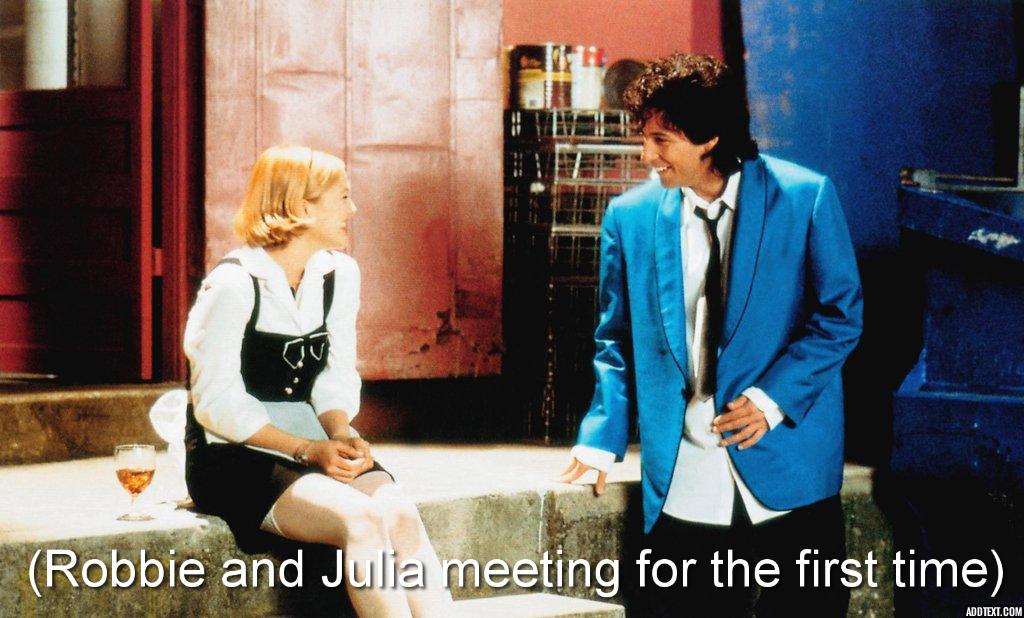
     After Robbie and Linda end, he starts falling for this women named Julia, who he met at a Bat Mitzvah. Later being told she has a rich fiance named Glenn, he instantly becomes sad. Feelings begin to develop for her while he cannot do anything to stop the marriage between Julia and Glenn. Robbie soon realizes that Glenn constantly cheats of Julia. He is outraged but does not have a right to act on the situation. While Katherine has concern for her relationship, she is not able to control it. Just how Glenn understands that Julia has no control over him and what he does during his free time. Since both of these concerning situations would be fixed if the other person had some sort of control, it allows the argument to come through to think about how control is thought to be necessary through a relationship in order to keep a healthy one. It develops the idea that true love can last as long as there is control on both ends for what each person wants out of eachother.


Katherine: “Then, you need a second (and possibly a third) set of comparisons: play, movie. Play, movie. Don't forget to use a larger font!

Thy husband is thy lord, thy life, thy keeper,

Thy head, thy sovereign, one that cares for thee,

And for thy maintenance commits his body

To painful labour both by sea and land,...And place your hands below your husband’s foot,

In token of which duty, if he please,

My hand is ready, may it do him ease.”

(Act 5, Scene 3, Lines 140-183)


     In the end of the play, Katherine realizes that she wants Petruchio in her life. In the beginning, Katherine acted in such a way that it was never expected of her to think of life with a man was necessary. Although towards the end, she contemplated what life would be like without a man and expressed to her fellow family that everyone needs a husband in order to be happy and to have security in life. She promoted the idea that women should look up to her man, and for the most part kiss the ground he walks on, interpreted by when she passionately said, “and place your hands below your husbands foot”. In the beginning of their relationship, Petruchio does many things to lessen her as a person. He starts off by calling her Kate instead of Katherine to make her angry. After treating her in a very bad and manipulative way, anything kind that he would do would seem as though it was the greatest moment to occur.

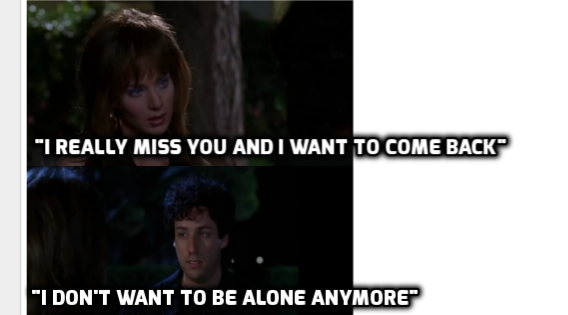
     Very later on after Robbie and Linda break off their relationship, Linda comes back to Robbie. Robbie comes home drunk and sees Linda waiting for him on his step in a very seductive outfit. After seeing Robbies vulnerability, she expresses that she misses him and needs him back. The morning after, Julia decides to go to Robbie's house to express her feelings about him and say how she loves him. Linda then answers the door in Robbies oversized Van Halen T-Shirt. Julia automatically feels unwanted there and rushes to Glenn begging to hop on a plane and get married. As it is in that moment, Julia felt powerless in the situation, she turned to her option that she no longer wanted which was Glenn. This scene displays how easy it is to let go of someone you truly care for when something goes on that is not what was wanted from the other partner.


     The similarities in expectations for relationships and love in “The Taming of the Shrew”, and “The Wedding Singer” still are apparent even centuries apart. As time develops in the lives of many individuals, it has the power to make people realize their love for one another, and the shame for one another. Love is never a real argument. Although one has the ability to say it, it is very easy to mess around with that statement. With so many things that balance out a successful relationship, the concept of ‘being in love’ can not be determined as real.


Work Cited:


Shakespeare, William.”The Taming of the Shrew”. Dover Publications, 1770.


February 13, 1998 (USA) Director: Frank Coraci. “The Wedding Singer”


Be the first to comment.

Success in Relationships: A Walk to Submission

Posted by Afi Koffi in English 3 · Pahomov · B Band on Friday, April 13, 2018 at 1:25 pm

Success in Relationships: A Walk to Submission

Comparing “The Taming of the Shrew” to “A Walk to Remember”  


“The Taming of the Shrew” higlights a theme that is still present in relationships today. In the play, Petruchio “tames” his wife Katherine and convinces her and the world that she is better off for it. This same idea is showcased in the more modern love story in “A Walk to Remember”. In this movie, Landon Carter is the stereotypical bad boy who falls for Jamie Sullivan after being forced to do community service as a result of one of his many offences. Their interaction impacts both of their personalities and outlook on life.


Although the male does not have all the power in their relationship, like in “Shrew”, in this movie the control is still important even though it is more two sided. Petruchio is not embodied by just Landon or Jamie for the entire movie. Rather, both Landon and Jamie have the opportunity to have control and manipulate each other during the movie. As a result, both of them have to take on the figurative role of Katherine, the submissive partner, in the relationship.These works reflect that even if it’s for short periods of time, audiences still believe that the success of a relationship requires the submission of one party.


“... Let him that moved you hither remove you hence. I knew you st the first you were a movable”

(2, 1, 203-206)


This quote is from the first time Petruchio and Katherine meet. Katherine is still ruthless and doesn’t care too much for Petruchio. Before he has the chance to tame her, she is painted in a negative light. This shows the reader that the submission of a partner is necessary and anticipated. Because Katherine has not submitted to Petruchio, the relationship does not exist.


Similarly, the individuality of Landon and Jamie prevents their relationship from beginning.  

This scene begins with Jamie attempting to start small talk to Landon. He then proceeds to shut her down and tell her about herself. She warns him to not presume to know her and lets him know that she doesn’t care what people think of her. This is identical to Katherine's initial attitude. The women in both the book and the movie make it clear that they are their own people and do not worry themselves with the opinion of others. What’s different is that in “A Walk to Remember”, this is viewed as independence while in “Shrew, it is seen as insolence. Regardless, this rashness is what is stopping the women from their pending relationships.


"When you are gentle, you shall have one too, and not until then”

(Act 4, Scene 3, 75-76)

In the scene, Petruchio is continuing his mission to tame Katherine. He does this by mocking her with material things that he has no intention of giving her. He says the quote to her to show that she can get what she wants from him when she behaves herself. This act involves the submission of Katherine. If she does not submit and act accordingly, she won’t receive the things that she wants to wear.


A similar bargaining and mocking technique can be seen in “A Walk to Remember” .


In this scene, Landon attempts to win Jamie’s heart after denying her in front of his friends. After that event, Jamie concluded that “there was no good in him.” Landon wants forgiveness and approaches Jamie only to be shut down by her demand to “prove it.” In this scene the figurative roles of Petruchio and Katherine have switched. Jamie is the person in control. In the same way Petruchio does to Katherine, she demands that Landon prove himself to her. Consequently, Landon has to act in a way that is pleasing to her in order to get want he wants, her friendship. What’s different is that Landon was placed in this position because he intentionally took on the role of Petruchio when he denied her because he was embarrassed of her. He would prefer Jamie act in a different way but she doesn’t give in. This causes him to realize that he needs to change to get her back. If he didn’t submit and apologize, their relationship would have ended. This supports the idea that the progression of a relationship relies on the submission of someone in the duo.


"I am so ashamed that women are so simple to offer war where they should kneel for peace, or to seek rule, supremacy, and sway when they are bound to serve, love, and...",

(Act 5, Scene 2, 177-180).

In this scene, after showcasing her obedience to Petruchio, Katherine scolds her sister Bianca, and the widow for not being better wives. Her entire speech sounds like words that Petruchio got her to believe. Katherine tells that she is a better person because of Petruchio and invites the other women to change for the better as well. This quote is important because it shows Katherine’s complete submission. She has been tamed and believes that she’s better off because of it. Without this submission, Katherine could not have the relationship she has now and couldn’t be able to reprimand the “bad” wives.


Similarly, in “A Walk to Remember”, Landon owes his transformation to Jamie.

In this scene that concludes the movie, Landon tells the audience of the result of his relationship with Jamie. He, like Katherine, praises Jamie for “saving his life”. His relationship with Jamie made him a better person. The fact that she challenges him to act in a better way is very comparable to Petruchio taming Katherine. The difference here is that Landon has changed, not by becoming obedient, but by being a more kind and gracious person. Landon would not have become and better person if he hadn’t submitted and changed for Jamie.


In the same way “Shrew” does, “A Walk to Remember” romanticizes the total submission and transformation of someone in a relationship. In “Shrew”, Katherine becomes totally obedient to Petruchio while in “A Walk to Remember” Landon becomes more kind and gracious. Today, the values Landon gained are seen as positive while during the times of “Shrew” being obedient may have been seen as positive. If “Shrew” was made today, the total submission into obedience would be frowned upon. If “A Walk to Remember” was made then, the values of kindness would mean nothing. In “Shrew”, Bianca is the kind and gracious maiden  but in the end she is not the best wife because obedience reigns supreme. This shows the audience that not only is submission in a relationship is crucial, but also that the qualities gained from this submission reflects the values of the society. Regardless, submission is painted as a necessity because it keeps the relationship going and changes people.


Works Cited

Shakespeare, William. The Taming of The Shrew. New Folger ed., Washington

Square Press, 1992.

Shankman, Adam, director. A Walk to Remember. Warner Bros., 2002.


1 Comment

Control in Love: Is it there anymore?

Posted by Julia Furman in English 3 · Pahomov · B Band on Friday, April 13, 2018 at 11:36 am

“The Taming of the Shrew” features a few different stories woven together, but one of the most notable is Petruchio’s efforts to “tame” the wild-tempered Katherine. It was written in early 1500s England, when women were expected to get married, have children, and raise a family. The film, “My Big Fat Greek Wedding”, was made more recently, in 2002. The film tells the story of Fortoula’s attempts to court Ian Miller, despite her family’s strong devotion to the Greek religion and the fact that Ian is not Greek.

These two stories involve some form of romantic love, but was that love even real? “The Taming of the Shrew” certainly implies the interesting idea that romantic love is a myth meant to disguise the truth that marriage is about control. Would a more modern feature film reflect that times have changed? Yes, it would; it has resulted in the idea that the control parts of marriage are dying down, and the love is shining through the cracks. While there is still an element of control in marriage, it is not as prevalent today as it was in the time “The Taming of the Shrew” was written. Today, audiences expect that the control part of marriage has died down, except for parental influence, and that romantic love has become more real.

“thy lord, thy king, thy governor” (Act 5, Scene 2, 154)

This is one noteworthy part of Katherine’s big speech at the end of the play. She was ordered by her husband, Petruchio, to say this to remind the women in the scene of their place. In this section, she refers to the husband as the lord, the king, the governor, meaning that they were the one in charge and had total control.

And they did have total control, at the time. This idea is less regarded in modern works, like “My Big Fat Greek Wedding.”

Screenshot 2018-04-13 at 11.32.53 AM

“The man may be the head of the house, but the woman is the neck, and she can bend the head any way she wants.” This quote and the screenshot are from the scene where Fortoula’s mother encourages her to persuade her father to let her get a job outside of the family’s restaurant. his quote is interesting, but other members of the audience might not catch its importance on first watch. It basically says that while the man is still the head of the house, the woman can influence him. This would suggest that as time went on, control in marriage shifted from total male dominance to a system where the power shifts between the two partners.

“I’ll curb her mad and headstrong humor.” (Act 4, Scene 2, 119)

This is an excerpt from one of Petruchio’s “game day speeches,” where he reveals that he plans to “tame” Katherine the same way the people of that time tamed falcons, which is through starvation and lack of sleep. In this section of the speech, he says that he’ll “curb” Katherine’s “mad and headstrong humor.” Although not everyone can understand Shakespearean text, the reader should know that he’s saying that he’ll quiet Katherine’s temper. He wants to change something about Katherine, which implies that for a relationship to happen, women have to change something about themselves to appease the man. Katherine tried to resist Petruchio, but he was too persistent. Additionally, the play allowed this to be okay because it was written as an over-the-top satire. However, the message is still there.

Women used to have to change something about themselves to make themselves more appealing to men. They don’t have to anymore.

Screenshot 2018-04-13 at 11.35.07 AM

In the early parts of the movie, I noticed a couple similarities between Fortoula and Katherine. Fortoula doesn’t have as bad a temper, but I still saw some connections. There was a pressure on her to get married, she had a sister who was described as “perfect” by Fortoula herself, as she married a Greek man and has three kids, and they wanted something more than what they had. Fortuola also went through a change, wearing contact lenses and more colorful outfits. However, this change happened because of a new job, not because of a guy. This would mean that changing to appease a man is optional for women. In the later parts of the movie, Fortoula became more similar to Bianca, as she actually likes her suitor, Ian.

“When the special thing is well obtained, that is, her love,” (Act 2, Scene 1, 135-136)

This was a part of a quote from Baptista, Katherine and Bianca’s father, where he tells Petruchio that if he wants to marry Katherine, he has to earn her love. It has always been tradition for the boy to ask the girl’s father for permission before he could start dating her. This tradition possibly lasted as long as courtship itself, showing that parents have as much influence in dating as the couple themselves. It is evident in the play that Baptista wants Katherine to get married, as he reveals in the first scene he appears in that he will not let his younger daughter, Bianca, get married until she does. However, he still puts up a challenge to see if Petruchio is good enough to marry Katherine.

Additionally, Baptista did not influence the control parts of marriage. It was never made clear if he was even aware of what Petruchio was putting Katherine through. If he was, it’s likely that he didn’t care, as it was normal for the husband to take dominance for his wife at the time.

Today, the only control aspects of marriage come from parental influence.

Screenshot 2018-04-13 at 4.23.11 PM

Like Baptista, Gus, Fortoula’s father, wants his daughter to get married, but still judges the potential mate. In the case of the movie, he wants Fortoula to marry a Greek man, but Ian, Fortoula’s love interest, is not Greek. Gus judges Ian throughout the movie, even after he is baptized into the Greek religion, for not being born Greek. He also cites the factor that Ian did not ask his permission to date Fortoula as a factor for his judgement, saying that a respectable man would have asked him for permission. He also says that he knows nothing about Ian. Gus may believe that Windex can work as an all-purpose medicine, but he was sensible to be wary about a guy who he knew nothing about and was also dating his daughter, although it did turn out good in the end.

The control aspects of marriage has died down, but parental/familial influence on marriage has not. In the 16th century, the control aspects of marriage were prevalent, as they were made blatantly obvious to the reader in “The Taming of the Shrew”. However, this idea of control in marriage is not there anymore, aside from the occasional thing about who “wears the pants” in a relationship. If control was still a part of marriage, “My Big Fat Greek Wedding” didn’t focus on it. Instead, it focused on the romantic relationship between Fortoula and Ian. The only “control” parts of their marriage came from Fortoula’s family, who took over much of the wedding plans.

Work Cited:

William Shakespeare, The Taming of the Shrew

Joel Zwick (director) and Nia Vardalos (writer), My Big Fat Greek Wedding

1 Comment

White Men Can't Jump - English BM

Posted by Zaire Williams in English 3 · Pahomov · B Band on Tuesday, March 6, 2018 at 4:13 pm

Be the first to comment.

Cardi B - English BM

Posted by Sydney Rogers in English 3 · Pahomov · B Band on Tuesday, March 6, 2018 at 1:38 pm

by Sydney, Avi, Lauren, Shamus, & Ashton

https://youtu.be/K6DuuJN_Stc
Be the first to comment.
134 posts:
← Prev
  1. 1
  2. 2
  3. 3
  4. 4
  5. 5
  6. 6
  7. 7
  8. 8
  9. 9
  10. 10
  11. 11
  12. 12
  13. 13
  14. 14
Next →
RSS

ENG3-028

Term
2017-18

Other Websites

Launch Canvas

Blog Tags

  • Homepage 3

Teacher

  • Larissa Pahomov
Slate (skeleton-v3 PHP 8 prototype) · Location: 1482 Green St · Shipping: 550 N. Broad St Suite 202 · Philadelphia, PA 19130 · (215) 400-7830 (phone)
×

Log In