• Log In
  • Log In
Slate (skeleton-v3 PHP 8 prototype)
Slate (skeleton-v3 PHP 8 prototype) Learn · Create · Lead
  • Students
    • Mission and Vision
  • Parents
  • Community
    • Mission and Vision
  • Calendar

English 3 · Pahomov · B Band Public Feed

Create a Post

  Reader Profile: Ms. Pahomov

Posted by Larissa Pahomov in English 3 · Pahomov · B Band on Wednesday, September 28, 2016 at 9:19 am
Photo on 9-28-16 at 8.59 AM #2

Ms. Pahomov hates it when strangers ask her “what book are you teaching in your English class right now?” Usually it means they want to just talk about what they liked to read (or not) in high school. When she was in high school, people told her she was a “fast reader,” and that was a bad thing for her, because she often read too quickly and missed the details. There are a lot of books she likes better now that she slowed down when reading, like “The Great Gatsby,” which she has probably read ten times at this point, each year when she teaches it. She is proud of the fact that she has the stamina for long books, but is more likely to carry around something that is 200 pages or less in her backpack.

One of the great sadnesses of her school year is that she uses so much of her brain to read and respond to student work that she has limited capacity to read on her own. She also recently discovered that she is old enough to have read books and COMPLETELY FORGOTTEN what they are about. Take, for example, the novel “Cat’s Cradle” by Kurt Vonnegut. She is certain she read it as a teen, but a student asked her about the plot recently and she couldn’t remember a thing. She is a little bit worried that this represents the rest of her life: forgetting things and having to go back to them.

One of her great joys of the school year is when she gets to read alongside her students in class. Her plan is to re-read “Cat’s Cradle” as soon as she finishes “Bone” by Fae Myenne Ng. The hardest time for her to read is on a plane or train. She always tells herself that she will, but she’d much rather listen to music and look out the window. She is a little bit ashamed of the fact that she never reads in German anymore, although she can. Never enough time!

Be the first to comment.

I Got You Fam

Posted by Jevon Price in English 3 · Pahomov · B Band on Sunday, April 23, 2017 at 6:54 pm

In both The Parent Trap and Taming of the Shrew, two relationships are formed through heavy influence by family members. In the Parent Trap, twin sisters Annie and Hallie used a series of tactics such as deception and trickery to reunite their long separated parents. While in Taming of the Shrew, Baptista used his being the lead male figure of the family as means to decide when and who his daughters, Bianca and Katherine would marry. Both situations see family members Annie, Hallie, and Baptista taking matters into their own hands to effect the relationship of others with varying success. The children in the Parent Trap, and the father in Taming of the Shrew. These reflect that the idea of familial influence and impact on relationships has transcended time, but time has equalized the power of women and men allowing for certain tactics that were once acceptable to be ended.

“Gentlemen, importune me no farther, For how I firmly am resolved you know: That is, not to bestow my youngest daughter Before I have a husband for the elder.”

(Act 1. Scene 1, 48-51)

In this quote, Baptista informs the male characters about the marital status and plans for his two daughters Katherine and Bianca. All of the male characters up to this point have shown great interest in marrying the beautiful and desirable Bianca, the youngest daughter. However, Baptista explains that Bianca is not allowed to court or contact any males excluding teachers until oldest sister Katherine, who has developed the reputation as a shrew or mean spirited is married off. Furthermore it is Baptista who has final say in both who and when his daughters are married to. Bianca and Katherine are at complete submission to their father who dictates their interaction and relationships with men Baptista displays a firm grasp and influence on the future of his daughters. His ability to do this also reflects the time period of the late 1500s where women had little to no choice in who they would be married of too. Instead this right given to parents, particularly fathers.

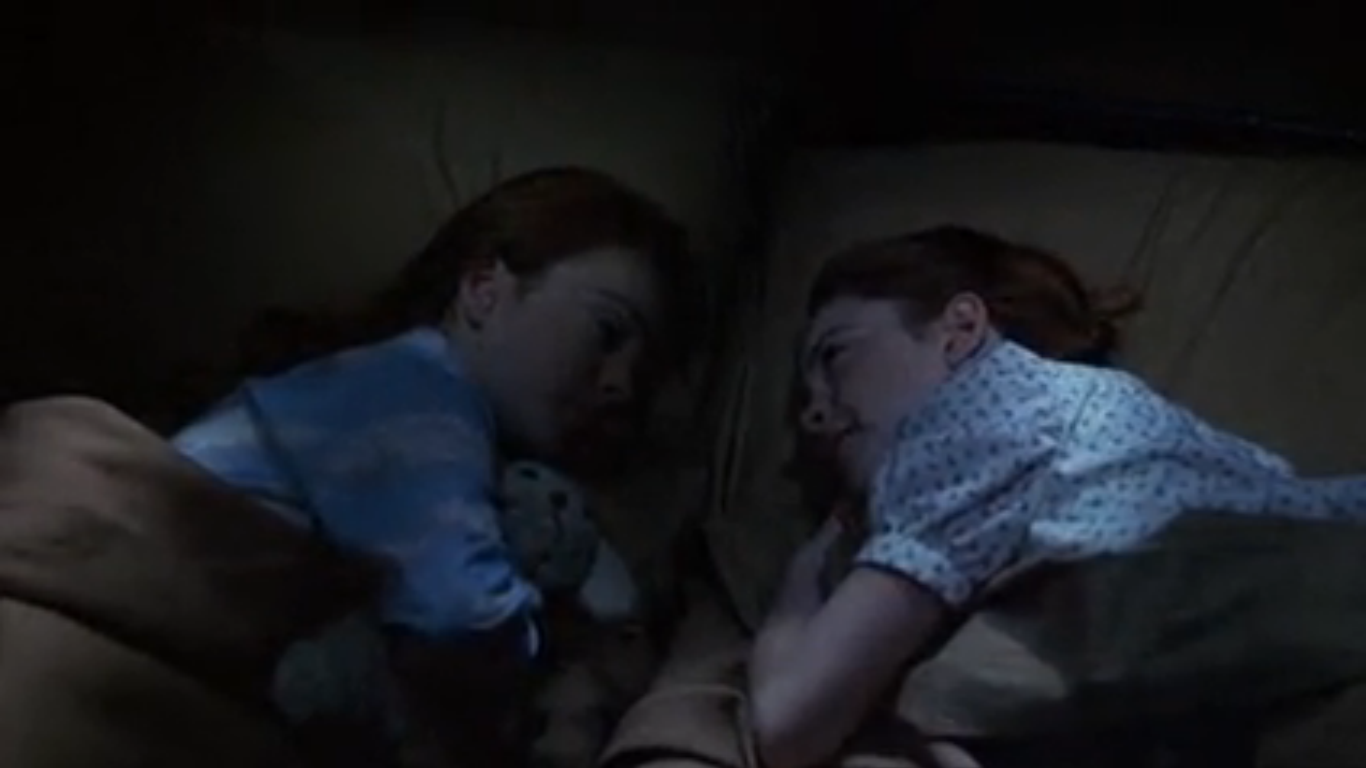
Annie and Hallie develop a similar mindset and plan however in this case it’s to get their long lost parents back together.


Screenshot 2017-04-20 at 9.43.19 PM.png

( The Parent Trap, 28:48)

In The Parent Trap, after Annie and Hallie discover that they’re twins, Hallie suggest switching places so they can experience the parent they never had. They soon realize that even with this plan, they’d eventually have to go back to their original parent and once again be separated. Because of this, Annie goes on to explain that this will also force their parents to come together after 11 years apart, and they’ll fall in love with one another. They spend the remainder of the film with their primary goal of getting their parents, Nick and Liz, to fall back in love and get remarried. The girls are faced with the obstacle of Meredith Blake, Nick’s fiancee, similarly as Baptista has the obstacle of Katherine’s raging temper which makes her undesirable. Baptista does have more power, wealth, and ability to attract someone to Katherine despite her bad reputation. Annie and Hallie go an unconventional route. There are equal in that both Annie, Hallie, and Baptista create an exact plan to get others to marry without receiving input for those they are trying to wed.

“ Then tell me, if I get your daughter’s love, What dowry shall I have with her to wife. (Baptista) After my death, the one half of my lands, And, in possession, twenty thousand crowns. (Petruchio) Let specialties be therefore drawn between us, That covenants may be kept on either hand.”

(Act 2. Scene 1, 126-134)

In this quote, Baptista is arranging for Katherine to marry Petruchio. The two men discuss the dowry that shall be given if the marriage does go forth. They go on to agree that if one dies before the other, they inherit whatever Katherine has inherited. Instead of giving his eldest daughter to someone who she has developed an actual relationship with, Baptista has done what resembles a business transaction in order to have Katherine married off. After figuring out the logistics and inheritance, Baptista is willing to let Katherine go, despite Katherine having no knowledge of their conversation or Petruchio to be her soon to be husband. Further in the book, Petruchio marries Katherine by force as she initially crys at the idea of being his wife. However at this time, Katherine could not do much about her circumstances, as dealings such as marriage were left to the father to decide.

Despite their plan seemed foolproof, Annie and Hallie were met with the obstacle of Nick’s fiancee who could make it so that Nick and Liz never have a chance to fall in love again.

mb.jpg

( The Parent Trap, 1:52:31)

When Annie pretending to be Hallie returns from camp, she quickly discovers that her father is engaged to the young, beautiful, and manipulative Meredith Blake. Annie realizing the danger that Meredith poses to their plan and to Hallie when she returns from London, launches a plan to get Meredith and Nick to separate. In a later scene after all of the characters have gathered in California Annie, Hallie, Nick, and Meredith go on a camping trip where the girls pranks Meredith several times with the intent on breaking her. It proves successful when Meredith tells Nick, “The day we get married is the day I ship those brats off to Switzerland, get the picture? It’s me or them. Take your pick.” Nick ultimately chooses them therefore ending his engagement to Meredith which gives him the opportunity to get back with Liz which does happen at the end of the movie. Similarly to Baptista, Annie and Hallie develop a method of getting their family member to marry a specific person, and while Nick and Liz weren’t obligated to marriage like Katherine, they were still susceptible to the girls influence which caused them to get back together.

The Parent Trap and Taming of the Shrew are two fictional tales from different time periods with varying plots, but one theme that can be taken from both sources is that the idea family influence in relationship is a standard or accepted action. This may not be relevant for every single family, but it does reflect a common idea that many people have come to accept. One could only give the explanation that people trust their family the most, hence valuing their input on relationship most. Whether the idea of parental influence from a wealthy father marrying off his mean spirited daughter, or young twins scheming to get their long separated parents to once again fall in love. It is up to viewers if this idea is successful, beneficial, or an actual thing in the real. In the end, both the movie and play ended with successful relationships.

Works Cited:

Shakespeare, William, G. R. Hibbard, and Margaret Jane Kidnie. The Taming of the Shrew. UK: Penguin , 2015. Print.

The Parent Trap. Dir. Nancy Meyers. Perf. Lindsay Lohan. Walt Disney, 1998.ProjectFreeTv.com. Web. 19 Apr. 2017.


1 Comment

Love's Like A Movie

Posted by Zoe Khan in English 3 · Pahomov · B Band on Sunday, April 23, 2017 at 6:06 pm

Love’s Like A Movie

The Taming of the Shrew / Across The Universe
​


The Taming of the Shrew features two characters, Lucentio and Bianca. Lucentio came to Padua to attend school, but ended up falling in love with Bianca at first sight. He abandoned his duties with school to pursue Bianca, and hope to court her in marriage. Bianca is the second daughter of Baptista, sister to Katherine. She’s many, many suitors available to her, but she’s unable to marry until Katherine is married off first. Across The Universe, a Beatles musical set during the Vietnam War, is focused around the romance of Lucy (Lucy in the Sky With Diamonds) and Jude. (Hey Jude) Jude came to America, from London, in search of his father and work opportunities. He meets Max, Lucy’s brother, at Princeton, and befriends him. He later meets Lucy and, upon falling in love with her at first sight, abandons his original plans in America to pursue her. Lucy is a student whose boyfriend, Daniel, went to war in Vietnam. She meets Jude just before Daniel dies in the war.  Despite Lucy and Jude being in a very different romantic situation than Lucentio and Bianca, both situations stem from love at first sight and the abandonment of the males original goals. The behaviors of people who experience love at first sight are essentially the same, and often come as a distraction.

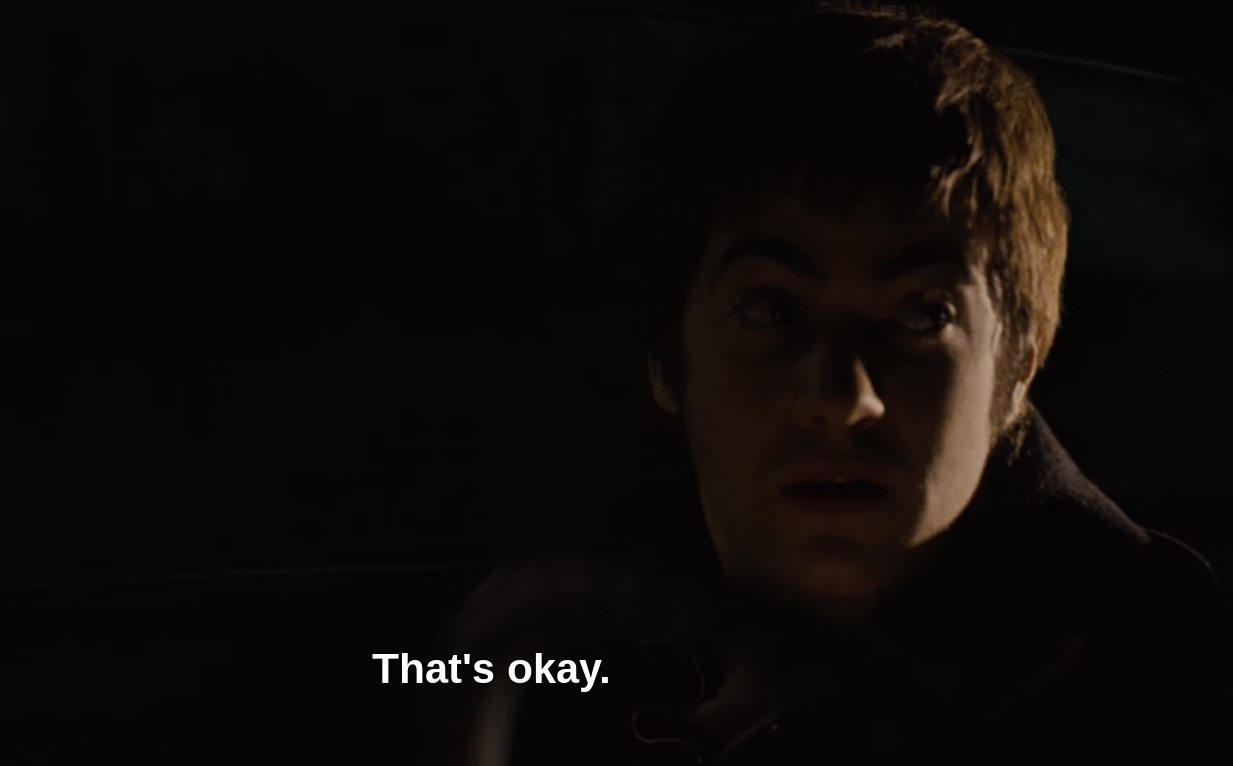
In the I’ve Just Seen A Face scene of Across The Universe, Jude is at a bowling alley with Max and Lucy after spending thanksgiving with their family goes terribly. Jude realises in this moment that he is ‘in love’ with Lucy.  

Screenshot 2017-04-10 at 20.26.26.png

Screenshot 2017-04-10 at 20.26.43.png

He’s had exactly one conversation with Lucy before this scene, and yet has decided he’s in love with her. The song’s lyrics, as well as the way the camera follows Jude as he watches Lucy, tells the audience he truly believes he’s in love with her after such a short time. Love at first sight is a very strong factor in this movie’s plot; the events that follow this realization are entirely driven by Jude’s ‘love’ for Lucy.

In The Taming of The Shrew, Tranio openly questions the possibility of love at first sight when Lucentio falls for Bianca after only seeing how she acts with her father and sister in public.

“I pray, sir, tell me, is it possible

That love should of a sudden take such hold.”

(Lines 148-150, A1S1, Tranio)

This quote seems to be countering all ideals the audience may have about love at first sight. He doesn’t believe it’s truly possible for someone to fall in love so suddenly and have it be a true, real love, like Lucentio, or Jude, swears it is. The reaction to love at first sight is very different for either party, though. Lucentio is questioned, while Jude’s situation goes nearly unnoticed until later on, when it’s only commented on very slightly. While love at first sight itself might’ve not changed, the reactions to it certainly have.

Towards the end of the song, Jude questions staying in the town to be around Lucy. (the location of Lucy and Max’s family is never determined)

Screenshot 2017-04-10 at 20.29.05.png

He originally came to the city to look for his father, who he found, and look for a new life and work, which he didn’t ever accomplish. When he meets Lucy, he gives up the rest of his mission for his love for her.

Lucentio experiences something nearly identical to Jude; he came to a city to attend school, but abandoned it after falling in love with Bianca. In this scene, he decides he’s going to solely pursue Bianca, and ignores attending school entirely for it.

“Tranio, I burn, I pine! I perish, Tranio

If I achieve not this young modest girl.”

(Lines 157-158, A1S1, Lucentio)

Love at first sight often comes with the abandonment of conflicting goals, as seen in Across The Universe, and The Taming of The Shrew. The love at first sight comes as a distraction from their original mission, or goals, that the love interrupts. Had Lucentio not seen Bianca, he would’ve gone to school like his father wished. Had Jude not met Max or Lucy, he would’ve either returned home to his mother or found work in America. However, both parties ended up generally well off in the end. (sans Jude and Lucy’s fallout around midway point for drama.) Love at first sight, despite being a distraction, can work out in the end.

Directly after the bowling alley scene, Max warns Jude of the existence of Daniel, Lucy’s boyfriend in the war. Jude is practically unfazed by this, and jokes about the fact he technically has a girlfriend, too.  Screenshot 2017-04-21 at 00.18.43.png

Screenshot 2017-04-21 at 00.19.21.png

Love at first sight also tends to come with obstacles, and the way they’re approached seems to have an impact on the turnout of the love in the end.

The Taming of The Shrew offers the obstacle of Baptista’s rule on how his daughters shall be wed;

“That is, not to bestow my youngest daughter

Before I have a husband for the elder.”

(Lines 50-51, A1S1, Baptista)

Lucentio goes into this challenge with a mindset extremely similar to that of Jude’s about Daniel. That’s okay. He acknowledges the barrier, and vows to find ways around it. He ends up enacting a huge, elaborate plan to get to Bianca, and succeeds. Jude chooses to ignore Daniel’s existence, and Daniel ends up dying in the war not long after. The audience expects the relationships to work out in the end because of how determined and unbothered the males were upon finding out about obstacles related to their love.

In a real life situation, Bianca, upon finding out Lucentio was lying to her, wouldn’t have wed Lucentio. Just the same, Lucy, after the fallout with Jude being too controlling and nearly abusive at times, would not have done anything she could to find him again. It’s the expectation of happily ever after in love at first sight situations that drive movies to make conclusions in this way. It’s the audience’s idea that a male being unfazed by obstacles in love, like another boyfriend or a controlling father, will make the love stronger. The reactions to love at first sight have changed over the last century in the way that people have stopped questioning it’s authenticity, especially in plays or movies. Love at first sight is, and has always been, seen as an ideal, happily ever after situation.
Be the first to comment.

Expecting the Expected

Posted by Elizabeth Burrows in English 3 · Pahomov · B Band on Sunday, April 23, 2017 at 2:32 pm


Comparing the book “Taming of the Shrew” to the film “Bridesmaids”

Romance has been around for decades, and similar patterns seem to be clear by comparing the book, “Taming of the Shrew” from the 1500’s, to a fairly recent romantic comedy, “Bridesmaids” from 2011. Both examples have similar relationships, were in Taming of the Shrew Petruchio a bold and masculine character pursues to marry the infamously difficult Katherine, likewise, where the main character Annie is seen as difficult and complicated, where she can’t manage to handle a relationship with genuine and kind officer Rhodes. In a relationship, in both the book and the movie demonstrate how clashing expectations often cause another partner to change accordingly or to be changed so that a relationship might work. Although, in the movie and the book, Petruchio and Rhodes take on different tactics to effectively fix their significant other to have the ideal relationship.


“What, will you not suffer me? Nay, now I see

She is your treasure, she must have a husband,

I must dance barefoot on her wedding day

And, for your love to her, lead apes in hell.

Talk not to me. I will go sit and weep

Will I can find occasion of revenge.”

(Act 2, Scene 1, 34-77)


At the beginning of his scene of this scene, Katherine and her sister Bianca bickering about marriage. Katherine, being the older sister is frustrated by the fact that no man expresses interest in marriage unless it is with her younger sister. She is also often being overlooked by her father, where he only has his best interest for Bianca. Many suitors only are drawn to Bianca because of her endearing personality that many of them find very attractive opposed to Katherine who is very unpleasant at the beginning of the play. Katherine quickly becomes frustrated and expresses her feelings. She makes it clear that she is well aware that Bianca is the prefered daughter and that she is upset that she has not found someone to marry unlike her sister. With that said, this shows the audience the character Katherine , unwanted because of her unlikely character, yet she is annoyed by the fact she has no one to marry. This sets the stage for the initial change of Katherine, how she starts off as a bitter unwanted person, but because of the expectation she has to marry someone, and the expectation Petruchio has for her, it alters who she is as a person.


Similarly, Annie, the main character from the movie “Bridesmaids”, is also a conflicting character.


Screen Shot 2017-04-21 at 8.41.32 AM.png

(2:30)


Likewise to Katherine, she has her various problems which seems to make an impact in her relationships. In the first scene of the movie, Annie is introduced by having sex with a go-to hookup Ted, in which he has no interest in pursuing  a real relationship with her. Ted and Annie are lying in bed where Annie starts to bring up the conversation of what their status is, making it clear to the audience she has different motives than he does, where he quickly says, “I don’t want to make promises I can’t keep.”, which refers to a relationship. After that Annie quickly agrees, lying about the fact that she does indeed want a relationship. Annie has an expectation for a relationship that Ted clearly can’t make, so she simply changes herself and what she wants to accomodate the relationship for Ted so that it will continue.


“And woo her with some spirit when she comes!

Say that she rail, why then I’ll tell her plain

She sings sweetly as a nightingale.

Say that she frown, I’ll say she looks as clear As morning roses newly washed with dew.

Say she be mute and will not speak a word,

Then I’ll commend her volubility

And say she uttereth piercing eloquence.

If she do bid me pack, I’ll give her thanks

As though she bid me stay by her a week.

If she deny to wed, I’ll crave the day

When I shall ask the banns, and when be married.

But here she comes - and now, Petruchio, speak.”

(Act 2, Scene 1 , 177-180)


Here in this part of the scene, Petruchio reveals that he plans on marrying Katherine, and in order to do so, uses various tactics to pursue her. Petruchio explains that he will try to change her bad habits by complementing or flaws or choices of action that she uses to push people away. With these tactics he uses, they are manipulating and almost aggressive to forcefully change Katharine into the wife he expects her to be.


Unlike Petruchio, Rhodes uses more nurturing tactics on Annie to more so change her rather than force her to be someone else.

Instead of playing mind games with Annie, he forces her to face her past where he believes is the root problem, where in this scene he lays out baking materials to help her connect with something that was once important to her. Rhodes hopes that by having Annie work through her problems, she will be able to fulfil the ideal girlfriend that he has in mind. Both Rhodes and Petruchio seek a relationship, but in order for that to work they have expectations that need to be met.

Screen Shot 2017-04-21 at 8.44.18 AM.png

(1:08:45)


“I am ashamed that women are so simple

To offer was where they should kneel for peace,

Or seek for rule, supremacy, and sway

When they are bound to serve, love, and obey.”

(Act 5, Scene 2 , 177-180)


In the final scene of the play, Katherine gives her infamous speech of how women should not resist, but simply obey their husbands and give them nothing but respect. By this point in the play, Katherine has transformed into a new person after the countless mind games and tactics Petruchio used to change her into a more ladylike wife. As Katherine says in the quote, she explains how she is ashamed of women who would seek rule or supremacy, which was almost the type of person she was before. This shows how Petruchio changed Katherine to accommodate the expectation he has for a wife, while Katherine changes herself, practically criticizing the type of person she was before. In the end, Petruchio successfully chnages his significant other to have an ideal relationship for himself.


Lucky for Rhodes, he ends up with Annie like Petruchio does with Katherine.

Screen Shot 2017-04-23 at 1.11.37 PM.png

(1:55:18)


In the last scene of the movie “Bridesmaids”, Rhodes surprises Annie at a wedding she was attending, after she had worked through her problems like he thought he would. Unlike Petruchio, Rhodes had hoped that by giving Annie the space she needed, and allowing her to figure out the issues she had on her own after he tried to help her, he ends up being able to have the relationship he initially wanted. Annie knew Rhodes expected her to change for the better so that she could be with him, in the right circumstances, and that’s exactly what she does.


In all relationships, from hundreds of years ago to know, still seem to have the same sort so expectation. In both the book, “Taming of the Shrew” and “Bridesmaids” they reveal that expectations in relationships need to be fulfilled in order for them to work. Both Petruchio and Rhodes pursued difficult characters to begin with, and in order for them to have the relationship they desered, they both had tactics on changing their partner to make it work. In respect to the time period, Petruchio used a much more abusive way to change Katherine, in which he plays mind games with her, and almost brainwashes her into hating who she once was. On the other hand though, this highlights how modern times have changed the types of expectations and respect there are in relationships. Rhodes, like Petruchio, needed Annie to change, but instead of using abusive tactics, he nurtures her to face her past and fix her problems on her own. In the end both of these relationship portrays that in relationships, in order for them to work, someone will have to change for the other person, traditionally a woman for a man.  


Work Cited

Shakespeare, William, G. R. Hibbard, and Margaret Jane Kidnie. The Taming of the Shrew. UK: Penguin, 2015. Print.

Bridesmaids. Perf. Paul Feig. YouTube. N.p., n.d. Web.


4 Comments

Love, Lies, and Coincidentally, Italy

Posted by Harrison Wellner in English 3 · Pahomov · B Band on Saturday, April 22, 2017 at 12:11 pm

Love, Lies, and Coincidentally, Italy

The Taming of the Shrew and Roman Holiday


From Padua to Rome, love always lies. That much, William Shakespeare and Dalton Trumbo are certain to agree on. Shakespeare’s play, “The Taming of the Shrew” and Trumbo’s 1953 film, “Roman Holiday” are evidence enough of that. The Taming of the Shrew, a victorian drama following the strange romantic mishaps between a love-polygon of unknown sides and the unlikely marriage of an overly-confident, moderately misogynist man to the titled "Shrew" of a woman, lends us its message through a number of characters. The first are Bianca and her many suitors, although most importantly the rich Lucentio who disguises himself as a teacher to reach his object of affection. The others, of course, are the aforementioned unlikely couple, Petruchio and Katherine, the former of whom decides to pursue marriage with the ladder because he really just wants a wife with money.


Roman Holiday, on the other hand, follows a mid-twentieth century princess from an undisclosed country, Ann, as she flees her overwhelming responsibilities for a day to fraternize with an American journalist in Rome. She lies to him about who she is, which he already knows, and he lies about who he is. Outside of the coincidental fact that both tales take place in Italy, the two stories share a striking similarity when it comes to how honesty, and more importantly, deception, play into romantic relationships built to last. As long as in the end, according to these narratives, the two parties fall in love, then the end justifies the means. Although one takes place 400 years in the past, and the other in the nearly modern day, the two pieces make it evident that lying and deceiving can be an acceptable course of action in a romantic relationship.


“I am Lucentio- 'hic est' son unto Vincentio of Pisa- 'Sigeia tellus' disguised thus to get your love- 'Hic steterat' and that Lucentio that comes a-wooing- 'Priami' is my man Tranio- 'regia' bearing my port- 'celsa senis' that we might beguile the old pantaloon.”

(Act III, Scene I, 33-38)


Lucentio, in his bid for Bianca’s love, disguises himself as a philosophy teacher, and sneaks his way into her daily life. In the quote above, Lucentio explains this ploy to Bianca, and how Tranio was disguised as himself in order to deceive Gremio, one of her other suitors. Though he readily admits the truth to Bianca, he still initially lies to her, and, as shown in the quote, he wants no one else to find out. For this reason, he is pretending to construe a Latin phrase, so that no one may hear them.

The leads of Roman Holiday find themselves in a somewhat different type of situation, with a different kind of lying, yet one that is no less deceitful.

(Roman Holiday, 1:03:50)

Midway through the film, the two star roles run into each other in the city after having gone their separate ways. In their conversation, both Princess Ann and Joe Bradley lie to one another about their current lives. Princess Ann claims to have run away from school, rather than her royal duties, and Bradley claims to be in the selling game. Bradley, of course, knows she’s the princess, but Ann (or Anya, as she tells him to call her), does not. Not only that, but their “accidental” encounter wasn’t nearly as accidental as Ann believed, considering how the American Reporter had followed her in secret. This is the interaction that truly sets their relationship into motion, and it’s one that’s founded entirely on lies.


“For patience she will  prove a second Grissel, and Roman Lucrece for her chastity. And to conclude, we have ‘greed so well together that upon Sunday is the wedding day.”

(Act II, Scene I, Lines 312-315)


Upon his first meeting of the titled “Shrew” of the play, Katharine, Petruchio starts his plan to “tame” the woman into marriage, and into becoming what he believes to be a proper wife. After his first private conversation with her, in which he makes little headway towards his plan and invokes nothing more than hatred from the young woman, her father, Baptista, along with several other men, enter the room. Petruchio, in what is likely the most bold faced lie one could possibly make under the circumstances, tells them that Katharine has fallen for him madly, and the two are to be wed on Sunday. Baptista, trusting this strange man’s words above his own objecting daughter’s, agrees to let the marriage happen. In this scene, Petruchio makes it clear to the audience that he is willing to weave the most dauntlessly false tales to anyone in order to marry his beloved Kate. He may not have been lying to Katharine herself, but he was forging the entirety of their coming relationship on a foundation of lies, and because she ends up loving him in the finale, it passes without issue. Of course, because the ends justify the means.


On the other side of the same coin, the main pair of Roman Holiday find themselves not only forming their relationship upon a fountain of deceit, but also ending it bathing in that same fountain.


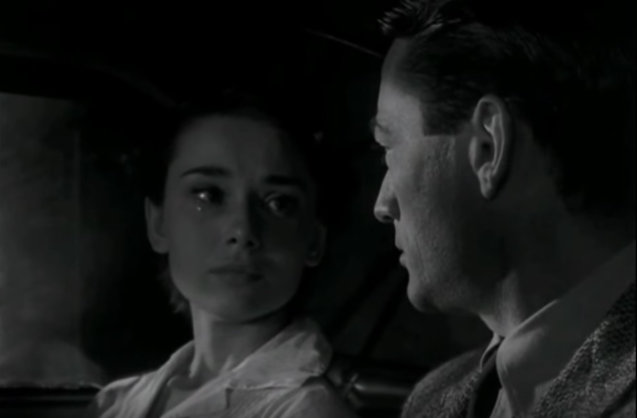
“I have to leave you now. I'm going to that corner there and turn. You must stay in the car and drive away. Promise not to watch me go beyond the corner. Just drive away and leave me as I leave you.”

(Ann, 1:37:28)


(Roman Holiday, 1:37:28)

Before the very end of the film, the two lead characters find themselves at the end of their time together. Princess Ann must return to her royal duties, and so she asks Mr. Bradley to drive her and drop her off. Before their last loving embrace, in which they kiss for the very first time, she tells him the quote listed above. She knows that she has to leave, and yet she still can’t bring her to tell him the truth of the matter. They both know she’s lying, and yet still the two come together for a kiss and a show of love before their final goodbye. Even right until the very end, the lies still flow through the veins of their relationship. But still, they are in love. And if they are so in love, any lies they told to one another no longer matter. The deceit can be excused. While they may not have entered with the intentions of falling for one another, they found themselves tumbling regardless. Once again, the ends justify the means, and the intentions aren’t even needed.


If one thing can be learned from these two pieces, it’s that love and deceit are almost always intertwined. Italy may be a coincidence, but those two features most certainly aren’t. And, according to these creators, love makes the deceit worth it. It’s a common sentiment, in these days, that love wins above all. So why would simple lies be made the exception? Whether it be a princess and a reporter, or a brash man and a wealthy shrew, lies may come about, and as long as the love survives it, there is reason enough to ignore it. At the very least, William Shakespeare and Dalton Trumbo would say so.


Work Cited

  • Shakespeare, William. The Taming of the Shrew. Ed. Barbara A. Mowat and Paul Werstine. Washington, D.C.: Folger Shakespeare Library, n.d. Print.

  • Roman Holiday. By Dalton Trumbo. Dir. William Wyler. Prod. Paramount Pictures. Perf. Audrey Hepburn, Gregory Peck. N.p., n.d. Web.
1 Comment

James Charles

Posted by Elani Gonzalez-Ortiz in English 3 · Pahomov · B Band on Wednesday, March 8, 2017 at 9:00 am

5 Comments

Kendrick Lamar and Social Philosophies (Mohamed, Luke, Luis, Nick)

Posted by Mohamed Bah in English 3 · Pahomov · B Band on Wednesday, March 8, 2017 at 8:43 am

Kendrick Lamar and Social Philosophies from Mohamed Bah on Vimeo.

3 Comments

Fifty Shades of Grey Marxist & Feminist Analysis (Hadleigh, Kay, Lotus, Sopheary)

Posted by Hadleigh Stammers in English 3 · Pahomov · B Band on Wednesday, March 8, 2017 at 6:33 am

5 Comments

Kali, TK, Jevon, Ryan

Posted by Tigidankay Saccoh in English 3 · Pahomov · B Band on Wednesday, March 8, 2017 at 6:08 am

https://www.youtube.com/watch?v=4fJi6r9wi7k&feature=youtu.be
Be the first to comment.

White Chicks

Posted by Elizabeth Burrows in English 3 · Pahomov · B Band on Tuesday, March 7, 2017 at 10:39 pm

6 Comments

Mean Girls: Literary Lens Analysis

Posted by J'Lynn Matthews in English 3 · Pahomov · B Band on Tuesday, March 7, 2017 at 9:04 pm

7 Comments
155 posts:
← Prev
  1. 1
  2. 2
  3. 3
  4. 4
  5. 5
  6. 6
  7. 7
  8. 8
  9. 9
  10. 10
  11. 11
  12. 12
  13. 13
  14. 14
  15. 15
  16. 16
Next →
RSS

ENG3-024

Term
2016-17

Other Websites

Launch Canvas

Blog Tags

  • alec baldwin 1

Teacher

  • Larissa Pahomov
Slate (skeleton-v3 PHP 8 prototype) · Location: 1482 Green St · Shipping: 550 N. Broad St Suite 202 · Philadelphia, PA 19130 · (215) 400-7830 (phone)
×

Log In