• Log In
  • Log In
Slate (skeleton-v3 PHP 8 prototype)
Slate (skeleton-v3 PHP 8 prototype) Learn · Create · Lead
  • Students
    • Mission and Vision
  • Parents
  • Community
    • Mission and Vision
  • Calendar

English 3 - Pahomov - C Public Feed

Create a Post

Time to Make Your Own Life Choices

Posted by Jesse Shuter in English 3 - Pahomov - C on Sunday, April 19, 2015 at 10:13 pm

Time to Make Your Own Life Choices

A Comparison between the Taming of the Shrew and Coming to America

Social justice is a thing that most people strive for. This includes everything from equal rights among different races to equal rights among different genders. The Taming of the Shrew by William Shakespeare is the story of two different couples going down very different paths to find love. One man needs to fight other men off to win his future bride, while another has to fight his own bride off to earn her respect and adoration. It was written during and about a time where men were thought of and treated as superior beings to women. Since then, times have evolved and so have love stories. Coming to America (1988) is a story of a prince fighting tradition and attempting to find a mate who loves him for who he is on the inside. It is a story of love, deception and comedy. It also displays a strong female lead who knows what she wants and isn’t going to let her father stop her from getting it. Women no longer feel like they need men to be their whole world. This is evident by examples such as those present in the movie Coming to America. Many traditions that used to exist are no longer valid. Even men have more say in their relationships as the parents have a smaller role than ever before. As shown by the differences between Coming to America and Taming of the Shrew, over time, women’s and men’s control over their own lives have become more equal.

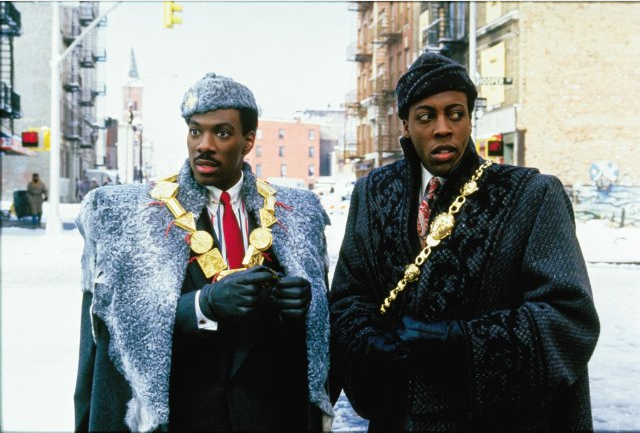
The main character in Coming to America is Prince Akeem, played by Eddie Murphy. As the movie opens, Prince Akeem is about to be married to a woman he has never met and is very distraught about the situation. Instead of following tradition and marrying this woman, he decides to take his friend and servant Semmi to America where he can find and earn his bride. However, he believes that any woman that knows who he is will act insincere because of his fortune.Screen Shot 2015-04-16 at 8.33.03 AM.png


In this early scene from the movie, Akeem and Semmi arrive in the “strange” land of America and realize immediately that they do not fit in. Akeem wants people to see him as a regular person and knows that his current attire is not the way to do it. He decides to put on a charade where acts as a poor person so that the person he falls in love with will love him for who he is. It is for this reason that I compare Prince Akeem to Lucentio from The Taming of the Shrew. Both are trying to earn their way into their future brides’ hearts by acting as commoners. This shows how traditions have evolved, giving kids more power in their own lives. Prince Akeem showed how times have changed by finding his own bride in the dating world. Lucentio, despite putting on this game, still had to have his servant interact with Baptista, the father of the girl he wants to marry, as at that time, the father played an unbelievably large role in the marriage process.

The girl that Prince Akeem will eventually find and fall in love with is Lisa McDowell. Lisa is the character with the most wide-ranging personality in the movie. When she first meets Akeem, she is romantically involved with another man named Darryl Jenks. Darryl is a rich man, but he is insensitive, slightly abusive and an all around obnoxious person.mQBp1ornAh4y6MaP9dyceXQTJ4I.jpg


In this scene Darryl is trying to charm his way into Lisa’s life. I would compare Darryl to the character Petruchio from The Taming of the Shrew. Both characters are very wealthy and use this wealth to try and control their mates. Another big similarity is that both characters feel the need to lock down their girlfriends or companions because of their beauty and wealth. However, at this time, both of their counterparts do not want marriage, so Petruchio and Darryl each lied to the respective fathers saying that they and their girlfriends agreed to get married. They both say this without their girlfriends’ (Katherine and Lisa, respectively) consent, but each is met with a much different result.

In the Taming of the Shrew Petruchio announces that he and Katherine have agreed to be married to which she responds with a lot of anger and sadness.

“Petruchio: ...And to conclude, we have ‘greed so well together that upon Sunday is the wedding day.

Katherine: I’ll see thee hanged on Sunday first.” (Act 2, Scene 1, Lines 314-316)

Despite Katherine’s obvious and severe protests to this potential marriage, no one seems to care. This is mainly because she is a woman at a time where they received little to no respect. Meanwhile, in Coming to America, Darryl announces the same thing about Lisa. At first Lisa is so upset that she storms out of the room, but when she talks to Darryl next she tells him off and breaks up with him saying that they will never be married. Her father supports the potential marriage because of what Darryl has to offer as a caretaker but Lisa does not care. This shows a huge evolution of the female character in a relationship. They have evolved from people that gets no say in their own lives and are forced to stay with whatever men will have them because they cannot provide for themselves, into real people with real rights who can take care of themselves.

Another aspect of relationships that has drastically changed is dating. As evident by the sudden marriage of Petruchio and Katherine, back then, as long as the father was on board, the woman got no say. There was little courtship of the woman, and a great deal courtship toward the father. In The Taming of The Shrew this very tradition occurs, or so Katherine is meant to believe. Despite the fact that it is not true, Petruchio tells Kate that her father agreed to marriage between them and there is nothing she can do about it. While cruel, this was not only possible, but common during this time period.


Petruchio: “Thus in plain terms: your father hath consented that you shall be my wife, your dowry ‘greed on, and will you, nill you, I will marry you. Now Kate, I am a husband for your turn...Here comes your father. Never make denial. I must and will have Katherine to my wife”. (Act 2, Scene 1, Lines 284–295)


In Coming to America the father figure is Cleo McDowell, an upper middle class restaurant owner and father of two daughters. Throughout the movie McDowell is trying to ensure that his eldest daughter, Lisa, not only ends up with the right man, but also ends up with a wealthy man so that he won’t have to worry about her future. It is for this reason that he pushes Darryl on her, and reject Akeem as a potential suitor (until he finds out he is a prince).


Coming-to-America-em18.jpg

In this scene Akeem is shown working at Cleo McDowell’s restaurant as a common janitor. It is for this reason that McDowell rejects him as a suitor, he wants Lisa to have someone who can take care of her and doesn’t care about how she actually feels. This is quite similar to The Taming of The Shrew where the father figure, Baptista, is trying to find the right man for his desirable daughter (Bianca) and any man for his shrewish daughter (Katherine). Baptista talks with suitors seeing who can offer the most to his daughter Bianca, not caring at all for her happiness, and wants to make sure she has a rich husband to provide for her. Here Baptista explains his rules about selling off his daughters, he wants to unload his less desirable daughter before the bidding for his very desirable daughter can begin.

Baptista: Gentlemen, importune me no farther, for how I firmly am resolved you know— that is, not to bestow my youngest daughter before I have a husband for the elder. If either of you both love Katherina, because I know you well and love you well leave shall you have to court her at your pleasure. (Act 1, Scene 1, Lines 48-54)

The two fathers are very similar in both their tactics and their desires for their daughters. The key difference between the two stories is the result. Because of the social convention at the time, Baptista is completely allowed to sell of his daughters like cattle and they would have to do what he says. Meanwhile, during the time of Coming to America McDowell can push whoever he wants to push on Lisa, but she doesn’t need to rely on a man the way that she would have had to in a different time period. She is free to choose whoever she wants, and even be alone if she so chooses.

Tradition has changed quite drastically as time has went on. Coming to America and The Taming of The Shrew are examples of two love stories with the same basic types of characters, goals, and plot lines and yet they are two stories with such different outcomes. Civil rights have made such a huge difference on the way that people act and think in the 21st century. Thankfully women’s and men’s control over their own lives have become more equal.


Works Cited

Coming to America. Dir. John Landis. Perf. Eddie Murphy, Arsenio Hall, Shari Headley and James Earl Jones. Paramount Pictures, 1988. Online Movie.

Shakespeare, William. The Taming of the Shew. New York: Penguin, 1977. Print.


Be the first to comment.

This is Why You can't Have Nice Things

Posted by Heaven Mendez in English 3 - Pahomov - C on Sunday, April 19, 2015 at 9:43 pm

This is Why You can’t Have Nice Things

Comparing relationship expectations between ‘Taming of the Shrew,’ and ‘Not Cool.’


The idea of a solid guideline within relationships has been around for quite sometime, justified by Shakespeare’s ‘Taming of the Shrew.’ Petruchio, an eccentric, exceptionally motivated suitor, seeks to win the affection, (or not,) of Katherine, regardless of what she wants. While this is far from the case today, in the 2014 release, Not Cool, the roles are almost completely switched. the main character, Tori, decides that she can ‘fix,’ her old classmate, Scott,  that made high school a hellish experience for her, only to learn that she has feelings for him.


At a glance, Petruchio and Tori almost have very different motives. Petruchio uses much harsher methods, including starving his own fiancee, in order to have her submit to him. while  Tori, unwilling to forgo the cold demeanor she’d built up for so long, uses more subtle methods  disguised as simple gestures of friendship in order to get what she wants. Despite this, her efforts almost always result in the same thing, her attempt to deny any kind of feeling toward Scott, before because of his lack of change, when in reality, it’s because of her refusal of letting someone else hurt her again. This portrays the constant fear that past relationships will often haunt someone, which forces one to become  against love, perceiving the notion that one is ultimately unlovable, even when it is far from the case.


Be patient, gentlemen. I choose her for myself.

If she and I be pleased, what’s that to you?

'Tis bargained ’twixt us twain, being alone,

That she shall still be curst in company.

I tell you, ’tis incredible to believe

How much she loves me. O, the kindest Kate!

She hung about my neck, and kiss on kiss

She vied so fast, protesting oath on oath,

That in a twink she won me to her love.

O, you are novices! 'Tis a world to see,

How tame, when men and women are alone,

A meacock wretch can make the curstest shrew.

(Act II, Scene I, Line 1153 Petruchio)


Petruchio describes the fact that regardless of how Katherine thinks, he will some how manage to ‘tame,’ her, by ensuring she does exactly what he says, has a certain attitude, and ultimately becomes his own pawn. He implies that marrying her, or otherwise keeping her completely under his control will help shape her into another person, giving the audience the idea that she is essentially unable to find someone else that would love her, without proper guidance.


Tori’s take on this approach is almost entirely different, with varying results as she goes.


After confronting Scott one night at a party, and having an encounter while Black Friday shopping, Tori decides to see if she can challenge the previous connotations of Scott’s attitude, and essentially have him gradually change his ways. Hence the introduction of the bucket list with a twist. The list contains different activities that generally hold major consequences, however the entire point, as speculated by Scott, is to loosen up.  It is later revealed, however,  that Tori’s initial intent from the start was to change Scott, in order to be exactly like she was. This gives insight on Tori’s past, which to an extent was ostracized by the fact that most had negative outlooks on her, which caused her to look down at the rest of the world, specifically Scott. These ideas, despite being so small, are a much bigger problem, because they give Tori justification that she is, in fact, vulnerable, and to an extent, unlovable.   This carries out through the movie, and through realizations and actions of her own doing, her mentality is challenged, showing her overall that she in fact, had nothing to hold a tough front over.


Why came I hither but to that intent?

Think you a little din can daunt mine ears?

Have I not in my time heard lions roar?

Have I not heard the sea puff'd up with winds

Rage like an angry boar chafed with sweat?

Have I not heard great ordnance in the field,

And heaven's artillery thunder in the skies?

Have I not in a pitched battle heard

Loud 'larums, neighing steeds, and trumpets' clang?

And do you tell me of a woman's tongue,

That gives not half so great a blow to hear

As will a chestnut in a farmer's fire?

Tush, tush! fear boys with bugs.

(Petruchio Act I, Scene II Line 16)


Petruchio, in one of his many speeches, declares in part, that if a man cannot control his wife, he is more often than not, effeminate, and therefore loses a strong sense of masculinity because of it. The problem with this kind of thinking, is the fact that it leads to a much more destructive mindset when it comes to relationships. These ideas can branch off from extreme moments of insecurity, specifically when feeling as if the opposing gender is better to some degree. By holding what Petruchio considers, ‘masculinity,’ by controlling his soon to be wife, Katherine, he gives himself some form of gratitude that he is far superior to her, because of his gender.


In the movie, this exact mindset is shared by a secondary main character, Joel, who believes that his gender alone sets him apart from the rest, as he attempts to chase after Janie, Scott’s younger sister.


Throughout the movie, Joel has an arrogant attitude toward both himself, and women in general. He feels as though, much like Petruchio, gender alone is a means of strength. This alone gives him a false sense of entitlement, which fuels his attraction toward Janie, motivating him to go to the extremes in order to impress her. While he does, in the end realize his mistakes, the vast majority of the movie is Joel taking pretty immense risks in order to captivate a girl that barely has any connection toward him, for his own selfish justifications. His attitude in general comes off as an entire facade, generated from a semi narcissistic personality, in order to hide major insecurities.


Women have definitely  taken a much higher stand when it comes toward relationships. They aren't generally going to change themselves for someone else, nor are they going to follow closely in the footsteps of Katherine. In a way, women have almost taken to the role of Petruchio.The main character holds the same attitude as Katherine does. She's blunt completely out there, and at first glance, extremely cold. The problem is though, her motives are very different from that of Katherine's which makes this comparison completely useless.


Unlike Katherine, Tori isn't the one being tamed, she is, however the one attempting to do the taming. She, unlike Katherine, stays true to what she really is, while attempting to change and mold the male main character into her own image. The same goes for Joel, in the sense that manipulating himself, in order to hide a false sense of accomplishment, ‘tames,’ Janie, in order to justify the fact that he is worth something and can be loved.


Sources Cited:


Not Cool. Dir. Shane Dawson. Perf. Shane Dawson and Cherami Leigh. Netflix, 01 Sept. 2014. Web. 19 Apr. 2015.

Crowther, John, ed. “No Fear The Taming of the Shrew.” SparkNotes.com. SparkNotes LLC. 2005. Web. 19 Apr. 2015.
Be the first to comment.

The Tactics of the Shrewd

Posted by Raz Reed in English 3 - Pahomov - C on Sunday, April 19, 2015 at 9:22 pm

The Tactics of the Shrewd

A comparison of The Taming in the Shrew and Amélie

Shakespeare’s The Taming of the Shrew proves that deception has long been a tactic people use to find a romantic partner. Lucentio is the son of a rich man who has traveled to Padua and is determined to gain the love of young, attractive Bianca. He disguises as a tutor, “Cambio,” in order to get closer to Bianca while his servant, Tranio, disguises as him.

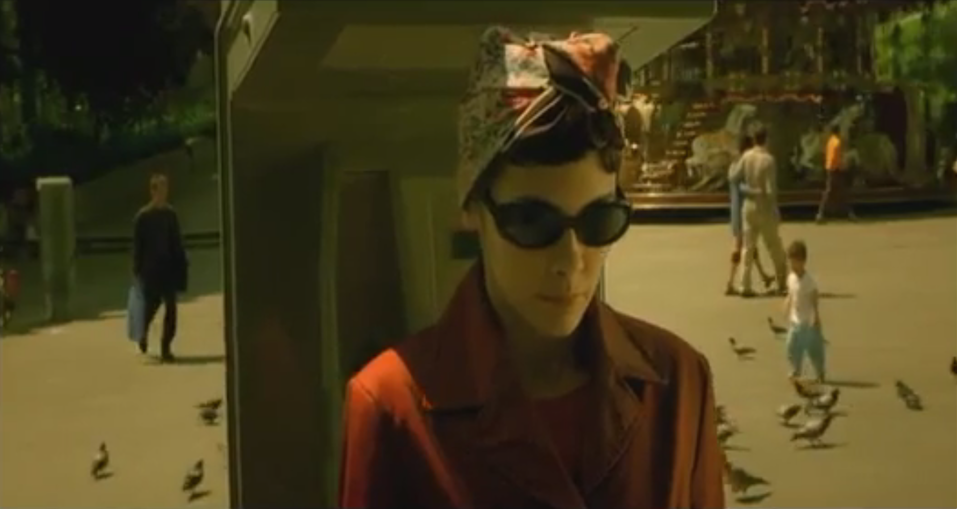
In Jeunet’s Amélie (2001), Amélie is a very shy young woman who falls in love with Nino, a man who collects and reassembles discarded photos from a photo booth. However, she is too shy to meet him, so she plays a cat-and-mouse game with him, leading him to various places all across Paris and dropping hints about her identity.

There’s a similarity between their motivations, but a difference in their tactics. Though the genders are reversed, Lucentio and Amélie have the same goal: to gain the love of their respective sweethearts. But, Lucentio has to work around Bianca’s father Baptista, who has said that Bianca shall not court any men until her older sister has gotten married, whereas the only obstacle Amélie has to overcome is her own reticence. Amélie and The Taming of the Shrew both support the message that a little deception in a relationship can be a beneficial thing.

“LUCENTIO, as CAMBIO

 Now mistress, profit you in what you read?

BIANCA

 What, master, read you? First resolve me that.

LUCENTIO, as CAMBIO

 I read that I profess, The Art of Love.”

(Act IV, Scene ii, Page 153)

In this quote, Lucentio is disguised as Cambio, a tutor, and flirting with Bianca while it appears that he is teaching her from a book. His line, “I read that I profess, The Art of Love” is a not-so-subtle way of telling Bianca that he is in love with her. Lucentio’s use of a disguise to get Bianca is similar to Amélie’s use of clues in order to reveal pieces of her identity to Nino and eventually meet him: they’re both acts of deception. Their tactics are different though, Lucentio is disguised as another person while his servant is disguised as him, whereas Amélie never actually disguises as anyone but keeps her identity clandestine. This also means that Nino and Bianca, despite the gender differences, are similar in one aspect: they are the targets of the protagonist’s affection and deception.

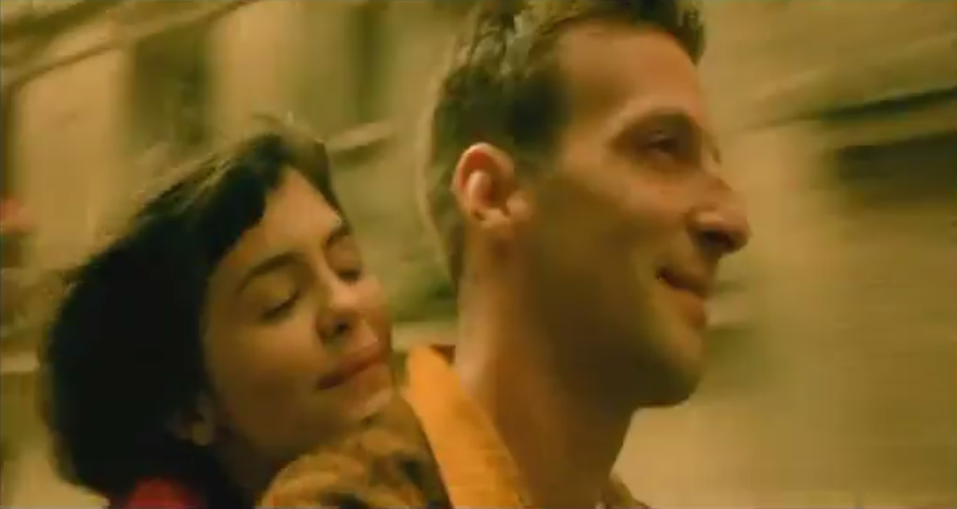
Here’s an example of Amélie’s deception.

In this scene, Amélie (center) leads Nino (left) across a local park with arrows in order to arrive him at his scrapbook which he had lost when it fell off of his motorcycle, all without revealing herself. She avoids communicating with her partner until it is necessary, unlike Lucentio, who disguises as someone else and then reveals himself later.

“Love wrought these miracles. Bianca’s love

Made me exchange my state with Tranio,

While he did bear my countenance in the town,

And happily I have arrived at the last

Unto the wished haven of my bliss.”

(Act V, Scene i, Page 203)

When Lucentio delivers this quote, it is near the end of the play and he has married Bianca. When closely examining Lucentio’s strategy, it’s surprising it worked. There are many things that could have gone wrong during its operation: Bianca might not have immediately fallen in love with Lucentio like she did, or Lucentio could have been found out by Bianca’s father, or Petruchio could have failed to court Katherine which would’ve meant that Bianca couldn’t marry, and so on. So, even though the scenario where Lucentio and Bianca marry isn’t realistic, Shakespeare chose to write it that way.

Amélie has a similarly unrealistic plan. She creates an elaborate path that will eventually lead Nino to her, but there are also many possible complications: she could lose track of him or he could lose track of her, Nino could lose interest, and so on. However, it worked out regardless and they ended up together.

This shows that both Shakespeare and the director of Amélie, Jean-Pierre Jeunet, had the same idea: they wanted to show that a little deception can improve relationships. The characters they created, Lucentio and Amélie, represent this. As both the play and the movie end, we are left with Lucentio and Bianca, Amélie and Nino, two happy couples who wouldn’t have been without a little trickery.

Works Cited:
- Amélie. Dir. Jean-Pierre Jeunet. Perf. Audrey Tautou. 20th Century Fox, 2001.
- Shakespeare, William. The Taming of the Shrew. New Haven: Yale UP, 1954. Print.
Be the first to comment.

Does The Family Affect Relationships?

Posted by Malwina Dymek in English 3 - Pahomov - C on Sunday, April 19, 2015 at 4:46 pm

Comparing "The Taming of the Shrew" to "While You Were Sleeping".

In the play  The Taming of the Shrew, Bianca is controlled by her father Baptista because her older sister needs to get married first in order for Bianca to get married. In the 1995 movie “While You Were Sleeping,” the main character Lucy does not have her family anymore until she saves a man that she fell in love with every time she saw him at the train station. His family believes they are engaged because the nurse at the hospital introduced her as his fiancé. She becomes a part of the family until the truth is revealed that she never met Peter.

          The Taming of the Shrew, has a viewpoint where the father decides who his daughter will marry, which will affect their relationship. The movie, “While You Were Sleeping,” shows a different way on how family acts to relationships, than the family from the “Shrew.” These two texts show that family involvement has changed over time because nowadays people pick who they are going to marry, and back then father or his/her parents decided for them instead.

Baptista:

"Gentlemen, importune me no farther, For how I firmly am resolved you know; That is, not bestow my youngest daughter. Before I have a husband for the elder: If either of you both love Katharina, Because I know you well and love you well, Leave shall you have to court her at your pleasure"

(Act 1, Scene 1, 48-54)

         In the “Shrew” Baptista is the father of Bianca and Katharina. Both of the daughters want to get married although there has to be a certain order of who is going to be first. The eldest, Katherina, has to get married before Bianca. The play shows that the family is affecting the potential engagement of Bianca and a suitor because Baptista is controlling who is going to get married first. Katherina does not have any suitors for her bitter attitude, therefore for Bianca to get married, it seems as though it will be a while because nobody wants to marry a witch.

Similar but not exactly like the play, “While You Were Sleeping” also shows that family has an influence on relationships. Lucy, the main character does not want to deny that she is not going to marry Peter because Peter’s family thinks they are engaged, and in love and doesn’t want to upset the family.

Screen Shot 2015-04-16 at 11.45.24 PM
​

  Lucy does not have her family anymore and she decides who she wants to be with. Every morning she works at the train station where she sees a man named Peter. He takes the train to his work and Lucy fell in love with him right away. She never met him, but in her opinion it was the love at first sight. He was just perfect. When he is pushed on the train tracks by other men, he is not at first aware and Lucy saves his life. When he gets to the hospital the nurse heard Lucy talking to herself about her wanting to marry Peter. When Lucy walked into his room they told her he was in the coma. His family came to the hospital and they did not know who Lucy was, but the nurse introduced her as his fiancé. Peter’s family did not know what was going on, but when they heard from the doctor that Lucy saved his life they were happy and approved of the “engagement” immediately.

         His family became like her family while Peter was in the coma, and they treated her like their daughter. Lucy did not know how to say “no” to being engaged to Peter so she just went along with it. This scenario shows that his family affected their “engagement” because they were inviting her for family gatherings and accepted her because she saved his life without knowing her before.

         This scene is similar to the “Shrew” because it shows how even Peter’s family controls their ‘engagement’ because they accepted Lucy for what she did. The family was so kind that Lucy didn’t want to break their hearts. The only difference between the movie and the play is that Lucy does not have a sister that affects if she has to wait for to get married or not.

Baptista:

"Content you, gentlemen. I will compound this strife. ‘Tis deeds must win the prize, and he of both that can assure my daughter greatest dower shall have my Bianca’s love. Say, Signior Gremio, what can you assure her?"

(Act 2, Scene 1, 361-365)

         Baptista also wants to make sure his daughter in this situation finds someone who is good. He want the best for his kids and in the play, Baptista wants to make sure their daughter will have a good life and not worry about making sure they have things to survive. The play shows that the man should be able to provide for the family. In order for the father to agree on his daughter getting married he needs to make sure the suitor is the right man for her. 

          The movie is a little bit different because the play was written a lot of years ago. The movie was produced in 1995 and shows more of a modern relationship.

Screen Shot 2015-04-16 at 11.48.33 PM

         In the movie Peter’s family really likes Lucy as a person. Peter’s grandfather heard Lucy talking to Peter when he was in the coma that they are not actually engaged, but she tells him how she always saw him taking the train. His grandfather talked to Lucy about it and he said that he understands why she did not say anything. He told her that Peter’s family needs her now and she is a good person. When Peter woke up, his grandpa made him think he does not remember her at all. Lucy talked to him after a while, but while Peter was in the coma Lucy spent a lot of time with Jack, who is Peter’s brother. At the end Jack and Lucy actually got married. 

Screen Shot 2015-04-16 at 11.49.57 PM
       The movie and the play shows that family wants the best for their children, but there are times where they might not make them as happy as they could. In the play the daughters could not be happy if the father picked their husbands because it would not be someone who they love, but at the end they marry who they love. In the society back then parents affected their children’s relationship/courtship. It looks like in the movie people pick whoever they want to marry at the end, but also they do not have to wait for their siblings to get married first.

Work Cited:


Shakespeare, William, Barbara A. Mowat, and Paul Werstine. The Taming of the Shrew. New York: Washington Square, 2002. Print.


While You Were Sleeping. Dir. Jon Turteltaub. Prod. Roger Birnbaum. By Sullivan Daniel G. and Fredric Lebow. Perf. Sandra Bullock, Bill Pullman, and Peter Gallagher. Buena Vista Pictures, 1995.

Be the first to comment.

The Romance of the Shrew and the Submarine

Posted by Lindsey Jones in English 3 - Pahomov - C on Sunday, April 19, 2015 at 12:39 pm

Comparing: 
Submarine (2010)
The Taming of the Shrew​


Romance is a thing that has been molded and reproduced for centuries. Books like the Taming of the Shrew portray romance as a victory and something to be sought after. Petruchio, the leading man, makes it his duty to have the intimidating Katherine as his wife. In the 2010 movie Submarine, shy and observant teenager Oliver wants to do the same thing; seeking the affections of conventionally unattractive girl in order to satisfy his need for romance.

Oliver and Petruchio are alike and different in both motive and character. Their initial idea of wanting to have a relationship are the same, but the way that going after the women they want are almost completely different. Petruchio is a brute and aggressive character who seeks to have Katherine as his wife for his own personal gain. This is very much Oliver’s initial reason for wanting to be with Jordana as well. While the motives are the same, the actions are different, these two situations make room for exploring society’s view on relationships, love, and how they are presented with the opposite sexes. More specifically, that true relationships are built on love, not by manipulation or force, and that women have more control in relationships than they had before.


“Few words suffice. And therefore, if thou know one rich enough to be Petruchio’s wife (as wealth is burde  of my wooing dance...She moves me not, or not removes at least affection’s edge in me, were she as rough as are the swelling Adriatic seas. I  come to wive it wealthily in Padua; If wealthily, then happily in Padua.”

-Petruchio (Act 1. Scene 2. Page 53. Lines 67-77)

During this scene, Petruchio  meets with Hortensio, who brings him with the option to marry Katherine. Petruchio, whom is introduced as a arrogant and violent (moments before he was hitting Gremio), learns that Katherine is wealthy. He then sees her as an opportunity to become even more wealthy despite not loving her. In this quote, he describes how regardless of how terrible she is, that he will pacify her even  into obedience when they marry. None of the other characters in the scene object to this, most likely because men being in charge of relationships was a common thing during the time period.

The main character in Submarine, Oliver Tate, finds himself with a similar mindset when he is introduced to his love interest. The deliverance is different, but the intent is very much the same.

Moments before this scene, Oliver Tate is reminiscing about how he wishes to be popular and beloved when he dies. Along with this, he believes that having a girlfriend would add to his fantasy. When he first comes across Jordana Bevan, he already has his mind made.

“Her only real flaws are is her sporadic bouts of eczema Other than that, she has many qualities. She never speaks about herself. She could be anything. She's moderately unpopular, which makes a romance between us more likely. She's also a girl - to be seen with her would improve my street cred, which, though high, could be higher.”

Despite the movie and play being centuries apart,  Oliver and Petruchio manage to share a similar viewpoint on women and relationships. Both of them want to be in a relationship not based on love, but on social status. If Oliver dates Jorana, his popularity amongst his peers and family will increase to the point that when he dies, he will have a legacy. Petruchio wants to marry Katherine so that he will become even richer than he already is. However, Oliver chooses Jordana because he believes she is lower than him on the social totem pole. He mentions that she is “moderately unpopular” while his “street cred” is already high (but could be higher). Petruchio knows that Katherine is rather wealthy. He chooses her not because she is lower than him, but  because she will make him richer.

In both the film and book, the men are taking control even before they are actually in their fantasized relationships. Neither Jordana or Katherine have given consent to the relationship. It has already been decided for them.  Both the Shrew and Submarine are reinforcing the idea that men are in control of the relationships they are in. However, the paths that Petruchio and Oliver take into getting the women to like are completely different. Petruchio initially starts out with kindness, which is painfully fake, and then immediately begins using force on Katherine. Olive however, never forces Jordana to do anything. He instead does everything that she wants him to do in order to get her attention and is kind to her despite her repeated rebuffs. Oliver and Jordana eventually end up in a relationship where he is mostly infatuated with her and she accepts his feelings as well. Oliver forgets his initial reason for wanting to date her and even ignores his friends that tell him to break it off. Katherine and Petruchio have a relationship built off of the greed of Petruchio and misery of Katherine. The contrasts between these two sets of relationships show that modern relationships are created with two consenting people and not force from another. Not only this, but that women have way more control over their relationships than they did in the past.

The moments in the movie that ensue after Oliver sees Jorana and tries to get her to date him is what adds the humorous aspect. While the viewer knows that Oliver is not experiencing the “love at first sight” trope, they still want to see what ensues afterward.

“Pluck up thy spirits. Look cheerfully upon me. Here, love, thou seest how diligent I am, to dress thy meat myself and bring it thee. I am sure, sweet Kate, this kindness merits thanks. What, not a word? Nay then, thou lov’st it not. And all my pains is sorted to no proof.”

Petruchio (Act 4. Scene 3. Page 167. Line 39-44)

This is one of the scenes where Petruchio is putting on his act of kindness, trying to woo and tame the “dreadful” Katherine. However, things aren’t going as expected. Katherine is rebuffing his acts of kindness with her usual condescending and rude language. It is clear in this moment that Katherine does not love Petruchio, and that no act of kindness will twist her since she does not love him.

Oliver’s ways into getting Jordana to love him varie. Throughout their relationship, he shows her kindness and understanding, much like Petruchio. However, the ways in which he shows this kindness are not fake. When Jorana realizes this, her tough exterior begins to soften, which deepens their relationship.


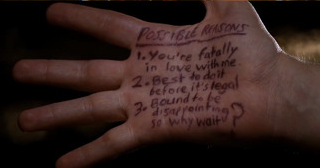
Oliver asks her to have sex with him, but Jordana asks for reasons why she should. Oliver writes on his hands three reasons, but Jordana ends up crossing off the first one which reads “You’re fatally in love with me”. Jordana knows that she likes Oliver, but she isn’t in love with him. Despite saying this, Jordana ends up having sex with him anyway.

In most modern day societies, many would agree that a man and woman in a relationship should love one another. In Jordana and Katherine’s cases, they aren’t in love with their significant others. Jordana may be technically Oliver’s girlfriend, but Jordana does not have as strong feelings for Oliver as he does for her. Jordana seems to like Oliver because of the things he does for her and the way he treats her. She doesn’t actually love Oliver as a person. This is why the relationship eventually falls apart. Jordana takes advantage of the fact that Oliver is in love with her and uses him to her full advantage. Thus proving that real relationships are built on true love and not force or manipulation. If Jordana existed during the Shrew’s time period, she most likely wouldn’t have had a choice of having sex with Oliver or breaking up with him. Unlike Katherine, who is ultimately forced to stay with Petruchio if she wants to live.

By the end of the movie, the similarities between Jordana and Oliver’s and Katherine and Petruchio’s relationships begin to split.  Oliver love for Jordana deepens while she continuously pushes him away. He sees that his parent’s relationship is falling apart and doesn’t understand why. Petruchio is able to further his agenda in taming Katherine, and eventually succeeds with a submissive wife and vast amounts of wealth to go with it.

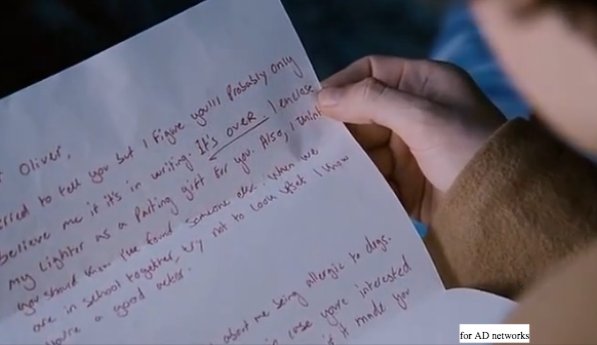
Soon, when Oliver turns to Jordana for help, she is nowhere to be found except for a letter in the mail that detailed:

“Dear Oliver, I tried to tell you but I figure you'll only probably believe me if it's in writing. It's over. I enclose my lighter as a parting gift for you. Also, I think you should know, I've found someone else.”

Despite Oliver and Jordana’s relationship ending, Katherine and Petruchio’s lived on. In the final scene of the book, Hortensio and Bianca are having their wedding accompanied by Katherine and Petruchio. To everyone’s surprise, Katherine has been tamed and obeys everything Petruchio says. Petruchio even has Katherine prove to everyone that she has changed.  

“Katherine, I charge thee, tell these headstrong women

What duty they do owe their lords and husbands.”

-Petruchio (Act 5, Scene 2, line 2638, page 154)

With this, Katherine then gives a long speech about how women should obey and submit to their husbands.

By the end of the book, Petruchio claims his victory and Katherine accepts her fate as his wife. Oliver eventually accepts the fact that Jordana doesn’t love him and they decide to stay friends. The difference between these two conclusions is that the time period effect how everything is carried out. Katherine and Petruchio both know they did not love each other. Petruchio saw her has a prize to win and Katherine was forced into marrying him. During Shakespeare’s time, arranged marriages were common and women usually had no decision on who they were to marry. The marriages were not built on love, but on social status and survival (Petruchio wants to marry Katherine in order to gain wealth and raise his position in society, and Katherine is forced into marrying him in order to survive). When looking at Oliver and Jordana’s relationship, everything is flipped. Oliver initially wants Jordana to be his girlfriend as a means of social status as well. He even takes the same route as Petruchio and tries flattering Jordana from the beginning. But the difference is that these behaviors are apart of Oliver’s character and are therefore genuine. He genuinely falls in love with Jordana. But the relationship falls apart because Jordana is not in love with him.

The book the Taming of the Shrew and the film Submarine both present that relationships only work when both members love each other. Not only this, but that women have way more control in their relationships than they did before. Katherine does not have the choice to leave Petruchio, while Jordana does. Katherine and Petruchio’s relationship is forced while Oliver and Jordana’s ends because it is one sided love. Modern audiences would feel satisfied with the ending of Submarine because it shows that love is what holds two people together, not abuse or force. The four hundred year contrast between these two art forms present that society's views on relationships and women's roles have definitely changed for the positive.

Works Cited

Shakespeare, William, and Thomas Goddard Bergin. The Taming of the Shrew. New Haven: Yale UP, 1954. Print.


Be the first to comment.

Wooing, Charming, and Taming

Posted by Myrna Yousuf in English 3 - Pahomov - C on Saturday, April 18, 2015 at 5:30 pm


Screen Shot 2015-04-18 at 5.27.57 PM


Screen Shot 2015-04-18 at 5.29.30 PM

Wooing, Charming, and Taming

Comparing “Taming of the Shrew” to “50 First Dates”


In “The Taming of the Shrew” the idea of a man pursuing and trying to woo a woman is still present today. The character Petruchio is very persistent in having Katherine as his wife and to make her his. Similarly in the movie, 50 First Dates, the main character Henry makes up his mind to woo Lucy who has short term memory less, so he has to win her over again every day.


Petruchio and Henry have both set their hearts on the woman of their choosing, however the way they approach their each individual situation with different tactics. Petruchio’s problem is the fact that Katherine is very adamant on resisting him, but that makes it easier for him to push her towards him. He finds her weak points to get her to comply with him. However, Henry has to come up with new ways each day to win over Lucy due to the fact that she does not remember anything the next morning of each day. Both situations have humorous context and also different ideas of male courtship and dating. Both of these show that society believes in male determination to get what they want no matter what the obstacle and that to win over a female there has to be persistency until she gives in.


“The poorest service is repaid with thanks, And so shall mine before you touch the meat.”

(Act 4 Sc. 3 (p. 164) lines 46-48)


In this quote, Petruchio is making Katharine say thank you to him for giving her food, even though he is the one who has deprived her of it. This is one of his tactics he uses for her to comply to him or else she would face consequences that she would not like. By making her behave and earn the things she wants to do he is able to “tame” Katherine and her resistance towards him.


Henry finds himself in a situation where he tries to have breakfast with Lucy each day, using different methods to approach her.


In this scene, it is one of the many days Henry has tried to find a way of having breakfast with Lucy. He pretends to cry which catches the attention of Lucy, and she approaches him asking if she can help him. He then continues to “cry,” and say, “I can’t read,” as he is looking at a menu. He pretends to struggle to read it and Lucy seeing this offers to help him how to read and asks him to join her for breakfast. Similar to Petruchio, he manipulates the situation which would bring Lucy to him and she would be the one giving him what he wants.  Petruchio is is using love for selfish reasons while Henry never intended for it to happen in the first place.


His different attempts to catch Lucy’s attention adds humor throughout this part of the movie and also shows the audience that he is doing exactly what he said he wouldn’t do, which is fall for a local. In this situation, he too is making himself fall in love with Lucy without realizing it.


“It shall be moon,or star, or what I list. Or e’er I journey to your father’s house.”

(Act 4 Sc. 5 (p.187) lines 7-10)

Petruchio is twisting his words around to test Katherine on how well she obeys him. He says the moon is shining when it is actually the sun. When Katherine goes to correct him, he threatens that she must believe what he says it is or else they will never make the journey to her fathers house. He tells her there will be consequences which makes Katherine vulnerable to agree to what he says. He doesn’t let go until she agrees with him.


However, Lucy’s loved ones are prohibiting Henry from pursuing anything with her because of her short term memory loss and they want to protect her. Henry is warned to stay away from her.


This scene is a part of an ongoing routine of Henry trying to meet Lucy and talking to her even after her dad had told him to stay away from her. He agrees to not go back to the diner where he used to meet her. Henry thinks of an alternative way, which is by using different methods like this scene where he gets his friend to beat him up in the middle of the road to catch Lucy’s attention. He does so successfully, and Lucy comes to the rescue and beats Henry’s friend with a bat. His new ways of coming up with a way to get Lucy to notice him and talk to him helps him to spend time with her. In “Shrew,” Petruchio is directly trying to get Katherine to be his while Henry is indirectly trying to just spend some time with Lucy no matter what it takes.


In the end, all of Henry’s attempts to get Lucy to live a normal life and to help her with her memory pays off. Henry decides that he loves Lucy too much to ever leave her, so even though her memory does not come back he helps her remember everything every morning by videotape that has all their moments together. This helps the audience see that persistency and wins over in the end. In “Shrew,” Petruchio gets Katherine to obey him after pushing her around and getting rid of her rebelliousness.


Work Cited:

Shakespeare, William. The Taming of the Shrew;. Washington Square, 1992. Print.

50 First Dates. Columbia TriStar Home Entertainment :, 2004. Film.  


Be the first to comment.

The Self and the Changing World

Posted by Raz Reed in English 3 - Pahomov - C on Tuesday, January 20, 2015 at 11:39 pm

Analytical Essay:

Of the billions of people on the planet, all of them have different experiences. Eventually, unfortunate things happen to them. Something as simple as a new, inconvenient class schedule at school, or something as serious as the death of a loved one. When these things happen, some sort of lifestyle change occurs. Maybe, as a result of the schedule change, a student has to wake up earlier. Or maybe, as a result of a spouse’s death, a man has to live without a wife. People can change, but change isn’t easy. All people have and need a coping mechanism in order to survive their changing world.

In Tim O’Brien’s The Things They Carried, Jimmy Cross is a platoon leader in charge of O’Brien and a group of American soldiers in Vietnam during the war. Cross is still infatuated with a his teenage crush, Martha, from years ago. This quote on page 1 shows his obsession: “he [Cross] would dig his foxhole, wash his hands under a canteen, unwrap the letters, hold them with the tips of his fingers, and spend the last hour of light pretending. He would imagine romantic camping trips into the White Mountains in New Hampshire. He would sometimes taste the envelope flaps, knowing her tongue had been there.” Cross is still attached to Martha not just because he can’t help it, but because it’s his way of coping with being a soldier in Vietnam. Each day, their troop wakes up at dawn, walks practically the whole day, then sleeps for a few hours. Day in and day out. It’s understandable that Cross needs to remember Martha to remember what home was like and to remember that if all goes well, he can get back to her.

On page 239, O’Brien explains the importance of storytelling during wartime to the reader: “We kept the dead alive with stories. When Ted Lavender was shot in the head, the men talked about how they'd never seen him so mellow, how tranquil he was, how it wasn't the bullet but the tranquilizers that blew his mind. He wasn't dead, just laid-back.” By telling each other stores, O’Brien and his comrades can, for a little while, escape the war, socialize, and have fun. A good story engages the listener and takes him or her into a different world. Without them, it would be much harder for the soldiers to deal with the gruelling daily routine. Storytelling is another coping mechanism that O’Brien and company utilize to survive the ever-changing war.

On page 33, O’Brien describes the character of Ted Lavender, a fellow soldier: “Like when Ted Lavender went too heavy on the tranquilizers. ‘How's the war today?’ somebody would say, and Ted Lavender would give a soft, spacey smile and say, ‘Mellow, man. We got ourselves a nice mellow war today.’” The tranquilizers make him sleepy and happy but still able to walk, so they’re the perfect mechanism to make the world a little more tolerable. Soldiers in Vietnam, particularly O’Brien’s crew, had to walk miles and miles every day. Without a coping mechanism like tranquilizers, they wouldn’t be able to deal with the drudging routine of war.

Here’s a quote from O’Brien in an interview published in the New York Times: “Storytelling is the essential human activity. The harder the situation, the more essential it is. In Vietnam men were constantly telling one another stories about the war. Our unit lost a lot of guys around My Lai, but the stories they told stay around after them. I would be mad not to tell the stories I know.” Again, the soldiers tell stories to other soldiers so that they can briefly escape the war they’re in. “The harder the situation, the more essential it is,” implies that O’Brien has been in plenty of difficult situations and probably has experience where storytelling was necessary at varying degrees to tolerate and get through the situation. His account confirms that having a coping mechanism, such as storytelling, is necessary to survive a changing world.

Tranquilizers, stories, and even dreaming, are all coping mechanisms. When people go through tough times, such mechanisms are essential to carrying on with their lives. Coping is simply a part of human survival. Change arrives in some form, and something has to be done to adjust to that change. That’s what coping is, and it’s how change happens in a person.


Works Cited for Analytical Essay:


  • Bruckner, D.J. "A Storyteller For the War That Won't End." New York Times Online. The New York Times. April 3, 1990. Web. October 20, 2009.

  • O'Brien, Tim. The Things They Carried. Boston: Houghton Mifflin, 1990. Print.


Narrative Essay:


One morning, two and a half years ago, my dad gave me an ultimatum. He told me that I had to take up some sort of physical activity. The options he recommended were sports and crossfit. I wasn’t a fan of the competitiveness of most sports and I had never heard of crossfit, so I asked him about crossfit. He explained that it was a fitness regimen for all ages designed to increase cardiovascular/respiratory endurance, stamina, speed and strength. I thought that sounded interesting, so I acquiesced.

At the time, I was really skinny for my age and height: 78 pounds. For some reason that I still don’t really understand, I wasn’t hungry often. Even when I was, I usually found whatever I was doing more interesting than food. Though I was told by parents that my weight was unhealthy, I had a bad tendency to ignore them. It didn’t seem unhealthy to me - I was never in pain, and except for occasional pangs of hunger, there weren’t any repercussions.

I started crossfit at the Sweat gym on Main Street, just a few blocks away from my house. I went two days a week to get personal training from Jim, who has been awesome throughout the whole session. I was an awkward kid and I remember saying very little for the first session we had because it was new and scary to me.

Over the next few weeks, I learned a lot of techniques and forms. Deadlifts, presses, front and back squats, cleans, jerks, snatches, and so on, became like second nature to me. Still today they’re embedded in my muscle memory. Knowing form sped up the training process - now I was really doing crossfit. Jim started assigning me actual crossfit workouts. They included a strength and a WOD (“workout of the day”) portion. The strength portion was dedicated to getting PRs (personal records) and the WOD portion was dedicated to completing an amount of exercises as fast as possible or completing as many exercises as possible in a given time.

After a month or so, I was gaining weight. Slowly, but surely - as a kid, I was always growing, but it was happening faster now. My dad had to tell me before I noticed, but when I did, that got me excited. I noticed that I was enjoying crossfit more than I used to. Two months after I started, I went to see the doctor for a checkup. I was now above the eighth percentile in body weight. This is about the time when my trainer opened up his own gym on Ridge Avenue, which is where I worked out from then on.

That’s my favorite part about crossfit, or any sort of exercise regimen. The more you do it, the more accustomed you are to doing it, and the better you get at it, and it’s uphill from there.

Soon, summer ended, and I went back to school - my first year at SLA. Things got complicated pretty quickly. When school ended, I had to take the train to the gym, which made my schedule hectic, given that I get out of school at very different times each weekday. I would walk up the hill on Ridge to the gym, then get driven home by parents. Fortunately, I settled into the not-so-routine routine well enough, and eventually, I went to the gym three times a week.

I did this for about a year and a half. I was gaining weight and increasing in body weight percentile, and the doctor told me during a checkup that my resting heart rate was lower than average (which is a good thing). When 2014 came, Jim bought a new gym. It was this huge, spacious building with a high ceiling just a few blocks away from the previous, and much smaller, location. It was also closer to the train station I got off at, so it was perfect. I went a solid three days a week for months.

Unfortunately, in the recent months in junior year, school caught up with me. I’m still doing crossfit, just at a slower pace - two days a week instead of three. But, crossfit has been immensely helpful in my weight gain process. Two and a half years ago, I was 78 pounds and around the eighth percentile for my weight. Now I’m 128 pounds and nearing the 40th percentile. Crossfit has been the perfect mechanism for me to change myself.

Be the first to comment.

Analytical Essay:

Posted by Tauqee Friend in English 3 - Pahomov - C on Thursday, January 15, 2015 at 11:18 pm


The relationship between self and and the changing world could be very simple or very complex. In a changing world you have 2 types of people the people who adapt to the new changes of the world and the people who decide not to change through all of the changes the world offers and it is a struggle deciphering which of the two is the better choice.


In the changing world  the decision to stay in the behind the world or stay with current times is essential. This is important because this decision could affect your lifestyle with no turning back. I people who tend to make this decision are making the wrong one with the exception of some. A good example of this is the movie “Kickin it old school.” This movie is about a 13 year old boy in 1988 who break dances then slips it coma after a performance. After 15 years he makes the decision to keep breakdancing and make a living off of that. this decision only works for some like him. Another example is a ex-convict getting released from a 10 year or plus sentence and doesn’t really know what to do since he is out. Him not trying to catch up with current times will make him live a life a crime and he is eventually going to be resentenced in jail. So sometimes that decision could change someone's life in a negative way.


In the changing world you have to envision your future at a young age that way when you have to make this decision you will not have a hard time choosing if you rather keep up with current times or to just be left behind by the world. A model example of this are athletes. I say this because athletes can’t just become athletes in the spot. It takes years of practice and training to become at least mediocre at whatever sport you are playing. Sometimes even when you keep up with the world it isn’t a good decision. A excellent example of this is in the book “The things we carried.” In one chapter the pack of soldiers are traveling through a water filled farm and one of the soldiers gets shot the wound was not fatal but they still left him there to die. They did this because they knew they would be shot to if they went back to help the wounded soldier.


In the changing world you must make the decision the decision to be different or to be like everyone else. Both of these decisions could make you miserable. For example say you go to school for being a lawyer being like everyone else you will finish law school but will be very unhappy with the career with choice you have made. Another example is going to law school and you are trying to be different from the rest of the students so you drop out and become an art student you realize that this isn’t going to make you any money to support your self therefore leaving you to drop out and find a minimum wage job and struggle through life.


So in a changing world you have to stay true to yourself or you are going to change your life in a negative way. So in the changing world change for the better.

Works Cited for Analytical Essay:


http://www.sparknotes.com/lit/thingscarried/

SparkNotes. SparkNotes, n.d. Web. 15 Jan. 2015.

http://www.metacritic.com/movie/kickin-it-old-skool

"Kickin It Old Skool." Metacritic. N.p., n.d. Web. 16 Jan. 2015.


Be the first to comment.

Narrative

Posted by Tauqee Friend in English 3 - Pahomov - C on Thursday, January 15, 2015 at 11:07 pm

The relationship between self and and the changing world could be very simple or very complex. In a changing world you have 2 types of people the people who adapt to the new changes of the world and the people who decide not to change through all of the changes the world offers and it is a struggle deciphering which of the two is the better choice.


The changing world has effected my life in many different ways. I say that because I live in an urban inner city area. In my area there are a lot of gangs and drugs around in parks and other public area’s. In changing world being the same will help you survive because if you are not like all the other people around my neighborhood you will be confronted and easily in danger.

A good example is one time i witnessed someone almost get jumped. A gang crowded around him and ask where he was from and he said he was from “7 duce” . This relates to my thesis because since he is like everyone else he avoided being hurt.


The changing world has affected me in a positive as well. In 6th grade we used to have a lot of vocabulary quizzes. Only 2 out of 40 students passed these quizzes. So everyone started to cheat and got great results after cheating. I was the only one not cheating on these test. After going over my grades and seeing that the vocabulary quizzes was bringing down a significant amount of my grade i decided to cheat. The next day we had a quiz and i was ready. I cheated and came to realize I received a 10/10 on the quiz. This relates to my thesis because In a changing world I followed what everyone else was doing and it worked out for the better.


In a changing world there has been some negative decisions that the changing world influenced me to do. Since i choose to be like most people the  changing world i followed thing that were trending. A really vivid example is when a certain shoe was very popular. I when i was about 12 years old a certain of shoe called fubu was very popular. Everyone was wearing them which was ironic because to be different you had to have a pair. So after a couple of weeks of begging my mom for the shoe she finally brought me a pair. Funny thing is I never actually liked the shoe but since everyone had a pair i convinced myself these were something i wanted. When I finally got a chance to wear the shoes the style was already played out. So I got no recognition for the sneakers on my feet and they were actually very uncomfortable. This relates to my thesis because trying to fit in with the changing world got me a bad pair of sneakers and disappointment.   


In a changing world being different is an option as well as being the same. Sometimes it doesn’t work out for someone who is different to be normal. Also sometimes we need to be normal to realize that we are different inside. We only know what’s good for ourselves and this is why this decision is so hard for people because we only know what is best for us. So Internally only we can decide what's best for us in the changing world.


Be the first to comment.

Self and the Changing World

Posted by Christian Moore in English 3 - Pahomov - C on Thursday, January 15, 2015 at 8:10 pm

​

Narrative

The things they carried were what was needed to survive. Carrying them around made the soldiers feel safe, secure, and in some cases comfortable. This shows that there are two types of soldiers. Ones who carry keepsakes and things with meaning to them, and ones who strictly carry weapons to be brought onto the battlefield.  Each individual soldier had to decide if protection or comfort was more important. Each was given basic weapons, but some decided that extra was needed. Pocket knives, steel helmets, fatigue jackets, flack jackets, .45-caliber pistols, and M-60’s were carried for protection. The ones carrying these may have been viewed as brave and war ready, but in reality were the ones who were likely the most scared. People who carry around weapons don’t do it to fight with them, but instead to intimidate their opponent. Soldiers who do this lack courage, and eventually are the ones who become paranoid on and off the battlefield.


Other soldiers decided to carry other things on their journeys. Carrying love letters and Bibles gave the soldiers the motivation to make it back home. It reminded the soldiers that there was more to live for in life. Love and religion are just two of the many things that gave the soldiers hope. This motivation and hope eventually turns into courage. When enough courage is built up a soldier is now able to make it through the war. "They were tough. They carried all the emotional baggage of men who might die. Grief, terror, love, longing--these were intangibles, but the intangibles had their own mass and specific gravity, they had tangible weight. They carried shameful memories . Soldiers in the armed forces are taught and trained to believe fear is a weakness. If fear is spotted in the heart of a soldier, they are considered cowards and have to live on with this reputation forever. In battle, if a soldier sees fear in the eyes of his opponent they are almost certain that they will be victorious. Fear is not something soldiers will admit to, but it is a feeling that is inside of them. This shows that soldiers covered there true feelings by acting brave and heroic, when in actuality they were scared.  These men were put in a situation where they were most likely to die. This would put fear in the heart of anyone. The courageous and confident soldiers were the ones who survived. The determination kept them mentally able to handle the situation and survive the war.  


Courage can be the best weapon on the battlefield if it is used correctly. This is why it is that that It's not the size of the dog in the fight; but the size of the fight in the dog. Courage and determination are stronger than any weapon that can be used on the battlefield. I survived, but it's not a happy ending. I was a coward. I went to the war." This quote shows that when in war, you must not show any emotions of fear towards your opposition. This also proves that having courage and not being afraid are two separate things.  


Soldiers who carry around things inspirational to them are more likely to survive than those who don't. This is because they have spunk. Courage is a soldiers best friend. It’s not always easy to have courage though, thats why imagination is needed to keep sanity.

Citations - 

Brien, Tim. The Things They Carried: A Work of Fiction. New York: Broadway, 1998. Print.

"The Things They Carried Quotes." BookRags. BookRags. Web. 16 Jan. 2015. <http://www.bookrags.com/notes/tttc/quo.html#gsc.tab=0>.

Analytical

“But why mom? Do I have to? It doesn’t taste good!” This is what you would hear if you sat down at my dinner table every night for the first 7 years of my life. Everything would be going so well until disgusting green foods would be put onto my plate. I am not so sure why I hated them, but like most children I just knew I did. Maybe it could have been because the beans were wet and slimy, or maybe because it just didn’t quite taste like pizza or french fries.

I would sit and stare at my plate for as long I can remember making sure I did not accidentally touch a piece of one of the slimy beans on my plate. My mom would start off by telling me that they were good for me, and I needed to eat them, but as the night progressed she would find herself telling me I couldn’t leave the table without eating them or that if I got up it would be my dinner for tomorrow. I would sit there for hours and eventually begin to poke at my food hoping somehow this would make it disappear. Some nights, after an hour of sitting I would just begin to doze off.


I used this time to imagine. I would think of floating in space on a N.A.S.A spaceship, or being a knight in a jousting tournament. I would block out everything else that was going on around me and focus on my daydreams. It was like I had my own little world, one where I did not have to eat vegetables. In these worlds, I could be whatever I wanted to be, and had no one who could stop me. Those times seemed like the best in the world. I was i my happy place and did not want to leave.


On nights when I would be given spinach, I would daydream about eating it and becoming Popeye the Sailor. Often times, I would enjoy doing this and would end up eating my vegetables. Not because I liked the way it tasted, but because I my imagination overpowered my reality. It was like I would eat the leaves of of impulse. While chewing the leaves, I would taste a sugary flavor and begin to enjoy the food. I think my imagination made me think that spinach wasn’t all that bad after all. My mom would come downstairs and say “see, that wasn’t bad at all. You could have been done hour ago”. Most times, I would ignore her and try to get back to my imagination. It was better than anything else around, and unlike TV the episodes were always new and original.


Now that I look back, I see that mind over matter actually works. This all comes from imagination. Tricking your brain into thinking something is actually happening. When you do this you may be able to do things you never thought were possible. If you try it one day it might work out for you.


Be the first to comment.
84 posts:
← Prev
  1. 1
  2. 2
  3. 3
  4. 4
  5. 5
  6. 6
  7. 7
  8. 8
  9. 9
Next →
RSS

ENG3-017

Term
2014-15

Other Websites

Launch Canvas

Blog Tags

  • Pahomov 1
  • english 11 1

Teacher

  • Larissa Pahomov
Slate (skeleton-v3 PHP 8 prototype) · Location: 1482 Green St · Shipping: 550 N. Broad St Suite 202 · Philadelphia, PA 19130 · (215) 400-7830 (phone)
×

Log In