• Log In
  • Log In
Slate (skeleton-v3 PHP 8 prototype)
Slate (skeleton-v3 PHP 8 prototype) Learn · Create · Lead
  • Students
    • Mission and Vision
  • Parents
  • Community
    • Mission and Vision
  • Calendar

English 3 - Pahomov - C Public Feed

Create a Post

Shrews in disguise

Posted by Abdullah Jeffers in English 3 - Pahomov - C on Monday, April 20, 2015 at 12:31 pm


Shrews in Disguise

Comparing the play "The Taming of the Shrew" with the movie "Hitch"


There are many thin lines that can easily be crosses in the pursuit of love. In the movie “Hitch” a guy named Albert hires someone to help gain the attention of his beloved, Allegra. This of course was done in secrecy and many would view this as not politically correct. On the other hand in the play “The Taming of the Shrew” a man named Lucentio falls in love with the most sought after girl in the city, Bianca. To win her favor he disguises himself as an instructor for her. By doing this he will be closer to her and gain her favor. In both cases deception is prevalent. Ultimately both spouses found out about their husbands deceit, yet in the end both couples stayed together. Both these stories show that for love the ends justifies the means.


"Tranio, I burn, I pine, I perish, Tranio,

If I achieve not this young modest girl.

(Act 1, Scene 1,5)


This quote early on in the play sets up the mindset the Lucentio will do something out of the ordinary for Bianca. For example him impersonating an instructor. Lucentio made this statement when he first set his eyes upon Bianca. Him and his servant Tranio were walking into town. It is soon after that the plan for Lucentio to be in disguise was formed. To a normal person this would be ludicrous, but for Lucentio who is so smitten with love that he would rather die than be without Bianca it is only a means to an end.


Similarly albert is having the same idea when he decides to hire Alex “Hitch” Hitchens to help get him and Allegra together.


In this scene you see Albert collaborating with his hired date man, Hitch. Unlike in The Shrew, Albert will not be in disguise. Rather, Hitch will fabricate a scenario which seems real to Allegra. In the scenario she will meet Albert and the chance of her falling for him will increase due to Hitch’s coaching. In this instance the deceit is lesser yet very unconventional to the established view of dating. This is can be seen as similar to asking a friend for help with a girl. On the other hand it takes this normal human action and pushes it to an extreme. Albert has no care for the means of how he gets with Allegra just as long as he he is with her.


"Love wrought these miracles. Bianca's love

Made me exchange my state with Tranio"


(Act 5, Scene 1, 128)


This statement was uttered after Lucentio’s disguise was discovered. also it is revealed that Lucentio's servant Tranio changed his identity to that his masters. This is explaining why he had done all this deceit. He claims love drove him to this extreme measure. Ultimately he got the girl because when she found out she did not care, and as long as the bride was happy no one else did.


In the movie Albert was exposed as getting help to woo Allegra.


During this part of the movie Hitch is trying to steer Allegra back into liking Albert. He claims that he just give guys the confidence to talk to the girls that they want. Also, that the true self of the guy is what gets the girl. Unlike in the play the deceitfulness is different because in the play Bianca falls in love with a a different characters but in the movie Allegra falls in the with a confident version of Albert. The end up reuniting and being happy. This shows that those the means was faulty the couple could still be together.

All in all in both the play and the movie both show males going to an extreme to woo the loves of their lives. In both the mens deceits are exposed but ultimately the women stay with them. Both play and movie portray a theme of the ends justifying the mean because at the end of the day when all was said and done both couples were happy.


Works Cited

Hitch. Columbia Pictures :, 2005. Film.
Shakespeare, William, and Barbara A. Mowat. The Taming of the Shrew. Washington Square Press New Folger ed. New York: Washington Square, 2002. Print.
Be the first to comment.

​ How Men Control Love

Posted by Jamison Turner in English 3 - Pahomov - C on Monday, April 20, 2015 at 12:24 pm

How Men Control Love

A comparison of “Taming of the Shrew” and “50 First Dates”


Taming of the Shrew is a play about two sisters and their road to marriage.  Katherine (the shrew) marries a man named Petruchio who tries to “tame” her and her awful attitude.  “50 First Dates” is about a man named Henry Roth who meets a girl named Lucy,  He thinks he’s finally found the perfect girl.  The only problem is she has short term memory loss and once she goes to sleep she forgets what happened the day prior.  Henry tries to get her to fall in love with him a different way, everyday.  These movies are very different but both depict a man who thinks he can control their respected women’s feelings.


Petruchio and Henry are both trying to get a girl to fall in love with them just in two very different ways.  Henry is doing it the sweeter way though nothing like his situation has ever happened in reality.  It is touching to see he cares enough about a girl to think of new ways to get her to fall in love with him every single day.  Petruchio on the other hand is very cruel to his wife Katherine.  He wants her to stop being so mean.  The decision he makes is very dehumanizing to Katherine.  He decides to stop letting her eat and sleep as a hunter would do to a Falcon in order to tame it.  No matter which way anyone looks at it, they’d prefer to be with Henry.  Petruchio didn’t even really love Katherine.  He just married her so her younger sister Bianca could get married.  Today it is widely believed by many people that you are supposed to marry someone that you absolutely adore and they are supposed to absolutely adore you back, as well.

Screen Shot 2015-04-19 at 10.32.31 PM.png

In this scene Henry(on the ground) has his friend act like he’s beating him up so Lucy (far left) comes and saves him.  For a comedic aspect Lucy pulls out a baseball bat and starts to beat the friend with it until he runs off.  Henry does things like this for many days until he gets caught by Lucy’s father who forbids him to speak to her.  Henry is under the impression that if he does this Lucy will start to remember him and ultimately fall in love with him.  At this point in the movie it is too early to tell if it works out for him but as it goes one we see how his plans pan out.


“And if she chance to nod, I’ll rail and brawl, and with the clamor keep her still awake.  This is a way to kill a wife with kindness…  He that knows better how to tame a shrew, Now let him speak; ‘tis charity to shrew”

Act 4 scene 1 line 206

This quote is from the point in the play when Petruchio has a plan to “tame” Katherine.  Like the scene from the movie, this scene is too early to tell whether or not the plan will work but you can see the difference between Petruchio and Henry’s approaches to getting their girls to fall in love.  Most in not all people would most likely want Henry to be their significant other.  This is evident towards the end of both the Play and the Movie.


“Thy husband is thy lord, thy life, thy keeper, thy head, thy sovereign, one that cares for thee… Too little payment for such debt.”

Act 5 scene 2 lines 162-170

This is the last line from “Taming of the Shrew” and Katherine is the one saying it.  It’s a very lengthy last line but basically Katherine tells the other wives to obey their husbands.  This could be either taken one of two ways.  The first way is that she believes every word she says and Petruchio has totally changed her.  The other way is that she is being sarcastic, she is only saying and doing what her husband wants to hear and see for her own good.  So she can eat and sleep.  Katherine was very stubborn but no one is mean their entire lives and when she’s going to live with someone for the rest of her life she might as well be nice to him because he is her provider and at this point in her life without him she is on her own.  


Screen Shot 2015-04-19 at 11.06.16 PM.png


This scene from “50 First Dates” shows Henry and Lucy hanging out with Lucy’s friends for the first time since she lost her memory.  She calls Henry her boyfriend and her friends ask Henry how he does it every day and one of them asks her husband “Why can’t you do that for me?”  Henry has gotten Lucy to fall in love with him everyday even though she doesn’t remember him once she goes to sleep.  Henry was able to change Lucy’s feelings towards him but not with force like Petruchio.  He was a gentleman to Lucy everyday and came up with a plan to remind her who he is and what’s going on at the current time.


These stories are both forms of entertainment so they are definitely far from the truth.  “Taming of the Shrew” is also very old so it is outdated as well.  These stories both depict a man getting a woman he has interest in.  Henry does it the nice way and in the end it works out for him.  Petruchio does it the harsh way and based on what Katherine said she most likely is in it for her own good.  


Be the first to comment.

The American Changing Shrew

Posted by Ameer Forte in English 3 - Pahomov - C on Monday, April 20, 2015 at 11:57 am


          The classic but controversial William Shakespeare play, “The Taming Of The Shrew” is one that audiences still disagree about . As scholars continue to attempt to understand what Shakespeare was trying to prove by creating a play in which, a once outspoken woman  becomes in full subjection to her husband. Claiming even he is her God.

          Though this is not one of those scholastic papers breaking down this play line for line, this essay will analyze the connections between “The Taming Of The Shrew” and the modern day theatrical film “American Wedding”. There are some themes that rise throughout the plot of the movie that connect characters between the two. One of which is that of supporting character in the movie Steve Stifler to the main character in the play Petruchio. Steve Stifler is like Petruchio in the sense that both are manipulative and change themselves to get what they want. In this case what they want is a woman. As shown in this play and movie, people change who they are to create love where there otherwise would not be any, and when this change is made it is often not genuine.


"Quote from Play"

“You wrong me, Signior Gremio. Give me leave.—

I am a gentleman of Verona, sir,

That hearing of her beauty and her wit,

Her affability and bashful modesty,

Her wondrous qualities and mild behavior,

Am bold to show myself a forward guest

Within your house, to make mine eye the witness

Of that report which I so oft have heard.”

Act 2, Scene 1, lines 49- 58

(Act x, Scene x, line numbers)


At this point in the play, Signior Petruchio is telling Signior Gremio how he plans to woo and charm Katherine, no matter what her personality may be. He says that he is such a gentleman he will overcome her personality. This shows that he feels he needs to be overbearing and very gentle with Katherine for her to fall in love with him. It is learned later in the book that is not truly his character.


Petruchio’s counter piece in the movie “American Wedding”, Steve Stifler, is in a similar but slightly different situation as Petruchio. Stifler meets a woman like Petruchio and supposedly falls for her upon first sight, and then exactly like Petruchio he changes his personality to come off as appealing to what the woman and the woman’s family and friends would like.


IMAGE GOES HERE


At this point in the movie, Stifler, a character known throughout the film for his noisy outbursts, annoyance and lack of respect for others, is about to meet the woman he would later claim to love. Candice, though, as he notices through eavesdropping wants a good man to fall in love with. So Stifler changes himself momentarily to show Candice’s parents first that he is a good guy. This, like what Petruchio did in the play, shows Stifler changing himself to give off an appeal of charm because he believes that is the only way Candice will love him. But it is seen that throughout the film that is not his true character.


"Quote from Play"

You lie, in faith, for you are called plain Kate,

And bonny Kate, and sometimes Kate the curst,

But Kate, the prettiest Kate in Christendom,

Kate of Kate Hall, my super-dainty Kate—

For dainties are all Kates—and therefore, Kate,

Take this of me, Kate of my consolation:

Hearing thy mildness praised in every town,

Thy virtues spoke of, and thy beauty sounded—

Yet not so deeply as to thee belongs—

Myself am moved to woo thee for my wife.

(Act x, Scene x, line numbers)

act 2 scene 1, lines 179- 188


Here in the play Petruchio finally meets Katherine for the first time. As recalled earlier in the play he tells Gremio that his charm will make Kate fall in love with him. His tactic to show this charm is to shower her with overbearing compliments of her beauty and character. Later in the book his character is shown as arrogant and rude whereas in this scene in the play he comes off as charming and extremely kind. As shown here Petruchio changes who he is in the hopes of getting Katherine to like him right away, but this change was not genuine because later in the play he decided to show her his true colors.


Steve finds himself in a similar predicament when he first attempts to show candice individually that he is a great guy for her. Earlier in the film it shows Steve overhearing Candice and her sister in the bathroom talking about the perfect guy for her. Coincidentally Steve tries to replicate and become everything she says when he meets her.


IMAGE GOES HERE


Steve much like Petruchio finds himself in front of Candice trying to make the best possible first impression he can make. He comes off as sweet and endearing to her and in her mind he is her perfect man. Towards the end of the film there is a scene where Steve is shown acting out of character and she realizes he is nothing like who she thought he was. Steve decided to use the same tactic as Petruchio and change himself to get the girl, but like Petruchio the girl realizes he is not who he claims to be in the end which is why the change is not genuine.


In the end it is shown throughout both situations that the male feels as though he has to be the perfect guy for the girl in order to be in a relationship with her. Petruchio changes to be sweet and endearing and so does Steve. Both changes though are not genuine, and it therefore causes complications in the relationship. Society’s views on relationships shows this ideal in full, Steve’s modern day situation with Candice shows the model for relationships everywhere. The woman wants the perfect guy and so people change who they are to create love where there otherwise would not be any, and when this change is made it is often not genuine.


Worked Cited:


"The Taming of the Shrew." Wikipedia. Wikimedia Foundation, n.d. Web. 20 Apr. 2015. <http://en.wikipedia.org/wiki/The_Taming_of_the_Shrew>.


"American Wedding." IMDb. IMDb.com, n.d. Web. 20 Apr. 2015. <http://www.imdb.com/title/tt0328828/>.


Be the first to comment.

Movie Visual Essay

Posted by Nebil Ibrahim in English 3 - Pahomov - C on Monday, April 20, 2015 at 11:38 am

“The Taming of the Shrew” is one of the is one of the earliest romantic comedies that has survived. In the play several men such as Lucentio, Hortensio, and Petruchio chase after women. In the 1985 movie “St. Elmo’s Fire”, Kirby is just like these men in this aspect except for the fact that the woman he is after is already in a relationship.


Kirby shares similarities to Lucentio as they both attempt to get the woman but fail. While their actions are similar their situations, the outcomes are different. Kirby is trying to get a woman who is much older than him while she is in a relationship, while Lucentio falls in love with someone of a similar socioeconomic class. Since Kirby is trying to get a woman older than him, so he is considered bolder and less caring of the social norm to marry a woman younger or around someone’s age. The fact that Kirby is just as eager to get close to Dale as Luciento is to Katherine is a sign of how the boundaries of what is considered an abnormal marriage are changing. The difference between “The Taming of the Shrew” and “St. Elmo Fire” is proof that people are becoming more open minded to people of very different ages and socioeconomic statuses being in relationship.


“You will be schoolmaster and undertake the teaching of the maid: That’s your device” (Act i, Scene i,  43)


In this quote Tranio is describing the idea he has for how Lucentio can get close to Bianca. The fact that Lucentio went along with this shows to what extremes he will go to in order to get with a woman. He does this in the spur of the moment as he just saw her pass him by for the first time.


Kirby finds himself in a similar situation with Dale except he is much more infatuated with her.

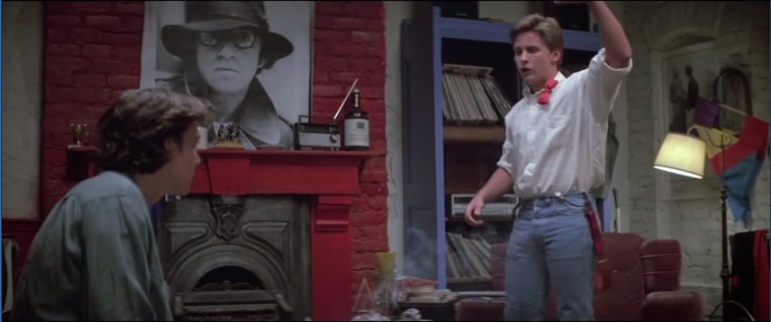
Screen Shot 2015-04-16 at 9.02.17 AM.png

“What’s the meaning of life? Dale Biberman”


In this scene of “St. Elmo’s Fire” Kirby is talking about how Dale whom he just saw at a hospital is the love of his life even though they spent years apart without contact. He does not care about the advice from his friend, which is to not to go after her because of her age and the fact that she is already in a relationship. He completely disregards the advice and goes after her anyway. He is willing to change his college major from law to medicine in order to get closer to her, which is similar to what Lucentio was doing when he disguised himself as Bianca’s tutor. While Lucentio had nothing to get in his way such as socioeconomic status. Kirby has the problem of her age and socioeconomic status, which shows just how much men have changed over the centuries in their pursuit of women and have changed what they consider to be an acceptable relationship.


Preposterous ass, that never read so To know the cause of why music was ordained. (Act ii, Scene i, 109)

This is from when Lucentio, while disguised as Cambio was talking to Hortensio about how he should go first. He acts very pompous and believes he is more important than Hortensio when trying to get Bianca. She then does let Lucentio teach her first. His attitude is a sign of how confident he is that she will marry him.


“And deep down for a long time I’ll wonder if somehow this isn’t my loss”

In this scene Dale is telling Kirby how she regrets not being able to be in a relationship with him. She kisses him on the cheek and then he kisses her on the lips and she embraces it. This shows how even while their ages are far apart and she has a higher socioeconomic status than him she would still want to have been in a relationship with him.


What is considered an appropriate marriage today and during the time “The Taming of the Shrew” was written are completely different. Marriage is about more than marrying someone who is in the same age group and socioeconomic class. Now its about finding anyone who you love and who loves you no matter the differences between them.


Works Cited

Shakespeare, William, Barbara A. Mowat, and Paul Werstine. The Taming of the Shrew. New York: Washington Square, 2002. Print.

St. Elmo's Fire. Dir. Joel Schumacher. Perf. Emilio Estevez, Rob Lowe, Andrew McCarthy, Demi Moore, Judd Nelson, Ally Sheedy, and Mare Winningham,. 1985.
Be the first to comment.

Truly She’s Not All That

Posted by Jacklyn Middleswarth in English 3 - Pahomov - C on Monday, April 20, 2015 at 11:38 am

Comparing “The Taming of the Shrew” to “She’s All That”


In the play, “The Taming of the Shrew,” proves that men try to beautify their women, which in turn fuels their ego and eventually the men get something out of it. In, “Shrew,” Petruchio marries Katherine to obtain her wealth, and makes her become a better person. In the 1999 movie, “She’s All That,” Zach Siler tries to do the same, but to transform Laney Boggs into a prom queen to win a bet.


In both mediums of entertainment, the man tries to change the woman, in which he gets something out of it at the end. By achieving this, they boost their ego, and the women are more likeable, but their situations are different. In “Shrew,” Petruchio is married to Katherine and already promised 20 crowns. Then he tries to tame her attitude, and neither party truly loves each other by the end of the play. Although in “She’s All That,” Zach makes the bet before knowing the girl, and ends up falling in love with her. Guys play women as though they are easily changed objects and think they’re the greatest ever by doing so if they are successful. These two situations are in very different time periods, but it shows how the male’s idea of dating and/or women in general has stayed the same. These texts reflect that men stay trying to change the women for their benefit and because of this, the woman becomes more attractive.


"Thus in plain terms: your father hath consented

That you shall be my wife, your dowry 'greed on,

And, will you, nill you, I will marry you….For I am he am born to tame you, Kate,

And bring you from a wild Kate to a Kate

Conformable as other household Kates."

(Act 2, Scene 1, 259-268)

Petruchio meets Katherine for the first time, and makes it clear that he is going to marry her, that the dowry is already set, and his job is to tame her. Petruchio already knows that Katherine isn’t the most pleasant person in the world to say the least, and that people hate her because of this. Since he’s going to be married to her, conforming her personality to be nicer adds to his benefit. By doing such a deed the people who dislike Katherine will see how she has become tamer and will find her more amusing.

Similarly to the movie, “She’s All That,” Zack knows that Laney has more of an introverted personality and isn’t really a people pleaser, so he tries to make more characteristics about her more appealing.


Screen Shot 2015-04-16 at 10.20.08 PM

Zach shows up at Laney’s house to convince her to go to a party. She says she has nothing to wear so he gives her a short, red dress that shows cleavage, but then she complains she’s a mess. Zack brings along his sister to help change Laney’s look by doing her makeup and even cutting her hair to her shoulders. Even now, the guy is trying to beautify her. Zack is the most popular boy in school, and since he is going to a party with Laney, he wants her to look more on his level. By changing one of the most “plain Jane” looking girls in the school to a beautiful prom queen, would be the ultimate achievement in showing Zack’s high school career. When Zack changes Laney to look more acceptable, the people around Laney see her as more attractive rather than boring or not even noticing her at all.


"Tut, she’s a lamb, a dove, a fool to him!

I’ll tell you, Sir Lucentio: when the priest

Should ask if Katherine should be his wife,

“Ay, by gogs wouns!” quoth he, and swore so loud

That, all amazed, the priest let fall the book,

And as he stooped again to take it up,

The mad-brained bridegroom took him such a cuff

That down fell priest and book, and book and priest.

“Now take them up,” quoth he, “if any list.”"

(Act 3, Scene 2, 130-139)

Gremio(who is a suitor for Bianca -Katherine’s younger sister) is talking to Tranio(who is a servant) about how at the wedding, Petruchio made Katherine look like an innocent child next to him. Petruchio had flipped out at the wedding to the priest and caused an uproar. By him doing such in front of a crowd with Katherine next to his side, makes Katherine look like a goddess. Petruchio decided to act in such an abrupt manner because Katherine will be embarrassed of Petruchio, and know that that’s not an acceptable way to act in front of people. Once she know’s this, she will act in a calmer manner all the time. Even though Katherine has a foul attitude, by Petruchio such shows Katherine off, which is why Gremio said Katherine was an innocent child. Compared to Petruchio in this scene, people are seeing the difference in Katherine. She acts as a lamb or dove, and to Petruchio she becomes more pleasing to others than him. Slowly but surely Petruchio is conforming Katherine’s attitude by being ruder than her so people will like her better.

Zack is slowly, but surely changing Laney as well, and people are noticing.


Screen Shot 2015-04-16 at 10.36.43 PM

Dean, Zack’s best friend is talking to Zack about “tapping”(having sex) with Laney. Zack says that hanging out with her isn’t about getting any. Dean asks if he could then partake because now since all of sudden due to Laney’s new looks and popularity, she’s become more attractive. Since Zack has spent so much time changing Laney to become better, people have noticed which is why Dean asks if it’s okay if he could have sex with her.

Both texts portray men as having the same outlook on women; women need to look a certain way in order to be considered “dateable.” The Taming of the Shrew was written in 1593, while “She’s All That,” was produced in 1999. These two texts are written over 400 years between each other, but both show that society deems it as okay that men change these women for their benefit, as long as the woman becomes a better version of herself. The portrayals of men and women in both the play and movie tell the viewer that in society, that there are certain physical and emotional expectations in courtship/dating.  


Works Cited:

Shakespeare, William, and Barbara A. Mowat. The Taming of the Shrew. Washington Square Press New Folger's ed. New York: Washington Square, 1992. Print.


She's All That. Perf. Freddie Prinze Jr, Rachael Leigh Cook, Paul Walker. Miramax Home Entertainment ;, 1999. Film.


"The Taming of the Shrew." SparkNotes. SparkNotes. Web. 20 Apr. 2015. <http://nfs.sparknotes.com/shrew/>.


Be the first to comment.

The Beginners Guide to Love in the Past and the Future

Posted by Sean Morris in English 3 - Pahomov - C on Monday, April 20, 2015 at 11:32 am

(Comparing “Beginners” and “The Taming of the Shrew”)


In the 417 years between when the play “The Taming of the Shrew” (1592) was written and the movie “Beginners” (2010) premiered, a lot has changed about what people see in relationships and love. In the play in one of the main characters is the titular “Shrew” Katherine, is a very loud mouthed and independent woman, at least until Petruccio marries her and she starts to become more subversive to him. In the movie “Beginners” is about a man, Oliver, who learns that his father; Hal, is not only dying but is gay, and reflects back onto his parents unhappy marriage that they were both forced into due to the circumstances and prejudice that existed at the time.


Both of these characters had very large personalities that were subverted due to their marriages and had to change themselves for it, although not for the better. “The Taming of the Shrew” and “Beginners” both show that changing yourself in a relationship will someone unhappy.


Kathrine:

“I pray you, sir is it your will to make me stale of  me amongst these mates?”       


HORTENSIO

“Mates,” maid? How mena you that? No Mates for  you, Unless were of gentler, milder mold.                                 


(Act 1. Sc . 1 lines 59-61)


In this scene Hortensio is talking with Kathrine about getting married, but Hortensio is arguing that little men would want her unless she was a calmer, gentler person in comparison to her rougher personality. As you can see , society, represented here by Hortensio, expects Katherine  to comply to what  it wants- which would be a calmer demeanor and attitude, though it is not in her own personal interests. To change herself for a marriage, with someone who; at this point in the play, Katrine doesn’t even know.

Screen Shot 2015-04-16 at 8.16.36 PM

This is similar to much of Hal’s life in which he had to marry and live with a woman for most of his life, while  secretly being a gay man. This was due to the societal conventions of the times he lived in in which being gay was thought to be a mental illness, with his therapist, and to a certain degree his wife when she first proposed, telling him that as much. Hiding his true feelings and sexuality for fear of losing “everything” restricted  life, and even his happiness for what he would sexuality, emotionally or otherwise.                                                                                                                                                          


KATHARINA

...

“And place your hands below your husband's foot: In token of which duty, if he please, My hand is ready; may it do him ease.


PETRUCHIO

Why, there's a wench! Come on, and kiss me, Kate.


In this scene it truly shows how far Katherine has “fallen” from her former self. After a barrage of physiological attacks from Petruchio her fire has almost died down leaving her an obedient shell of her former self. She obviously isn’t happy with her new surroundings; who would like to be starved and sleep deprived? But in order to receive these basic human needs she needed to change- again quite dramatically- for the sake of the relationship, and even her own well being for the better part.


Screen Shot 2015-04-16 at 9.41.30 PM

However in contrast, when we see Hal refer back and started living his life as an out gay man, he is tremendously happier. With a loving relationship a plethora of new friends and hosting parties as demonstrated in an early montage in the movie he clearly is a happy, and presumably happier man. Because he changed himself for his relationship with Hal’s mother he wasn’t able to live the majority of his life as he wanted to. At one point he goes to a gay bar for the first time and tells his son it was more for young men, than him at 78. He states  “I don't want to just be theoretically gay. I want to do something about it.” showing that he’s lived his life so repressed from his true personality and that, now that his wife has passed away, he can live his life as he;s always wanted.


KATHERINE

No shame but mine. I must, forsooth, be forced, To give my hand, opposed against my heart,, Unto a mad-brain rudesby, full of spleen, Who wooed in haste and means to wed at leisure. I told you, I, he was a frantic fool, Hiding his bitter jests in blunt behavior, And, to be noted for a merry man, He’ll woo a thousand, 'point the day of marriage, Make friends, invite, and proclaim the banns, Yet never means to wed where he hath wooed. Now must the world point at poor Katherine And say, “Lo, there is mad Petruchio’s wife, If it would please him come and marry her!”

(act 3. sc2)

In this it shows Katherine's frustration in approaching an unhappy marriage with Petruchio in which she’ll be reduced to being “Petruchio's crazy wife”. Surely the fact that she is tough to marry doesn’t escape her but it hardly seems to bother her; especially as Petruchio remains her best option at this point. Up until this point her identity has been mostly about her, while not all positive- being the titular “shrew” and having a reputation in the plays story, however now with Petruchio in the picture, her identity will always be second to him, and her relationship to him.


Screen Shot 2015-04-16 at 9.34.46 PM

In this revealing scene, Hal reveals to Oliver that Oliver’s mother knew that Hal was gay but that she claimed that she “could fix that”. This relates to Taming of the Shrew as they both show examples of people unhappy with change, and their true personalities being reverted to their relationship to someone they truly do not love. In Hall's case it shows, that while he enjoyed his life as a whole, he clearly wished he could have lived as he wanted to- being out as a gay man.


In conclusion both The Taming of the Shrew and Beginners show how changing oneself for a relationship doesn’t make them happy. What is interesting to note that while Taming of the Shrew shows someone who is getting deeper and changing himself for their unhappy relationship, Beginners shows someone; both literally and metaphorically, coming out of such a relationship and becoming happier with the life he has left. The messages presented in both The Taming of the Shrew and Beginners are truly universal and can be shown as a cautionary tale for someone not to go into such a relationship but can also be used as a means of inspiration to any poor individual's stuck in such a situation.

Works Cited:
  • Beginners. Dir. Mark Mills. Perf. Ewan McGregor, Christopher Plummer, Mélanie Laurent, Goran Visnjic. Focus Features, 2010. Film
  • Shakespeare, William. The Taming of The Shrew. Ed. Barbara A. Mowat and Paul Werstine. New York: Washington Square, 1992. Print.
Be the first to comment.

"Shrew? You Keep Using that Word. I Don't Think it Means What You Think it Means."

Posted by Bella Mezzaroba in English 3 - Pahomov - C on Monday, April 20, 2015 at 11:27 am

​The Taming of the Shrew and the Princess Bride

The classic play, The Taming of the Shrew, written by Shakespeare is arguably the original romantic comedy. The Princess Bride, and 1980’s film, is a more modern romantic comedy, even though it takes place in a world resembling medieval Europe. The characters from the play that will mentioned most are Bianca, Lucentio, and Petruchio. From the Princess Bride, the characters of Buttercup, Westley and Prince Humperdinck will be analyzed.


There’s numerous similarities and differences between the characters but most similarities can be drawn from the interactions the characters have with each other. The two texts reflect that regardless of relationship status, men and women of a certain ilk will interact in set ways, portrayed in the roles they play such as dominant, subservient, or respectful.


“ Hic ibat as I have told you before Simois, I am Lucentio hic est son of Vincentio of Pisa Sigeia tellus, disguised to get your love.”

  • Lucentio page 111 Act 3. Sc. 1 Lines 33-35


In this scene, Lucentio is letting Bianca in on his plan to wed her and win her love. He’s being sneaky outwardly as he is masking is true intent from prying ears by speaking his intentions in between lines of Latin.


Westley conveys his love using a similar train of thought.


“As You Wish” -Westley


In the beginning of the film, Westley was a  farm boy at Buttercup’s farm. Whenever she requested something of him he responded by saying, “As you wish.” Buttercup later realizes this is his way of saying, “I love you.”

Westley is discreet, much how Lucentio was, in professing his love. Both men confessed their love in ways that would only be understood by the intended, Buttercup and Bianca. These men are of a strong willed and honest nature and, therefore, are willing to do moral things to get their woman. These moral things can also be construed as romantic, another trait both of these men share.

A difference in the courtship methods of Lucentio and Westley  are the levels of discrepancy. Lucentio’s methods are much more humorous, as they are poorly veiled and obvious to Bianca from the start. Westley, on the other hand, speaks in riddles and codes. It takes Buttercup much longer to decipher the meaning behind, “As you wish.”


“This is the way to kill a wife with kindness”     

-Petruchio Page Page 153 Act 4 Sc. 1 Line 208


In this quote, Petruchio, the master of deceit and cunning, is making a speech to himself concerning the taming of his wife. He means to do horrible things to her, all in the name of love and kindness.

In the Princess Bride, there is a character whose evil tendencies do match Petruchio’s.


“Please consider me as an alternative to suicide.”

-Prince Humperdinck


Prince Humperdinck is Buttercup’s betrothed. He chose to marry her and she went along with it because she believed her true love, Westley, to be dead. In this point in the movie, she knows Westley is alive and tells Prince Humperdinck that she will not marry him and if she is forced too, she will be dead by morning. Prince Humperdinck agrees to send word out to Westley (who is being held captive in the dungeons) that Buttercup wishes to marry him and not the Prince. Of course, the Prince is bluffing and never sends out word, leaving Buttercup to believe her true love abandoned her and that she must marry Humperdinck.

Both men are manipulative. They’re of a cruel and conniving nature. This makes them likely to take advantage of weaker people, as they both did. Although Buttercup, being likened to Bianca, is the one being taken advantage of by Humperdinck, Katherine is the one being abused by Petruchio.

“Why, there’s a wench! Come on, and kiss me, Kate.”

-Petruchio page 221 Act 5 Sc. 2 Line 196


In The Taming of the Shrew, near the end of the play, Katherine makes a speech about the role of women. After her sudden change of heart, her husband Petruchio tells her to come and kiss him. The play then ends shortly after.

Here is the most obvious difference in the two. The movie ends with Buttercup running away with her true love Westley while the play ends with Katherine becoming “tamed.” Both are considered happy endings, for their time period. Although the ends are vastly different, the connections between characters through their actions are still present. Petruchio and Humperdinck both expect their women to be subservient. The relationship Petruchio and Kate has is that of subservient/ dominant. This is the type of relationship Humperdinck wants from Buttercup.

In the end, times have changed drastically since the Shakespeare’s time and the 1980’s. However, the same general human behaviors relating to love and marriage still stand.

Work Cited

Shakespeare, William, Barbara A. Mowat, and Paul Werstine. The Taming of the Shrew. New York: Washington Square, 1992. Print.
The Princess Bride. Dir. Rob Reiner. Perf. Cary Elwes and Robin Wright. Twentieth Century Fox Film Corp., 1987. DVD.

Be the first to comment.

Taming of the Wedding Crashers

Posted by Desmond O'Donovan in English 3 - Pahomov - C on Monday, April 20, 2015 at 10:56 am

The movie “ Wedding Crashers” is similar to William Shakespeare's “ Taming of the Shrew” in the sense that two guys fake their identities in order to meet women. “Wedding crashers” is a romantic comedy about two guys, John and and Jeremy  who frequently crash weddings in order to meet women. In order to do this, they often have to lie about who they are in order to seem like they were invited to the wedding. This is similar to “Taming of the Shrew” because in the play the characters Hortensio and Lucentio pretend to be different people in order to be with a woman, Bianca. In both “Wedding Crashers” and “Taming of the Shrew” men lie to women about their identities in order to be with them, and this causes conflict for them. It ends up working in wedding crashers, when John successfully gets a woman named Claire to break up with her boyfriend.  Lying in relationship can cause conflict, and may result in successful or failed relationship as seen in the contrasting results of “Wedding Crashers” and Taming of the Shrew” .

In “Taming of the Shrew” Lucentio and Hortensio plan to disguise themselves as teachers in order to be with Bianca. They both collaborate in this scheme to try and be with a girl.


“ You will be schoolmaster and undertake the teaching of the maid: that’s your device.” Tranio, Act 1. sc. 1, 196-198


They are agreeing to work together to disguise themselves as teachers in order to get to, and potentially marry Bianca,  because the plan won’t work for either of them if they give each other away. But their is some competition between them, as they both want the same woman. They have a mutual understanding that allows them to work together, but in the end, only one of them can marry Bianca.


In “Wedding Crashers”John and Jeremy are also planning what their disguised identities are going to be. They need to do this in order to meet girls at the wedding.

John plans the backstory to be “We’re brothers from New Hampshire, and we’re venture capitalists.” John (left), 23:34


John and Jeremy have to plan false identities in order to meet women, just like Lucentio and Hortensio. They are collaborating in order to do this.John and Jeremy’s cooperation with one another, however is stronger because they are not competing for the same woman, like Lucentio and Hortensio.

Lies are often seen through, and the truth is revealed. If Lucentio wants to marry Bianca, she has to find out who he really is. He quietly tells her during a philosophy lesson who he really is and what his intentions are. He does so discretely so that Hortensio will not hear.


“ His ibat, as I told you before, Simois, I am Lucentio, his est, son unto Vincentio of Pisa, ⎾Sigeia⏋tellus, disguised thus to get your love, Hic steterat, and that “Lucentio” that comes a-wooing, Priami, is my man Tranio, regia, bearing my port, celsa senis, that we might beguile the old pantaloon.” Lucentio, Act 3. sc. 1, 33-39


The charade of Lucentio and Hortensio being teachers was only meant to be temporary. The plan was to use the disguise in order to meet Bianca, and then one of them would marry her. At some point the truth would have to revealed.


In “ Wedding Crashers” Claire, the girl that John is in love with, finds out about who he is before John gets a chance to tell her. John admits everything later, because if he wants to have any chance of being with her she has to find out who he really his.

“For longer than I care to remember, my business has been crashing weddings. I crashed weddings to meet girls.”

This is similar to taming of the shrew, accept for the fact the Claire found out who John was before he admitted it. John did eventually give her the full story of his situation though. When these people lie to meet women, they eventually have to reveal their true selves in order to succeed.


Bianca doesn’t want to marry Lucentio after he admits everything. She tells him that his strategy for trying to be with her was foolish and ineffective.


“ The more fool you are for laying on my duty.” Bianca, Act 5. sc. 2, 143


Lying to a woman in order to be with her did not work for Lucentio nor Hortensio. Lying can cause conflict, and can damage a potential relationship.


Things work out better in Wedding Crashers. When John admits who he is, Claire quietly takes it in. Her boyfriend, Zack shows the general feeling that everyone, including Claire, has about John at that moment.

“ This congregation really doesn’t care about how depressing your life is, John.”  Zack, 2:29:02


Claire initially feels like John is pathetic after he tells her who he really is. She doesn’t want to be with him at first, but she eventually changes her mind. Lying worked for John in “ Wedding Crashers” in the end because he ended up worth Claire.  


“Taming of the Shrew” and  “Wedding Crashers” shows that with lying comes conflict, because the person being lied to feels betrayed. This is a risk factor in lying, but sometimes lying can actually work, as seen in “ Wedding Crashers”. Lying is a gamble, and one must decide if they are willing to take the risk.
Sometimes it is seen as the only popular course of action, like it was  in these two stories. Society does not condone lying in relationships, but sometimes it can actually work in establishing a successful relationship.


Works Cited


Shakespeare, William. The Taming of the Shrew. New York City: Folger Shakespeare Library, 1992. Print.


Wedding Crashers. Dir. David Dobkin. Perf. Owen Wilson, Vince Vaughn. New Line Cinema, 2006. Online.


Be the first to comment.

Pleasure May Not Always Be The Right Pleasure

Posted by Kadija Koita in English 3 - Pahomov - C on Monday, April 20, 2015 at 1:01 am

Pleasure May Not Always Be The Right Pleasure

Comparing “Taming of the Shrew” to “Deliver Us From Eva”

By Kadija Koita


In the book “Taming of the Shrew” Katherine is one of the main characters is somewhat unfriendly and is completely shut off with the idea that someone could be in love with her. She is a  in the book and seems very closed off to love and anything that has to do with it.  Many people believe she is evil and a “shrew”, thus the name of the book. A very confident Petruchio tries to woo Katherine into marrying him, which may seem impossible, but works out at the end.

 In the 2003 movie “Deliver us from Eva”, the main character Eva, played by Gabrielle Union, has a lot of similarities to the main character in the book, Katherine. The plot of the movie is mainly about a woman named Evangeline Dandridge who is uptight and mean to her sister`s spouses. In order to get them out Eva out their hairs, the husbands get the town`s player Raymond played by LL Cool J, to go out on a date with her for $5,000. All goes well, but the plan is skewed when Raymond actually falls in love with Eva.  One similarity is that many people believed that Katherine was evil and that many people believed that someone needed to “tame” her. Although there are lots of differences, such being that Katherine was never in love with someone prior to falling in love with Petruchio, but Eva was once in love before falling for the movie character, Raymond. Petruchio is being compared to Raymond  who is payed to go out with Eva in the movie but seemingly falls for her in the end. This is the same that goes on in the book, although Petruchio knows he must marry her in order to get the dowry, and Raymond must try and go out with Eva in order to get the $5,000. In these two love stories, it shows that even though many other parties try to interfere themselves in the relationship, the two parties have to be the ones that are truly involved with each other in order for the relationship to succeed.


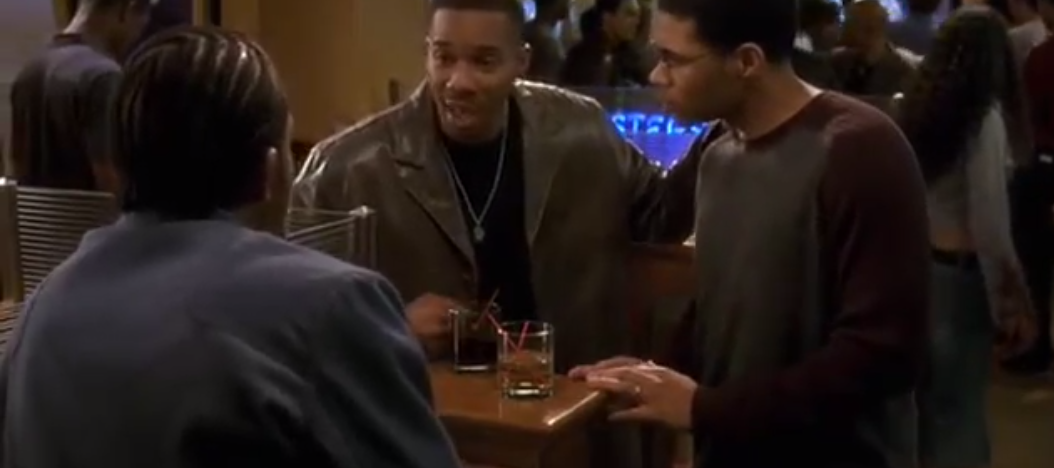
In this scene the three husbands, Mike, Darrell, and Tim have just been kicked out of Tim`s house for watching football. In a prior scene, Eva made them get out after saying this whole speech, just to basically say get out. They think that Eva is so mean and they dislike her so much. She controls their lives and make them feel like they are being controlled. The reason for them being kicked out is because Eva and her sisters needed the room to do a book club meeting. The three husbands had to go to the bar instead. While they are there, Mike  sees an old friend (Raymond) who they think can woo Eva to get her out their marriages. They have a little discussion in the bar and come to an epiphany that Raymond may be the one to get Eva out of all of their marriages. Mike even continues and says “This can work with Ray, the boy is a specialist, he is a master player.”  In comparison to Petruchio, Raymond is in it for the money at first. They both want to woo a lady who obviously has a hard time letting people in. On the contrary, Petruchio has to marry her for her father`s dowry and all raymond needs to do is go out with her a few times to get a couple thousands dollars. Which connects to my next quote from the book.


Tranio says “Ay, mistress, and Petruchio is the master, That teacheth tricks eleven and twenty long. To tame a shrew and charm her chattering tongue.” (Act iii./SC 2/ Line 213-20)


Tranio, Gremio and lucentio can all be compared to Mike, Darell, and Tim, the husbands who need Eva to date someone in order to get her out their hairs. In this scene Tranio, Lucentio and Bianca are all having a conversation about how they have someone for Katherine. At first Bianca is hesitant, but Tranio assures her that he is good and will marry Katherine in a day. In comparison, Gremio and Mike are the characters being compared because they try and find someone that will woo Katherine. They make sure the person has experience in basically charming women. In contrast, in the book, they involve Katherine`s sister in the conversation to let her know, but in the movie Eva`s sisters never know about what is going on with their husbands are doing. They know about Raymond, but never know his true motives. In the book, Bianca doesn't know Petruchio`s true motives either, but knows that Gremio and lucentio are trying to find Katherine someone that can woo her, so that she can get married, and eventually Bianca can then get married. This flows into my next scene to connect more with my thesis.


In this scene Ray is outside of Eva`s job, because he is trying to convince her that he is the one for her and to let him in again. The reason that it is the second time that Ray is trying to be closer to Eva is because Eva found out that he was doing a bet on her the whole entire time and that he wasn't truly in love with her. Although Ray claims that he was by saying “I am never, ever going to find another woman like you.” As you can see Eva is fed up and is now closed off to anything that Ray has to say. This compares to the book because Petruchio, also tries and say something like this to Katherine and makes her feel that he really and truly wants her. Both Petruchio and Ray, seem to use their words wisely into charming these women, Katherine and Eva, so they can ultimately be together in the end. On the contrary, Petruchio never ever reveals to Katherine that the only reason for him wanting her is because he wants her father`s dowry. Petruchio only commits to Katherine because of the money and Katherine never knows that. Ray tells Eva, thus making him pushed more away and for Eva`s wall to be back up. This leads up to the next quote from the book.


Katherine says “Nay, then, Do what thou canst, I will not go today, No, nor tomorrow, not till I please myself. The door is open, sir. There lies your way. You may be jogging whilst your boots are green. For me, I`ll not be gone till I please myself. `Tis like you`ll prove a jolly surly groom, That take it on you at the first roundly.” (Act iii./SC 2/ Line 213-20)


     In this quote Katherine is basically yelling at Petrucio telling him that if he doesn't love her, he can leave. She feels that she needs someone that is really going to be there for her, as to anyone who wants to be in love. In comparison to the movie character Eva, Katherine also explains to her lover that if he is not here to lover her  then they can stop wasting their time and get out their life. Both Ray and Petruchio have had to make their mark to woo these two women. In contrast though, Petruchio walked out right before this scene, which is the reason for this quote. Ray never stopped trying to charm Eva, but was always persistent. Petruchio was not very persistent, often putting his confidence on a 10.


Screen Shot 2015-04-19 at 5.43.34 PM.png

In this end scene, Ray just confessed his true love to Eva in front of everyone at her job. Eva had been lied to and put Ray in the doghouse. In order to woo her finally, Ray had to really show Eva that he loved her, and that was by buying her a horse that she always wanted as shown on the left in the picture. In comparison to the book, both couples ended up being together and either one of the parties confessing their love to their partners. Although in contrast, in the movie Ray confessed his love to Eva in front of all her co-workers, on the other hand in the book, Katherine actually confesses her love to Petruchio in front of all their family and friends. This may be kind of shocking, go off that in the book, Petruchio was the one that was supposed to be charming Katherine and saying that he loved her, but Katherine confessed her love to Petruchio, which was the moral of the title, “Taming of the Shrew”.


Petruchio says: Why, there`s a wrench! Come on, and kiss me, Kate. (Act 5./ SC.2/ Line 197)


This is a later scene,when Katherine has just confessed her true love for Petruchio in front of all her friends and has in a way been “tamed”. She says how she will be by his side and will do as a wife is supposed to. Comparing this to the movie, Katherine and Ray are very similar, in that being that they both tell their lovers that they surrender themselves into loving them completely. Also both Petruchio and Ray are the ones to finally grab their women and say “kiss me”. In contrast Petruchio's tactics are still to get Katherine`s dowry, but Ray has completely dismissed that notion and only want Eva.


Ray and Eva and Petruchio and Katherine obviously all have something in common, they all want something. Weather it be love or money. In the beginning the road is rocky and it seems that the men in both texts are trying to charm the woman, but in the “Taming of the Shrew” Katherine is the one to confess her love to Petruchio. Interference from outside parties may not always be the right thing to do when it comes to relationships, because it`s up to the 2 original parties to truly feel something, even if it`s not there at first.


Work Cited:

Shakespeare, William. The Taming of the Shrew. New York: Penguin, 1977. Print.

Deliver Us from Eva. Universal, 2003. DVD.


Be the first to comment.

The Trap of the Shrewd: A comparison between The Taming of the Shrew and The Parent Trap

Posted by Dillon Hershey in English 3 - Pahomov - C on Sunday, April 19, 2015 at 10:35 pm

The Parent Trap (1998) is about two girls, Hallie and Annie, who go to a camp and find out that they are twins, but separated after birth, one living with their mom and one living with their dad. When their camp is over they switch places in an effort to try to get their mom and dad back together, so they can all live together. When Annie goes back with their dad, she finds out that their dad picked up a summer girlfriend named Meredith and that they are planning on getting married later on in the summer. Meredith is 10 years younger than their dad and immediately, Annie doesn’t like her. In The Taming of the Shrew, Petruchio is up for the challenge of marrying Katherine, a daughter of a wealthy man because of the dowry that goes along with Katherine. Marrying Katherine is perceived as a challenge because she is someone who is grumpy and not well liked. These two stories show that society’s values around courtship and marriage have not changed because both suitors are in the relationship for the money.


In Taming of the Shrew, everyone thinks that Petruchio is a little crazy when he says that he would be willing to marry Katherine. Petruchio just really wants the dowry from Katherine.


“Then tell me, if I get your daughter’s love, What dowry shall I have with her to wife?” - page 83 (Act 2. Scene 1)


In this scene Petruchio is talking to Baptista, Katherine’s father and Hortensio, a suitor for Katherine’s sister. Hortensio was surprised and confused as to why Petruchio would want to marry someone as crazy and ill-tempered as Katherine. When Petruchio mentions that he has a wealthy background, he also mentions Katherine’s dowry to Baptista. The dowry was either a piece of land or money or both that the father would give to the husband to ensure that he would stay with the wife. Petruchio only really thinks about marrying Katherine because of the money involved with her.


In The Parent Trap, Meredith pretends to be nice and sweet but Annie and Hallie can see right through her act. She wants to marry their dad because he has so much money.


Screen Shot 2015-04-16 at 9.13.30 PM.png

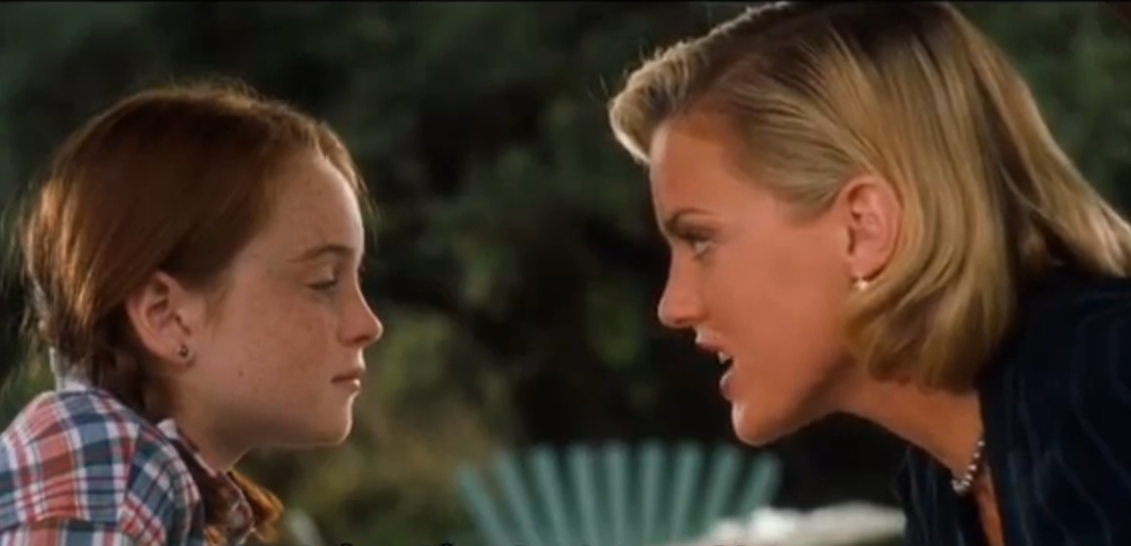
In this scene, Meredith is meeting Annie for the first time. Annie already knows some rumors about why Meredith, age 26, is marrying their dad, who is at least 20 years older than her. The rumors are saying that she just wants the money that goes with the winery that Annie’s dad owns. Meredith is slightly nervous because Annie seems like an obstacle in the way of her and the money. Meredith already has lots of money being a publicist but she has want to always have more, enforcing the idea that more is always better. In this way, she is alike to Petruchio because they are both in the relationship for money even though they have already have a good amount from their families.


“And to conclude, we have ‘greed so well together That upon Sunday is the wedding day.” - page 97 (Act 2, Scene 1)


In this scene, Petruchio has finished talking to Katherine and has told her father that they are ready to be married because Katherine loves him. Katherine, in fact, does not love him or even slightly like him, so Petruchio is flat out lying to Baptista so he can get the dowry and money quicker. At this point in the play, some people believe that he has forgotten about the money and only thinks of Katherine as a challenge to overcome by annoying her. Petruchio must have some concern about the dowry still, because it is a large amount of money and land.


Screen Shot 2015-04-16 at 9.30.57 PM.png


In this scene, Annie confronts Meredith about her intentions of marrying her father. Meredith gets defensive and mean but doesn’t deny the rumor that she is marrying for money. Meredith sees the girls as a roadblock in front of her money, so she tries hard to get rid of them. She is lying to their father that she likes them and that she would be a good stepmother for them. Petruchio lies to Katherine’s father about how he got her to love him, so that Petruchio could get the dowry. Later on in the movie, Meredith mentions to her father about how much money her boyfriend has and how in love with the money she is. This reminds the audience how driven she is for the money and how much she wants to have more and more.


Petruchio seems like a better person because eventually he forgets the idea of the money that Katherine comes with, or so it seems. He then moves on to the goal of taming Katherine by giving her an ultimatum; agree with everything he says or she won’t be well fed. Since Petruchio is stuck with Katherine, after marrying her for the money, he has to figure out a way to live with her and make her tame. Meredith, at the end of the movie, gives the girls’ father an ultimatum; herself or the girls. She gets so fed up with the girls’ antics and tricks that she is willing to give up the large amount of money that their father has for some peace. In both of the stories, the greedy character has to overcome some obstacles or roadblocks that are in the way of the money that they want. In the end, Petruchio gets the money along with the woman, but Meredith doesn’t succeed. In Taming of the Shrew, Petruchio is willing to live with a bitter woman for money and in The Parent Trap, Meredith is willing to marry a man that she doesn’t particularly love for money. This shows that society’s view on marriage and courtship is that people will marry for money, no matter what they have to deal with on the road to money.


Sources:

Shakespeare, William. The Taming of the Shrew. Ed. Barbara A. Mowat and Paul Werstine. New York: Washington Square, 1992. Print.

The Parent Trap. Dir. Nancy Meyers. Prod. Charles Shyer. Buena Vista Pictures, 1998. DVD.


Be the first to comment.
84 posts:
← Prev
  1. 1
  2. 2
  3. 3
  4. 4
  5. 5
  6. 6
  7. 7
  8. 8
  9. 9
Next →
RSS

ENG3-017

Term
2014-15

Other Websites

Launch Canvas

Blog Tags

  • Pahomov 1
  • english 11 1

Teacher

  • Larissa Pahomov
Slate (skeleton-v3 PHP 8 prototype) · Location: 1482 Green St · Shipping: 550 N. Broad St Suite 202 · Philadelphia, PA 19130 · (215) 400-7830 (phone)
×

Log In