• Log In
  • Log In
Slate (skeleton-v3 PHP 8 prototype)
Slate (skeleton-v3 PHP 8 prototype) Learn · Create · Lead
  • Students
    • Mission and Vision
  • Parents
  • Community
    • Mission and Vision
  • Calendar

English 1 · Giknis · D Band Public Feed

Create a Post

Social Decline continued....///Vincent Cammisa

Posted by Vincent Cammisa in English 1 · Giknis · D Band on Sunday, March 18, 2018 at 9:11 pm

Social Decline Continued


In my previous blog post I gave a brief description of my topic, the negative effects on social media. These effects vary from sleep, depression, and lack of communication skills. We also talked about the percentages of households that contain handheld devices, along with a prediction in the future of what the year 2020 will look like. I will go on into a little more details , listing and informing you, the reader, more negative effects of participating in social media.


So far we have talked about three negative effects caused by social media, Next I have another effect of social media, and it is kind of crazy how many non benefiting affects that I can find form the internet. So, the next one is the addiction aspect, and the time consumption, how it can eat up the time out of your daily life.


Doing some research on the topic I found some repeating patterns. Various ones showed up on different sites, one not loving technology so much, but what they really want to access is done through technology. What is one thing that requires a phone? That thing is communication with friends, and how they need to keep up with the “latest news”. One thing to notice is that with the addiction, it ties into the communication situation we discussed as said in a washington post “teens spend so much interacting with each other on social networks and phones that they are growing less comfortable with in-person interactions and not developing essential social skills.”  and this just proves my previous claims.


Adults are usually on there phones frequently, but they have a farther variety of reasons why to be on their phones as much as they are. Teens however are getting to the point where there phone time consumption is fit for an adult.


Observe image below


6B18377491434BD4949D22C678EAB33A

In this image they are showing how withing the four year span of 2004-2008 that the time teens are on there phones now imagine 10 years later in 2018 and see who is on their phones more.


The next thing on the list that I am going to mention is something more generally about female teenagers. How social media has a huge influence on their self-image. Girls are constantly are self conscious even if they do not admit, I can say that guys are also affected by it, but I think that girls go to the father extreme of finding the level of satisfaction, or just to satisfy other individuals.


Being a student that attended three different school, each one consisting of both genders. During those years consistently, I’ve observed and would say 75% of the students are drained and focused into there self image, and social media just boost it to another level. A short passage from cnn states… “it's not a law that you have to post a selfie before, during, and after every activity. But for kids, it's pretty much mandatory.  The resulting likes, thumbs-ups, and other ratings all get tallied, both in the stark arithmetic of the Internet and in kids' own minds. For some -- especially girls -- what starts as a fun way to document and share experiences can turn into an obsession about approval that can wreak havoc on self-image.”. Imagine a world without social media? Would you be better and healthier human being? Maybe you would get a more healthy amount of Sleep, are you obsessed? Those questions that I just asked were put to the test.


For the past month I have been thinking about what do do for my original research I figured why don’t ask our generation, the teens. So it started as interviewing teens, in person, for a quick five minutes. The process was smooth but I wasn't getting the information that I needed and I needed some insight where the person answering wasn't feeling invaded and was comfortable answering. So that is when i decided that I was going to conduct a survey. Answers varying from exactly proving my points to not so much. Considering both I cae to a conclusion, but first let's look at the results to  my survey.


Screenshot 2018-03-17 at 8.48.21 PM

Looking at this chart and with the results I can confidently say that the majority of the people who answered to the survey would be a better or a more improved version of themselves without social media. I can not say if they would be happier though.


In the first post we talked about the effects social media has one an individuals and one of those is the mass amounts of sleep lost to social media.


Screenshot 2018-03-17 at 8.55.58 PM

Going into this question I knew that sleep was something that was being taken over by social media or even Netflix( let's not get off topic) but at this point I think you get the point for this one Let us look at one last one.


The last one I will be looking at with you is how much time is put into your social media/cyber life. From how much I participate and noticing with my friends with how much they use it I can say that we are pretty consumed. One answer states ”I've become less attentive. Sometimes I go on it in the middle of class or something” Some though say that social media doesn't really bother them.. Let us take a look.


Screenshot 2018-03-17 at 9.22.37 PM

Some mixed opinions  but, with these varied answers it helps me come to a conclusion.

So my conclusion is a little bit of opinion and facts because I believe a lot of people can, and do experience negative affect, but there are some people who either can ignore the decent amount of bad or they just are lying. Anyways. This is a successful experience and I think myself have learned a lot. I am still curious about why people are so engaged into social media I’m into it a lot but I somewhat still don't have an idea why I am involved with it  so much. After all of the work I have done on this I still am not 100% sure about my Agent of Change but I wanna start small. People need to be aware before anything can be preached.


Anne Otated  and Biblee Ography

Tags: english 9 // you and the world
4 Comments

Something More Than A Litter Bug

Posted by Randy Le in English 1 · Giknis · D Band on Sunday, March 18, 2018 at 8:44 pm

Something More Than A Litter Bug


If you haven’t seen my recent post on litter, come check it out here.


My first blog post was diving into an online research about litter. I discovered that one of the contributors to litter was straws. I found that I had to go further with straws after seeing a video of a straw stuck inside a turtle’s nose. I visited many websites on how straws could affect wildlife, more specifically marine animals. And so my journey began and I am here today to take my research onto the real world.


For my further research, I decided to go out and observe the area nearby my neighborhood. I first needed to make a list of what I needed to observe and have my purpose to be clear. I was first thinking about only focusing on straws but why ignore the remaining litter because any type of litter is still endangering. So then I came up with my purpose of observing litter in general. Many questions occured around me and some were “How many people littered?”, “How did they litter?, “Why did they litter?”. The questions could go on forever


I decided that I shouldn’t focus too hard on finding one thing because I needed an open mind while doing this research. There’s so much to find and everything could contribute to my research. I simply took out my phone and decided to take a walk around my neighborhood. I found many places where litter could be hidden or tossed into. Strangely, there are many places where litter can be found but there is almost a go-to litter place around the neighborhood where piles of litter can be found. Whether it be leftover food containers or old household items, it is still considered litter and I took note of this.


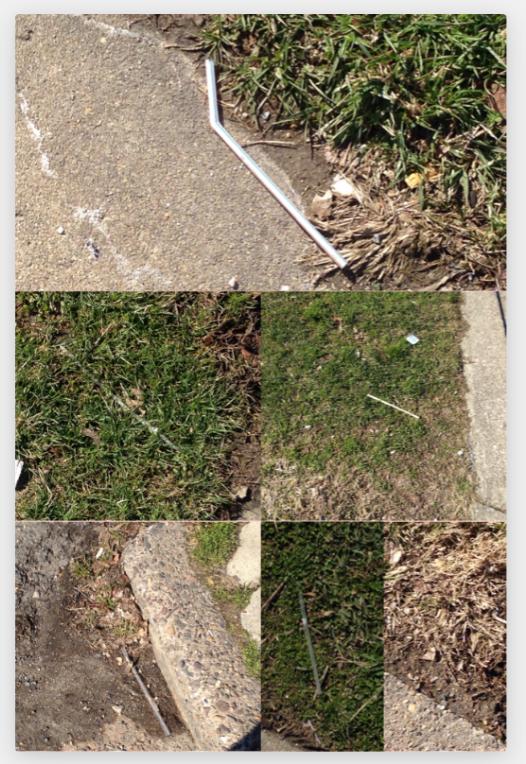
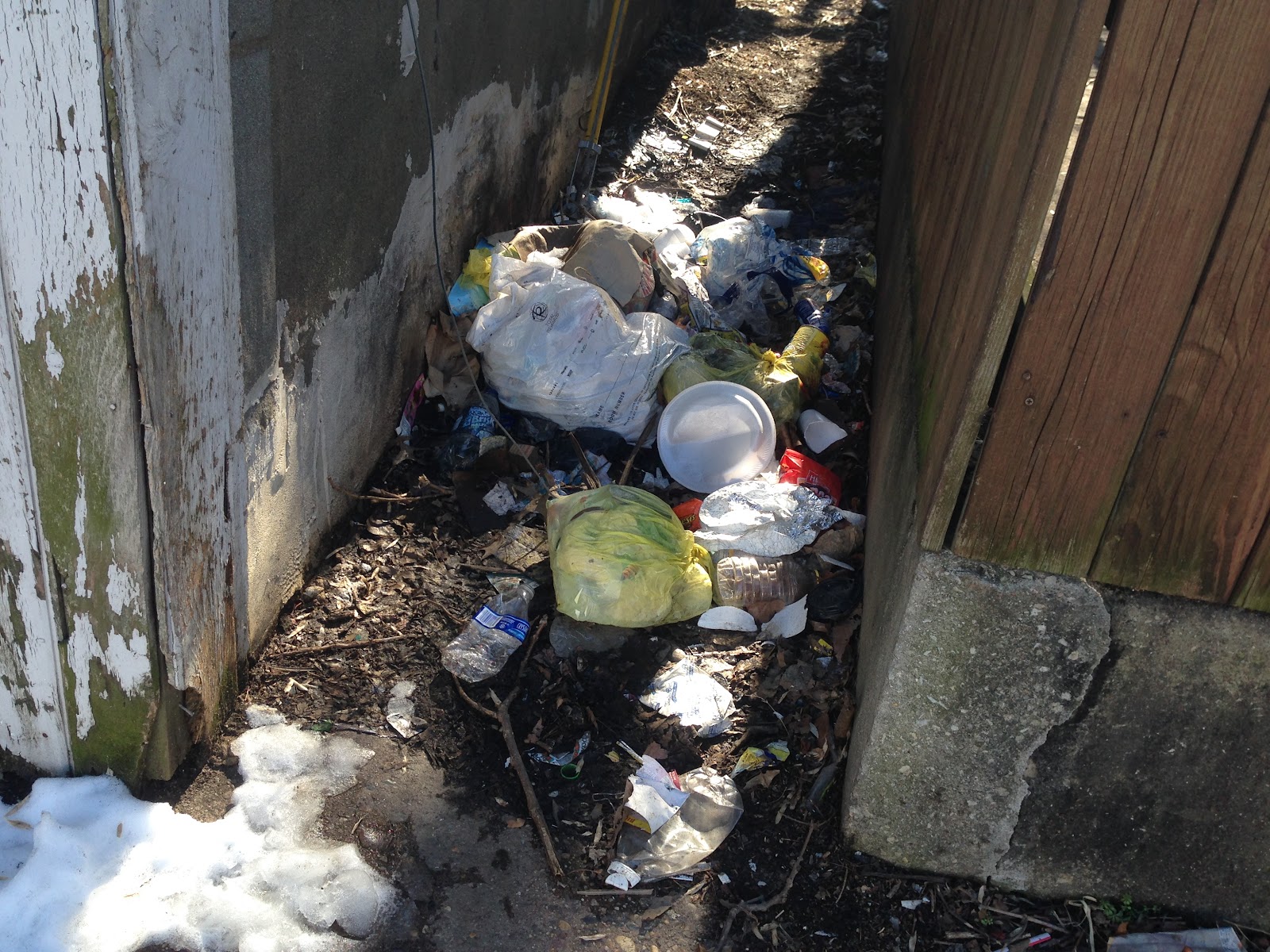
A photo taken of large amounts of litter stockpiled in a hidden gap.

A photo of litter found in the corners of houses.


As I continued my observation, littering became more obvious. I had never sat down and watched if litter occurred as often as it does now. I like to relate this to cutting or skipping a lunch line. Many people still do it and many people hate it. It’s something that we all know and can relate to. Some methods could be “meeting with a friend” or just straight up cutting. This goes in the same way as littering because I find that people sneak a empty bottle around a corner when nobody's watching or they throw trash without caring. To add to that, others also openly litter by dropping off their remainings of their lunch from their car window.


Photos of straws found hidden next to rocks or within grass.


After I was finished with my observation, I continued my online research. Recently, a CURBED Philadelphia article has been published. The article speaks about a new map that users could test the litter around their neighborhood on a scale of 1-4. I recently test this on my neighborhood and found that the average score was about 2.5. According to my observation, I found this accurate because I wouldn’t say everything is terribly dirty but there is still litter. In addition, the map also shows that the deeper you’re in Philadelphia, the more litter you might find.


In the end, change needs to happen and it will. Currently, Philadelphia is identifying the problem using a snapshot of how polluted the city is currently. Knowing this, I am thinking of my agent of change to be something around my neighborhood and friends. I want to start small and I can do this by referring back to plastic straws. I have seen many organizations on plastic straws and I plan to help them out by possibly calling restaurants nearby to only give straws upon request only.


Check out my Annotated Bibliography for further information


Tags: English 9, You & the World
5 Comments

Catcalling In Society

Posted by Gabriella Torres in English 1 · Giknis · D Band on Sunday, March 18, 2018 at 8:43 pm

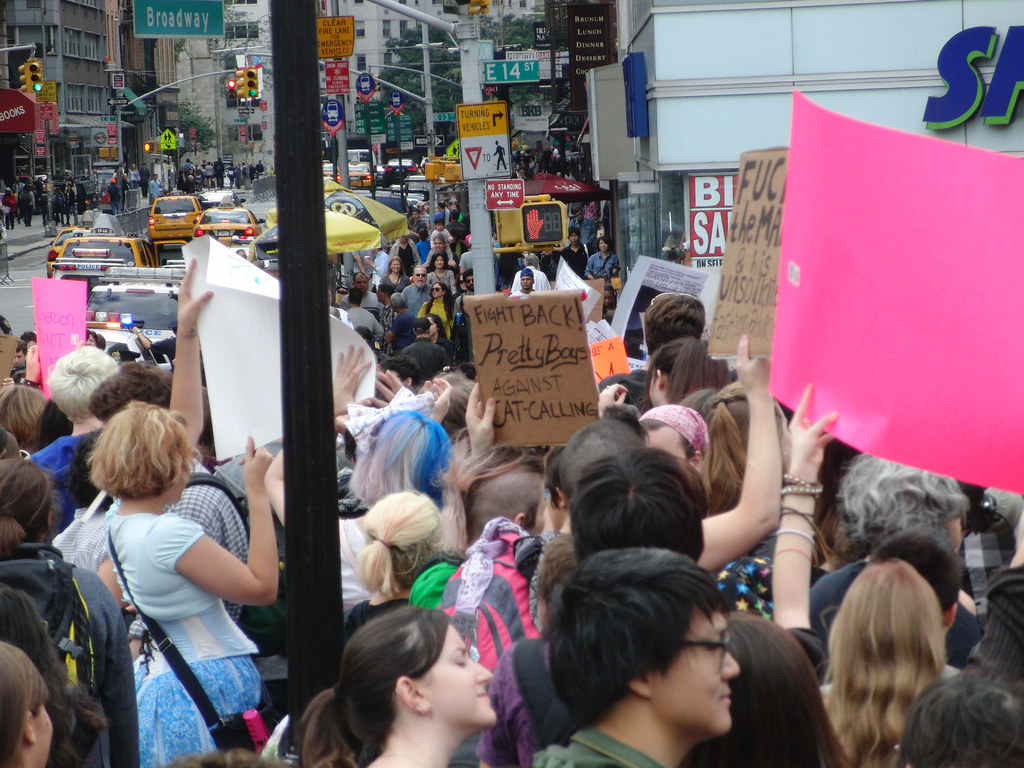
All of my research from post #1 has impacted the way I have continued to think about catcalling. My research before was about how growing up is not as easy as it may seem, especially if you are a young woman. Men have grown up in this society where they feel the need to make comments about our bodies without thinking twice about it. As women we do not appreciate theses comments. Obviously some women feel as though they enjoy the attention and feel as though men are doing nothing wrong going ahead and commenting on their bodies. They don’t think about how some girls can be 12 with a well developed body that makes them perceive as a woman at least 18 years old. So men believe it is okay to make sexual comments towards them without thinking that they may be under the age of consent.This is when catcalling becomes such a thing that needs to be seen and made aware to the world. When doing this second post I had did my own observations by making women take a survey and tell me how they feel about Catcalling.If you would like to view my first post the link is here.

Since the last post I have taken the initiative to dig deeper into the stories I have found on the internet and see what stories I can get on my own. At first I found some credible sources from women writing about what had done to make awareness of catcalling and their personal experience. As Rachel Hosie had said,“For me, it has always been more than an annoyance. It’s shaped my experience in public space. It’s affected my confidence and comfort walking down the street. It’s silenced me ― I’ve never felt comfortable responding to catcalls, as much as I’d like to tell these men off.” When I seen this article it made me think back into my 1st post and realize the connection between both. Each of the articles I had forund had a way of saying they needed something to change but neither one of them had done anything. They had just said they wanted to do something but writing about it was their way of getting something done. In this tense though this time someone wrote about how they felt and also even made a way to bring awareness. Rachel had put sidewalk chalk in bins in NYC where she let women right different catcalls they had received so, women and men were able to see that first catcalling is not a right thing but also to show to the women that they aren’t alone.


This article made me realize that if one person feels as though this way then multiple people may also so, I created a survey with a couple multiple choice and short answer questions that would help me get information for my cause from different age groups to be able to see how they view catcalling. This did take a little longer then expected trying to get responses since not everyone feels comfortable talking about their experiences or giving up about 5 mins of their time responding to this survey. At the end I had received about 80 responses giving me more than enough stories and their personal opinion about catcalling to write about. At the end of everything the results were very shocking. After all the responses I was still left wondering if there is anything that can actually be done to change and get through men's heads that catcalling is not okay.

The first question of my survey was How old are you? This was to get a general idea of the age range I was retrieving from survey takers. Majority of the people that had took the survey were between the ages of 15-16 making them freshman or sophomores in high school. With some of the data you can also notice that I had some survey takers that were between the ages of 11-12 which opened my eyes as soon as I looked at the data because it shows how not just adults receive sexual comments made towards them. This also relates back to the article in Post 1 about the statistics showing kids between the ages of 11- 12 recieve comment from men of all ages because of the way child may look may seem as though they are older then they truly are.

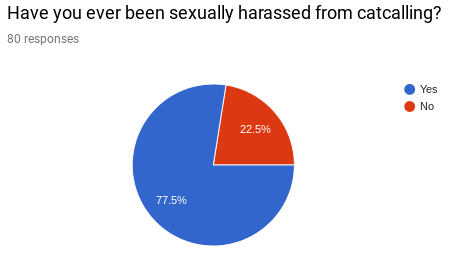
This was the second question of my survey was Have you ever been sexually harassed from catcalling? This showed how 77.5 % out 80 people which is 62 people have been sexually harassed from catcalling. Which is pretty intense that only 18 other people were not. This is showing to me how it is more likely to be sexually harassed then not so if you ask more people it would be more of a chance that they say yes then no which is such an eye opener to myself and I hope to everyone else too.

Now here is my third and fourth question: At around what age did you first receive a sexual comment made from an unknown male? And describe a time where you were the victim of Catcalling. This is when information received changed the way things were seen. When you look at the  the graph is is showing about what age did each women receive their first catcall. Majority of the people said they received their first catcall between the ages of 11-16. These were the 3 top age range that had gotten any type of sexual comment made to them. Then their is personal experiences given by 37 of our survey takers. Each of them gave a personal story they felt they would share for this project. This was the exact part that made me say wow. How can so many people have so many experiences with catcalling that could of lead to so many more serious problems; mental issues, low self esteem, and much more.

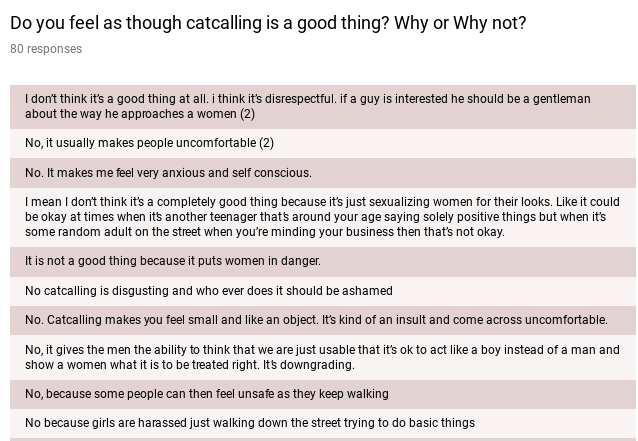
While looking at these two answer charts that I received from my survey made me realize that majority of the women feel as though catcalling is not a good thing and they really do not know exactly what to do to stop this situation because of the comments making women feel unsafe around their surroundings but also make them feels as though they are objects and not human beings and this is something that has been going on for so long that they feel as though that nothing that maybe thought of will change the mindset of a man to stop from making these degrading comments to women.

When looking at all this information I received It made me realize how many women go through catcalling on a daily. Also some of their stories showing how rude men or if you may want to call them boys degrade women with harsh comments that they feel as though will do no harm.This all adds to my research because I was able to see this for myself and not get this information online where I wouldn’t know if some of these stories were false, but when i had read some of my survey takers experiences it showed me that this is something that needs to change even if it isn’t a immediate change something need to give.

At the end of this all I am still left wondering what I could do for my Agent of Change because there are so many things that I could do to bring awareness. I feel as though if i put something together I can make a short film having women speak about catcalling and post it and see where it leads from there. Obviously this is one idea I hope to think of something more thoroughly.


Annotated Bibliography: https://docs.google.com/document/d/1semQkUFkWIfrTt7-4D7wBLAFR4YS0_vT0ISagUwy2bw/edit?usp=sharing


1 Comment

Asian American Voting Rights Activists' POV

Posted by Xin Yi Zou in English 1 · Giknis · D Band on Sunday, March 18, 2018 at 8:43 pm

Before reading on...take a look at my first blog post, Where Are Their Voting Rights?

This will give you background information of what is going on with Asian American voting rights from the past until of now. From the Voting Rights Act to the changes that have been made and the ways people have helped in this issue.


According to CAAM, in 2012, eight million Asian American and Pacific Islanders were able to vote and only 47.9 percent of them voted. Even though, the population of eligible voters increased by 29 percent since 2010, voting for Asian Americans and Pacific Islanders is still a problem. Asian Americans that live in swing states like Nevada, North Carolina, Ohio, and Pennsylvania is also a problem because it would take a longer and broader time of allowing them to in civic participation. Ways that they try increasing the population of Asian American voters are phone banking, going to door to door, and having volunteers to help out with voting registration and language difference.

For some Asian American voters, language is still a problem at voting polls. For example, Saurabh Das was not only able to vote at the poll, he was able to help other voters at the poll by translating the ballot in different languages for non-English speakers or readers. IN 2014, he was put in jail for translating for his mother at the voting poll and for not being registered to vote in Williamson County, Texas. Because he was put in jail, his mother wasn’t able to vote for the person she wanted to and mistakenly voting for a different person.


For my original research, I decided on interviewing Wei Chen, the Civic Engagement Coordinator of Asian American United (AAU) and Xu Lin, one of the board members of AAU and currently the owner of Bubblefish. I was also planning to send out surveys to seventh and eighth graders at my old school, FACTS because I thought that it was be better to have two points of view of Asian American voting rights, not only from experts but so young citizens because they will be making a difference in the community one day and from asking them for their opinions about Asian Americans will change knowledge of what’s going on and my perspective of Asian American voting rights. I wasn’t able to send out surveys because I thought of it as a plan b if my interviews did not work out as planned.

While I was interviewing Wei Chen, I learned that if people that are trying to make a change to voting rights for Asian Americans, it would take at least five to ten years to see little changes happening in the community. For elders or older generations from China, some may be unfamiliar with voting booths or polls because in China, there is no voting booths or polls.


For more information of the interview, take a look at the transcript below.

From the interview with Xu Lin, I learned that you don’t necessary need to be apart of an organization everyday to fight for the justice of the issue that you think is important. For example, Xu Lin is now an owner of a restaurant and since he would like to see a difference in Asian American voting rights, he is willing to allow GOTV volunteers to borrow the room in the restaurant for meeting and more.


To hear my interview with Xu Lin, view the voice recording below. I apologize in advance if it is hard to hear.


https://drive.google.com/open?id=1R9REslzVWUGLt8CAMCoKl_Ii2gUKkdM_


For my Agent of Change part of the You and The World project, I was thinking of volunteering at Asian American United (AAU) to help out with voting registrations or notifying citizens in Philadelphia to register as a voter. I also thought of creating a presentation to present to the class or a class at a different school while volunteering at Asian American United because if I present this issue to others in the community, more people will be notified about this issue and pay more attention to voting rights and helping out citizens that are non-English speakers or readers. This is only an idea so I am not sure if my ideas for my Agent of Change would change or not.


Annotated Bibliography


Be the first to comment.

Make Wage Inequality a Thing of the Past

Posted by Sarah Cohen in English 1 · Giknis · D Band on Sunday, March 18, 2018 at 8:38 pm


In my first post,I discussed how the gender wage gap is different for different types of women. It varies based on both age and race. Some of my research for this post included finding some more statistics about the inequalities between men and women in the workforce. I learned that a woman with a masters degree makes about the same as a man with a Bachelor’s Degree. A woman with a Bachelor’s Degree make around the same amount of money with a man with an Associate’s Degree. Women also tend to go for sub-majors that do not pay as much. For example, women hold 56% of jobs in biological and life science while they only hold 17% of engineering jobs.

For my original research,  I conducted an interview with Laura Mattiacci. She is a partner at Console Mattiacci Law. This is a law firm that focuses on representing people who have been treated unfairly at work. She got into this type of law because she wanted to be able to represent people who could not speak for themselves.


Laura Matticci
Laura Matticci

After school on the day of the of the interview, I went down to the office. I get down there and I  told the security guard in the building that I was there to see Ms.Mattiacci, the security guard called up to her office and they said that she is not in the building. I am then told that my interview was supposed to be over the phone. At this point it was around 4:25 (my interview was scheduled for 4:30), so I did not have time to go home and do this interview. After getting some advice I went back into the building and asked if there was office I could sit in to do my interview. They said yes and I went up to their offices. Once I got on the phone with Ms.Mattiacci she said that she had not been notified of this interview, and had no idea what she was supposed to be talking about. Below are my questions as well as a few notes.


Screenshot 2018-03-18 at 09.14.21
These are the notes I took during my interview

In the interview, she told me about how the best way to prevent wage discrimination based on gender is by being transparent about how much people are making.If people know what others are making, they can know if they are being paid fairly.  One way to promote this is through unions. In a union, where everyone is fighting for the same cause. She said that many people do not know that they are being paid unfairly.

She also told me about the Lilly Ledbetter Act which talks about how long you can wait to sue for unfair pay. That was the last law passed about the gender pay gap. Ms. Mattiacci said she does not predict that any new legislation will happen until the current administration is not in power. Sadly, she said that as of now we are going back in time when with wage inequality. After my interview, I am still wondering what I personally can do. It does not seem like there is much of a movement about this issue.

To go with this interview I also read an interview with NPR where a woman from an Icelandic Women’s Rights Organization was talking about a system that they are using to prevent the wage gap. This system involves an audit for businesses that have  25 or more employees. This makes sure that these companies are paying their workers what they deserve based on how much work they are doing for the company. If a company realizes that they are not paying their employees equally they are required to fix it so that their employees are being paid what they deserve. This has surprisingly resulted in raised for men as well as women. Since the program is quite expensive they are starting with the biggest companies and are hoping to make there way down to smaller ones eventually.

For my activism stage of this project, I am considering doing something that is based on awareness towards this issue. This may include creating a website about this issue or maybe creating flyers or posters about this issue. I hope that I will be able to do something that helps the women of tomorrow be paid what they deserve.

Go here to view my annotated bibliography
Tags: English 9, You and the World
Be the first to comment.

Gang Violence - Not a Single Story

Posted by Samuel Friedman in English 1 · Giknis · D Band on Sunday, March 18, 2018 at 8:36 pm

In blog post #1, I took an issue in the world and I further developed it to see what could be done to solve it. I focused more on why I was passionate about the topic as well as sources for information. I proved its significance as a valid topic and went into further depth about the issue. I explained the impact that it has on people and why it needs to be solved. Lastly, I had to explain what I wanted to learn going further, and from then I have learned a lot.


Since my last post a lot of new information has been discovered. In my recent findings, I found an organization who not only share my concern for gang violence but they are actually doing something about it. Philanthropy Roundtable is an organization that is combating violence with nonviolence. They offer a lot of programs and take in a lot of donations. I recommend checking out their magazine, Philanthropy Magazine and they have an excellent website as well. Another source that I used I actually reused the website and found a different article. It is an article about gang resistance education and training law from the site US Legal. It is about a program that teaches youth how to protect themselves from threats like gang violence. These programs are focusing on the same type of things that I am. Solving gang violence with nonviolence is the best solution when combating this issue.


In my original research I interviewed one of my classmates. Like me she lives in a neighborhood were gang violence is common. She is affected by gang violence everyday. This helped inform me on my issue because we both have different stories and different memories and live in different neighborhoods. We both have a different perspective on the same issue and are affected by it in similar ways. She informed me on how gang violence effects neighborhoods on a bigger scale. This helps me understand my topic better because it informs me that I am not the only one who realizes that this issue is an issue. It also helps me understand how specifically this issue affects others. With this interview, I am now very informed on the current issue that is gang violence.


After doing a fair amount of research and having a strong opinion on the matter, I feel as though the only way to protect neighborhoods and their citizens from gangs and gang violence is to non-violently inform them so that they can protect themselves. Also I think that putting more patrol cars in sketchy areas is necessary. After all of my research I still am left wondering what is the real reason for one to join a gang? Is there really one solution that solves it all? What can I do as a citizen and as a youth to inform people on this topic? I wanted to see if I could get this information from an expert. Along with my interview with my classmate I was supposed to interview a police officer who specializes in gang violence and gun violence, unfortunately the interview did not work out. Now that I have done all of this research I plan on looking into some of the programs about gang violence and developing my agent of change.


Annotated Bibliography


Interview

1 Comment

Farms and Food Waste

Posted by Elena Smith in English 1 · Giknis · D Band on Sunday, March 18, 2018 at 8:20 pm

​

In my previous post, I talked about food waste and how it is a major world problem that does not get the attention it deserves.  The good news is that food waste is an issue that can be solved. Eliminating waste would save all of the resources that go into making, processing and distributing uneaten food.  It would also diminish the amount of methane released into the atmosphere. As I continued my research about food waste, I started to focus on where the waste starts: the farms where food is grown.


Since I made my last post, I found out that 20% of all food never even makes it off of the farm. Like I said in my last post, farms don’t give their foods to big brands like Acme or Costco because they know that the food won’t be bought by consumers. They don’t give away the food to shelters because the farms don’t receive tax cuts, which means all food transported to different areas comes out of their own pocket. Because of this, many farmers just throw out any extra or misshapen produce and leave it at that. Many organizations are starting up in response to food waste and have started delivering farm produce straight to people’s doorsteps, but these companies are few and far between.


Most big time companies, like Costco, only buy the best looking produce available from farms, which starts the cycle of food waste

For my Original Research I wanted to interview two companies, one called Move for Hunger that moves produce from families moving out of their homes and gives the food to shelters. The other company I wanted to interview was Whole Foods, just to ask about how they deal with food waste since it is an issue that they are aware of. I ended up interviewing neither of these places, since both did not answer my emails. But thanks to Ms. Giknis, I was able to interview an organization called Imperfect Produce.  


Imperfect Produce is a company that imports fresh produce that otherwise would have been wasted from local farms in California and distributes the fruits and veggies to people in the state. People get major discounts if they’re buying it online, getting organic food for half of what it would cost at the supermarket. Although the Imperfect Produce started in California, the company has been spreading to major cities outside of the state such as Portland and Seattle. The person I interviewed, Anneliese, worked in a department called Brand Management where she made the logos for the company.  She also organies events to get more publicity about the company. I did record the conversation, but when I saved it to my downloads it saved as text file instead of audio, so I don’t have the transcript or the recording of my interview.


In the interview, I learned how Imperfect Produce ordered the food from farms and the basic workings of the company. The company is slowly growing, and it plans to become national and reduce food waste and the problems it causes. Since its opening in 2015, they haved saved over 15 million pounds of food from being waste and have saved 42 million pounds of Co2 from entering the atmosphere.


For my Agent of Change, I was thinking of looking at how much money my mom and I spend and waste on food in one month and then the next month see how much money we can save by being more aware of how much we spend on food. I’m not sure how I would calculate how much we spent, but I hope I can figure something out. If there is a significant difference in the amount of money we spend, I hope we can contribute less and less to food waste as the year goes on.


Here’s the link to my Annotated Bibliography


3 Comments

Exhilarating the Nation's Curiosity

Posted by Matthew Nguyen in English 1 · Giknis · D Band on Sunday, March 18, 2018 at 7:14 pm

Artist’s rendering of NASA’s SLS on the launchpad.  Credit: SpaceNews.com: http://spacenews.com/nasa-sets-december-2019-date-for-first-sls-launch/

“All three engines up and burning.  3, 2, 1, 0, and liftoff! The final liftoff of Atlantis.  On the shoulders of the Space Shuttle, America will continue the dream!”  Since the end of the Space Shuttle program, NASA has aimed for the much more ambitious goal of sending a man to Mars.  Currently, they plan to launch man to Mars by the mid 2030’s In the last blog post, I talked about how NASA’s funding has declined since its apex in the 60’s 70’s and the moon landings.  Since then, the Space Shuttle has expanded knowledge of living within space but it can travel no further than low earth orbit.  To do that, they need to build a new Space Launch System or SLS. However, it is already much more expensive than the proposed BFR from SpaceX who plan to launch more to Mars at just a fraction of the cost.  One possible reason for this is the change of power in the United States meaning change in plans for NASA’s programs, leading to progress taking a long time to be done with constantly changing goals.  

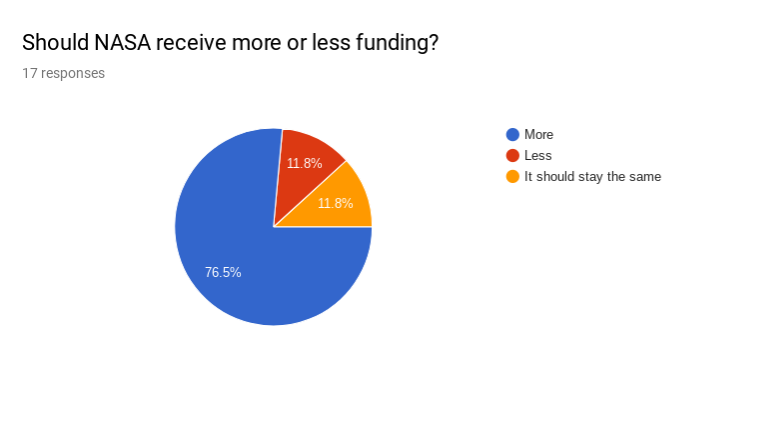
After having collected surveys from students at SLA, I would like to share my results, but before that, I will state the goals of my survey.  My plan for the survey was to ask people how much they believed that NASA receives, along with whether they should receive more or less funding.  As I continued my research, I began to add more questions based on companies like SpaceX competing with NASA. When it came to the answers, the common answer to “how much money do you think NASA receives?” was around the ballpark of 2-5 Billion, with some saying in the range of millions, and one answer saying trillions, but the trend is showing that people think NASA receives less money than they actually do,

which is around 18 Billion.

The majority of people believed that NASA should receive more funding, and they said that the money for that should come from the budget for Government or Military for the reasons of it being important for them to combat global warming and advance technology on earth with endless possibilities.  The people who said that NASA should receive less funding said that it should go to education, citing the reason that our school system is falling apart and would need the funding.

Another question that was added was on the topic of NASA’s manned Mars mission, which to me, would show the people’s faith in NASA to send humans to Mars within a decent time frame.  The majority had faith in NASA to land a man on Mars before their planned date timeframe of the 2030’s


For the next series of questions had to do with NASA versus private companies when it comes to landing a man on Mars first.  NASA plans to use the SLS to launch humans to Mars while a likely rival is SpaceX with their Big Falcon Rocket or BFR, who plans to get to Mars cheaper than NASA, but a timeframe isn’t clear yet.  This question was more split with slightly more than half believing that NASA would send humans to Mars first, citing that these private companies might not be reliable and the rest saying that Private companies will send humans to Mars first, with one reason being as they are cheaper than NASA.  


Annotated Bibliography here.

Tags: benchmark, You and the World
Be the first to comment.

New Information on the Illegal Animal Trade

Posted by Antonia Solar in English 1 · Giknis · D Band on Sunday, March 18, 2018 at 6:45 pm

In the last post, I talked about my You and The World Project and how I picked illegal animal trafficking as my research topic. I learned how the rarer an animal is, the more demand there is going to be for that specific animal or animal product. Also, the reason why there isn’t that much information about the people selling these products is because they are big industries that provide financial support. Furthermore, illegal animal trafficking is also usually done by people who are local and who live in low income neighbourhoods, which is why they end up turning to illegal animal trafficking.


 Image result for illegal animal trafficking
Ivory being cut from a rhino to be illegally traded. © MICHEL GUNTHER / WWF-CANON

When live animals are trafficked, they can suffer from malnutrition, stress, depression, loneliness, and even death. According to an article from PETA (People for the Ethical Treatment of Animals,) animals have a mortality rate of 80-90%. From the same article, I also found that 90% of reptiles trafficked die within a year. When wildlife animal buyers realize they cannot care for animals, they abandon them by setting them lose to the wild or leave them outside of a zoo. This can cause animals to either die of starvation or to end up becoming an invasive species. Buying an exotic animal can not only be harmful to the animals themselves but also to humans. The article states, “Parrots and other exotic birds can transfer potentially deadly pathogens such as psittacosis, salmonella, and even avian tuberculosis to humans.” This shows how humans can gain all kinds of diseases from the wild animals they buy. It also says that “With the number of inspectors, we are able to physically inspect 25% of wildlife shipments.” Even with the regulations that are put to protect wild animals from being illegally traded, the laws are barely enforced.


Related image
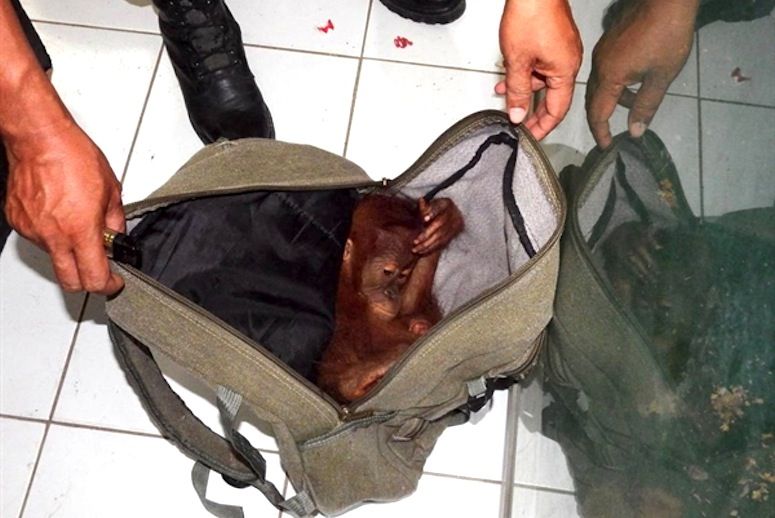
Baby orangutan found in backpack being illegally trafficked. (Photo: WCS Wildlife Crimes Unit)

One of the biggest contributors to the illegal animal trade is people who buy exotic animals to keep as pets. According to the The National Humane Education Society, “For one, many owners do not have the knowledge or financial ability to adequately replicate a wild animal’s habitat within their own homes. Second, many exotic pets, such as hedgehogs and sugar gliders, are extremely small and can be easily crushed by furniture, closing doors, rowdy children, etc. Birds, specifically have the unique ability to fly away, only to die in temperate climates once the outdoor temperature drops in the winter. Third, not all veterinarians treat exotic animal patients.” This shows how just because people want to have a “cool” pet, they can end up hurting both themselves as well as the animal they are taking care of.


Related image

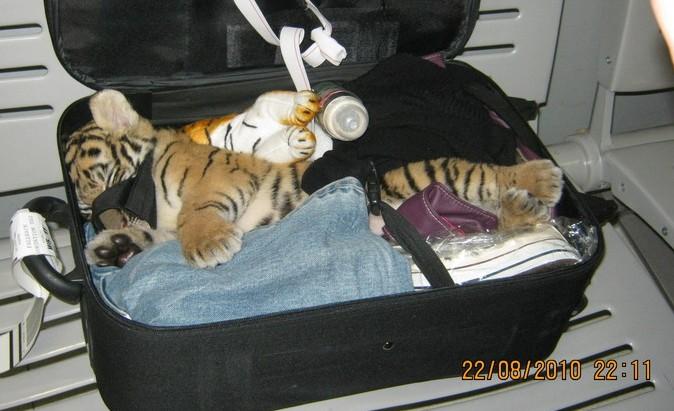
Tiger cub being smuggled in suitcase. Photo credit: "Wildlife Checkpoint, Suvarnabhumi Airport."


After all this new research, and learning so many new interesting things about wildlife trafficking, I decided to conduct my own research. I interviewed Susan Lieberman, the Vice president of the WCS (Wildlife Conservation Society.) In the past, she had also worked for the WWF-International as the Director of the Species Programme. She also worked for the US Government at the US Fish and Wildlife Service. She has a PhD in tropical ecology. Dr. Lieberman has also worked on the intersection between science and law. This is why I thought she would be the perfect person to interview.


Susan Lieberman, PhD

For my interview, I really wanted to ask questions that would either expand my knowledge about a certain topic or teach me something completely new. From my interview with Susan Lieberman, I learned many new aspects of wildlife trafficking as well as got a more insider look on what things were really like and on how deep and widespread the problem is. Here is a transcript of the interview I did. I also learned more about the ways that both individuals and government institutions could help stop this illegal trade. Some questions that I am now left wondering about is why don’t people know more about this issue and why don’t governments enforce the laws more to protect animals?


Picture of interview questions during phone interview.

All of these new things that I learned make me want even more to help stop this horrible trade. Now I know that there is more that needs to be done because if we don’t do anything, animal species could become extinct. For the last step of this project, our Agent of Change, we have to physically do something that is going to help end the problem that we picked (illegal animal trade.) For this, I am not sure what I want to do. I am thinking of maybe posting a video or poster on social media to help inform people about the problem. Finally, I hope you learned about the problem of the illegal animal trade and you help spread the word because we can all help make a change.


Annotated Bibliography


Tags: English 9, You & the World
3 Comments

How much is the NFL really doing?

Posted by Sophia Paul in English 1 · Giknis · D Band on Sunday, March 18, 2018 at 5:01 pm

This post will continue about the issues with safety among the NFL. If you have not read the first post, please take a few minutes to read and then come back. Click here to read the first post. If you still did not read the first post, I am still going to summarize the first topic. I first started out talking about how many injuries there are per game. There could be 6 major injured each game! That is crazy. I also talked how pre-season is too long and super unnecessary, because they already have to play 16 weeks of football and 4 more games that don’t mean anything is unnecessary. I then started to talk about how CTE affects football players and the effects it will have later on in a football player’s life. I wrapped it by pointing out how high school students are our future and how if they play football at a young age, football could cause some very negative effects in the long run.

After the first post, I wanted to do more research about the different injuries in the NFL. I read more about CTE. There was a study where former NFL player’s brains were donated to see how many of them had CTE. What the study showed was shocking. The study showed that 99% of former player’s brains had CTE. That is a huge number. The sample might have been a bit too small to see if this trend is truly true. There were only 202 brains donated, but that is a decent sample size. That could also mean that some brains were in stage 1 while others were in stage 4, but that is still a huge number.


This is a chart that shows the number ACL tears from the 2012 season to the 2017 season. (https://www.playsmartplaysafe.com/newsroom/reports/2017-injury-data/)
     A few other common injuries that I did not talk a whole lot about in my first post are ACL and MCL tears. ACL and MCL are ligaments in your knees and can tear if moved in the wrong way. An anterior cruciate ligament (ACL) tear can be in 3 different degrees of severity. It can range from being mildly damaged to the knee joint being completely unstable, and sadly most of the ACL injuries are complete tears of the ACL. Tearing your ACL can also happen over the tiniest of things like planting your foot the wrong way or stopping too fast. The main that people have to repair ACL tears are using other ligaments from other parts of your body. In the NFL there were a staggering 57 ACL tears each season for the last two seasons (2016 and 2017 season). That number is way too high as well.
This is a chart that shows the number MCL tears from the 2012 season to the 2017 season. (https://www.playsmartplaysafe.com/newsroom/reports/2017-injury-data/)

A medial collateral ligament (MCL) tear is more common among people who play football. You can tear your MCL if you get tackled and land the wrong way, or if you jump and the land the wrong way. MCL injuries are more common than ACL injuries and can be treated in better ways. If the tear is just slightly injured, then you can just wait to let it heal. Surgery is not usually required even for more severe cases. It is only requested if the person wants the MCL to heal faster. Last season, there were 151 MCL tears in the NFL. Even if MCL tears are not the most severe injury, that is too many tears.

For this stage in the project, I had to interview or do a study about an expert on my topic. I tried and tried and tried. I emailed Roger Goodell, the commissioner of the NFL, 3 different times with 3 different emails and I have still gotten nothing from him. I then tried to contact some doctors that know a lot about concussions and injuries in the NFL and same deal; no responses.  I then went to plan B, and I was going to try to call the front offices of different organizations within the NFL, but that also did not work. I was starting to worry that no one cared about me. I then tried to contact local football high schools to ask for an interview with the players, and EVEN them did not respond. I then emailed back all of the people I already emailed, and someone finally responded! I then had my dad’s friend contact some high school football coaches and he helped me get more interviews and some survey responses.

The very first interview that I have was last friday (March 16th). The man that I interviewed was named Dave Kutzler, and he is a youth football coach. The reason why I wanted to interview him is because he would provide an interesting perspective about football. Below are the questions that I asked him and what he responded with. There is also the audio of the interview if you would want hear it that way.

Q: What do you enjoy the most about football?/What made you want to become a youth football coach?


A: “I played from a young age as well. I think I started when I was 8 years old, and I played till I was 16, and I have a lot of fond memories like playing with my teammates and stuff like that, so that is really what wanted me to coach football. When I was playing I always had fun, I never got hurt, never got a concussion. So, yeah that is why I like it.”


Q: How has the greater awareness of player safety changed the game and the way you coach?


A: “I have coached for about 10 years. Back when I first started coaching him, he did flag football for his first two years, and then when you are 7 years old, you can convert to playing tackle football. When I first started out coaching, I had to take a bunch courses that were pretty expensive. They are run by USA Football, which is endorsed by the NFL, and they have NFL coaches giving video chats that we would have to watch. The people who pioneered a lot of the ‘Heads Up’ stuff were the Seattle Seahawks. They had a defensive coordinator who taught this different style of tackling, more like rugby style, where it is called ‘Heads Up’ tackling or ‘Seahawks’ tackling where your head is always up, you never dip your head. It does not get rid of the concussion injuries, but it does eliminate neck injuries. What the Seahawks taught was that you wrap around the legs and roll, which is a different style of tackling than I learned early on. From the years that I have coached, I have seen it change. For the first 5 years that I coached, there were no instructions, there were no videos or courses to take. They just trusted that the people teaching the kids understood the game. But in the last five years, they started to teach how to do proper techniques regarding the neck injuries, spine injuries, concussions on how to take that out of the game. So there have been a lot of advancements in the youth coaching within the last  4-5 years. Before that there was almost nothing.”


Q: Do you think that the NFL should be implementing the “Heads Up”/Rugby style of tacking?


A: “They actually do. That is why you are seeing a lot of these dudes roll. Within the last year or two, a lot of the defensive back hits have not been anywhere near the head. I do not think that it is widely broadcasted, but I do think that this ‘Seahawk’ tackling is being used more often than you think. I think that a lot of people are starting to teach it that way, because the NFL changed the rules so much because if they do not, they will be penalized and will hurt the team more. If you do not see it a lot now, you will see it very soon (the “Heads Up” tackling”).”


Q: You said in the email that for the 10 years you have coached, none of your players have received a concussion. What have you done as a coach to make sure of that?


A: “When the kids are young, I would say anywhere between 7 and 10 they truly do not hit hard enough as far as concussions. So that has really never been a concern, and I do not think it should be a concern for any parent or any organization. They just don’t hit hard enough, they are just a bunch of bobbleheads walking around a football field. Now, at about age 10 or 11, you can start to see some of these kids really develop. They are really starting to understand the game, and really starting to understand the hits. That’s really when the teaching and the movement and the pushing towards that ‘Seahawk’ tackling (“Heads Up) football is put into place. We took that as coaches and integrated that. Football starts in August. Your biggest concern in August is heat exhaustion. So they taught us that as well. What to look for as far as heat exhaustion (symptoms, etc.), and the first week is no pads, and just allowing the body to get used to the heat, and the running, and stuff like that. That is week one; no hitting, just heat. The second week is really when you teach the kids basic fundamentals. What I mean by that is doing step by step processes of how to hit, and we do it very slowly. It is really two weeks of getting your body just to the heat and the second week is very step by step no large hitting. Not only that, they teach us that during practices, you should not have the kids tackling more than 3 yards part. In other words, you are not running 20 yards in full steam, bashing each other 20 yards apart. That contact is very close contact, so if the contact is very limited during practice, we do not have large collisions. Within the last 5 years, the NFL has really brought in a lot into the lower levels of football as far as training.”


Q: So, as highers schoolers go to college and might want to be professional football players, and they are not doing the 3-yard tackles, when do they learn that running 20 yards at full speed to tackle someone is not the right idea? When is the learning curve?


A: “What we also teach is this thing called angle tackling, and the ‘Heads Up’ tackling. You always have your head up, and you always have to keep your head out of tackles. When I played, you always had a coach who would say, ‘Put your hat on,’ or ‘Let ‘em up’. Stuff like that. We do not say stuff like that anymore. When you have a tackle, your head has to go across the body, the head is never down. During games, hopefully, that what we have taught in the 3-yard drills, does work. You are going to see concussions in any sport; soccer, cheerleading, gymnastics. The best thing that we can do is to keep emphasizing the ‘Heads Up’ to just keep your head out of the tackle. I do know that they teach the technique at high school level football. That probably is also probably only been out for 4/5 years, because when we (coaches) have to take the courses, there are high school courses. The high school coaches have to take the high school level courses.”


Q: Do you think that enough/too much is being done to prevent concussion in football?


A: “There is never too much. There can always be more, but do I think that they are going in the right direction and heading the right way as far safety? Let's face it: If people do not address this issue, football is not going to existent anymore. About 3 or 4 years ago, I would say that amount kids signing up for football was at an all-time low. But now that people are starting to see what we (the coaches) are doing as far as courses, training, stuff like that, the amount of kids signing up for football is rising again. I have seen within the last 2/3 years, the levels are going back up, but there was a time where some parents were reluctant about putting their kids in. But again, there is never enough training. I think that they are heading in the right direction. It is definitely a lot better than it was.”


Q: Have you received any concerns from parents regarding the safety of their child/children?


A: “I have not. I think they see us (coaches) the way we approach our practices. We have their their best interest at heart as far as safety. Let’s face it; these are kid are anywhere from 10 to 14 years old. Most of the kids who play football have been playing  a few years before that, and also the kids who play football are a different breed. Most of them are very aggressive kids. Most of them are very up-beat kids, very postivekids, not a lot of negativity. And honestly that is another reason why I love coaching football, just kids that can listen to discipline, kids that like discipline, kids that listen, kids who want to get better, kids gernalary a little more athletic. I love teaching kids football. They are a different breed - I can not explain it. Some of the kids that play baseball can play while others are just okay. If you can not play football, you are afraid to hit, stuff like that, you get weed out pretty quick. So you are dealing with a type of child that wants to be there, and wants to get better, and wants to learn teamwork, and wants to learn the game of football. That is another why I really like it (coaching football) as well. I loved dealing with the kind of kid that is really interested in it.”

Q: Any else that you think would help me?


A: “I know that we all want to keep our kids as safe as possible, I mean there are all kinds of sports that can be dangerous. Like I was telling you earlier, cheerleading can be dangerous especially if you are getting through 20 feet into the air. People can get hurt by that. That being said, you can not put your kids in a bubble. We can do all kind of things to keep them as safe as we can. But kids have to be kids and I hear parents say that they will never let their child play football, but if they want to? I do not want to hold my kid back. If he wants to play football, I will ensure that he is getting the best instruction as he can to be safe, but I would let him do it. I hear a lot of the conversation, ‘I will never let me kid play’....why...why? There might be another sport that you could not play because your parents would not allow you, you be upset? That is kind of how I feel about it. The kids are totally into it. Alright lets teach them the proper way to play and go by it that way.

After doing the interview with Dave Kutzler, I learned a lot. I learned that football is changing for the better. Youth coaches are teaching the kids the proper way to play without injuring themselves. I also did not know how much the NFL is helping out. They want the younger generation to be safer so they can play in the NFL as well. They want as many kids to enjoy football. The interview also many me think of my project in a different light. I thought that there was a lot to improve upon within football. You can never help out too much, but the NFL is working on safety issue more than I thought that they were. Dave answered all of my questions wonderfully and I was left with no questions.

The very next day after I had my interview Dave, Will Parks called me. Will Parks is a safety who plays for the Denver Broncos, but he grew up in Philly. My dad’s friend, friend friend, knew Will and set me up with an interview. I do not have the written portion, but I do have the audio that you can listen to.

After doing the interview, I learned a lot. Will Parks was lucky enough to have no major injuries, but has seen injuries. He noted that the last game of the season that he played, he saw one of his own teammate’s break a leg. His response to someone the questions were similar to Dave, in the fact that he said that football is football. There will be injuries either way. He also said that if you want to play harder, you have to more careful and watch out for yourself. Since Will Parks did not have any major injuries, I could not find out some information about players who had to go through the injuries process, but other than that I got all I needed from Will Parks.

For my project, I also did a survey. The survey is supposed to be filled out by high school football players to see how much they know about the risks of football. I have a few responds, but I want to wait a few more days for more responds, so I will post another post about the survey and what it said.

After doing all of this, I have learned a lot. Reading a bunch of articles made me think one way, and then doing my interviews makes me think another way. At first, I thought that the NFL was not doing a whole lot, but after doing the interviews, that is false. The NFL is trying to reduced injuries in football. The last thing that I have to do is “change” or fix my issue. I have some general ideas, but they are half-baked. I might try to design a helmet or pads to reduce the number of injuries, or I can make a website or powerpoint to have my reader know about the issue. If you have ideas please comment below.


The link to my annotated bibliography is here.
Tags: English 9, You & the World
Be the first to comment.
92 posts:
← Prev
  1. 1
  2. 2
  3. 3
  4. 4
  5. 5
  6. 6
  7. 7
  8. 8
  9. 9
  10. 10
Next →
RSS

ENG1-026

Term
2017-18

Other Websites

Launch Canvas

Blog Tags

  • English 9 12
  • You & the World 10
  • You and the World 5
  • benchmark 2
  • Public 1
See all See less
  • English 1
  • 9
  • Y&TW
  • english 9 // you and the world
  • Book Club
  • Looking for Alaska

Teacher

  • Amal Giknis
Slate (skeleton-v3 PHP 8 prototype) · Location: 1482 Green St · Shipping: 550 N. Broad St Suite 202 · Philadelphia, PA 19130 · (215) 400-7830 (phone)
×

Log In