• Log In
  • Log In
Slate (skeleton-v3 PHP 8 prototype)
Slate (skeleton-v3 PHP 8 prototype) Learn · Create · Lead
  • Students
    • Mission and Vision
  • Parents
  • Community
    • Mission and Vision
  • Calendar

English 1 - Giknis - X Public Feed

Create a Post

America, Get Smart!

Posted by Gabriel Copeland in English 1 - Giknis - X on Monday, May 11, 2015 at 10:19 pm

Thank goodness America, we can name the Vice President, but America, who is the Head of The Supreme Court? America? America? Yea well that is what we all expected. In my first report about how much America knows about itself, research really hammered the country showing that we really are clueless when it comes to Civics, Politics, and History. Especially when it comes to taking a test on said information. In my own research based off the United States Immigration Test flash cards and other sources, the results were… Worse than expected!

At the most simplest terms, this chart below shows how many participants passed and how many participants failed the test.


A study by Xavier University found that 35% of Americans would fail a 10 question immigration test (You had to get 6 questions correct to pass). So I created a 10 question test of my own to see whether that was true.  The mode of all my responses, was a total of 3 correct answers! Yes it may be harder for younger people, but these questions ranged from the most basic questions ever, to those that might require more background knowledge. I got 30 responses and as they kept coming in, the results got worse and worse. An answer for the question, “Who did the USA gain independence from?” was, and I am not joking, “Abe Lincoln.” Now for those with less time on this earth than others or maybe those who aren't the best at academic studies, Abe Lincoln is not a country. Though in some categories participants excelled, such as naming the Vice President and only one of the answers was wrong. Compare that though, to the 30% of people who could not name the Vice President according to a scathing Op-Ed piece in the New York Times. The article not only smashes the American public on that, but just about general knowledge as well. Back to my report though; all in all 22 of my subjects, (73% of participants) people failed the test. Thanks to more research a reason appeared.

Screenshot 2015-05-11 at 9.24.04 PM.pngScreenshot 2015-05-11 at 9.24.16 PM.png

The now immortalized Abe Lincoln answer.


The Pew Research Center conducted a survey of American news outlets and the results were quite captivating. It found that more and more citizens are “deserting news outlets because it no longer provides the news and information they had grown accustomed to.” To top that off, “campaign reporters were acting primarily as megaphones, rather than as investigators, of the assertions put forward by the candidates and other political partisans.” I find it surprising that this was identified earlier. The news in America is not much of an informational outlet or source, but just a method to spew bloated stories full of misrepresentations to the American public. Unfortunately and truthfully we cannot blame our lack of education on the news, but part of the problem is lack of early studies on these topics.

As it should be known, education is a very hot topic and commodity these days, as you might have heard about lack of education funding or restructuring of Standardized Testing, but my guess is that you have not heard about the lack of history teaching. My theory is and unfortunately I was not able to corroborate this with other research, that the interest and amount of history knowledge correlates to the amount of political education you have. Since this is a theory I would like to remind readers that this is not confirmed but this is purely an opinion of mine. If any of my readers find a source that supports this, please do let me know. There is one last piece of the puzzle missing, and that is how to stem the tide of this disease

Knowing is one thing, acting upon knowledge is another and so I plan to do so. Since most of my testing, research, and focus was on politics, I plan to make a lesson plan about elections candidates and who to vote for. More specifically this will go towards newly registered voters who might need coaching, especially with a midterm election coming up. The goal of this lesson will be to properly and without bias, educate voters on each candidate. Thier background, political, social and personal beliefs and platforms. As well as other relevant knowledge. It may be boring but each voting age person plays a key role, I mean without voters where would this Republic stand? Without voters our country will not function properly and the people will become dissatisfied, but by voting and doing your civic duty, you can prevent chaos and make your voice heard.


Works Cited


1 Comment

Ooh, New Friend Request!

Posted by Zoe Chernowski in English 1 - Giknis - X on Monday, May 11, 2015 at 10:05 pm

In my last Blog Post I mainly discussed Online Predators. In a nutshell Online Predators are people who commit child sexual abuse that begins or takes place on the Internet. This needs to be brought up and have more awareness for many reasons. One; most children are not educated or not educated enough about this topic. If we could teach kids how to be safe Online, there would be a lot less of this crime going on. Two; some parents are not educated enough in this field. If more parents knew the signs of a predator, then more of these instances can be avoided or cut off before it goes out of control. And finally; our society is mostly based off of modern technology. This allows Predators to stalk in the depthness that is the internet and can get away scott-free. If we educate and teach more individuals about this issue, more events like these can be stopped. There has been cases where some police units are trying to bring up awareness, however it is not brought up enough on a global scale. So what are some of the signs of an Online Predator? According to the Washington Police there are several tricks Online Predators use including, but not limiting to; chatting privately, flattery, intimidation, asking for personal information, and sympathy. The main way predators lure in their victims is by ‘grooming’. “Grooming is how online predators manipulate children into meeting in real life with their sole goal of having sex with them. Predators will spend weeks, months, and/or possibly years "grooming" their victims before asking them to meet in real life.”

To find out how much our students actually know, I gave out a quick survey regarding Online predators. The first question was seeing if students can define the term Online Predators.Screenshot 2015-05-11 at 8.52.54 PM.png

These are just a few responses from the survey results.

As seen above, most responses were correct, however there were some questionable ones. “Predators Online.” was one result. So this topic is brought up, but not to the extent people should know about.

The next question was if you actually know the first signs of a predator.

Screenshot 2015-05-11 at 9.05.44 PM.png

As shown on the graph, many people answered yes. However I asked them for specifics. Most people in fact did not know the first signs which are chatting privately, flattery, intimidation, asking for personal information, and sympathy. Participants stated that the first signs were asking to meet up or pictures. These are when the Predator already has you in their grip. So this means children are being taught what the most noticeable signs are, but not necessarily the first red flags.

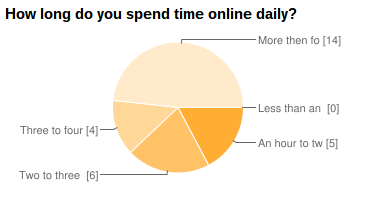
We also have to be wary how much time children these days spend on the internet.

Screenshot 2015-05-11 at 9.18.23 PM.png

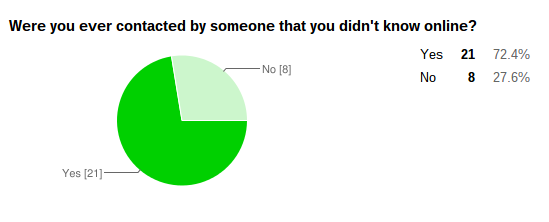
Because our generation spends so much time on the internet, we are easier targets. In fact most of the students claimed they were contacted by an outside force on the internet.

Screenshot 2015-05-11 at 9.20.16 PM.png

Overall I would say my findings are what I expected. Kids know about it, but not enough. Which is why my Agent of Change ideas can bring awareness to this subject and teach the full extent of this issue. I plan on giving a detailed presentation about this subject. I have to still work out the kinks on this plan. I was also thinking on hanging posters in our school and outside to bring awarness.


Bibliography
Be the first to comment.

Petition to support all people? Say I.

Posted by Sarith Chuon in English 1 - Giknis - X on Monday, May 11, 2015 at 9:52 pm

From my previous blog, I talked about my father’s Sponsor, William Sloane, and Tan Le, who talked in a Ted Talk about her immigration story, which is part of my topic. And now I will talk about more info that I’ve gathered the past few weeks. We’ve talk about how Sponsor has two different meaning towards the U.S or America and towards Immigrants. I hope this summary refreshed your mind!


First, I’ll start off with an organization that I have recently been in touch with. They’re called SoarLegal. They help immigrants today come to America. Their office is in Oregon which is out of my reach so sadly I was not able to have a personal interview with them but thankfully I have just gotten in touch with them, recently. At May 11, 7:58pm, I called and talk to the woman on the line for SoarLegal. She said that she was new to the job, so she doesn’t know much. What I’m surprised about, is how there’s people still getting hired to be helping immigrants. Other things they do is; Domestic Violence Victims, Farm workers, Human Trafficking Survivors, Individuals who are not in legal immigration status, Individuals with criminal histories, Individuals with physical/mental disabilities, Juveniles, Lesbian, gay, bisexual & transgender, Torture survivors. What I wanted to do is an Interview and Survey. Sadly, I wasn’t able to interview anyone, and I had only received 11 responses for my Survey.

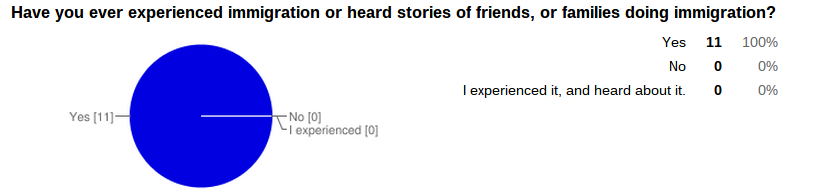
On this graph, it shows me that everyone who’d participated in my survey, has had experienced it or heard stories. That shows and tell me that immigration is big; but not big at the same time.

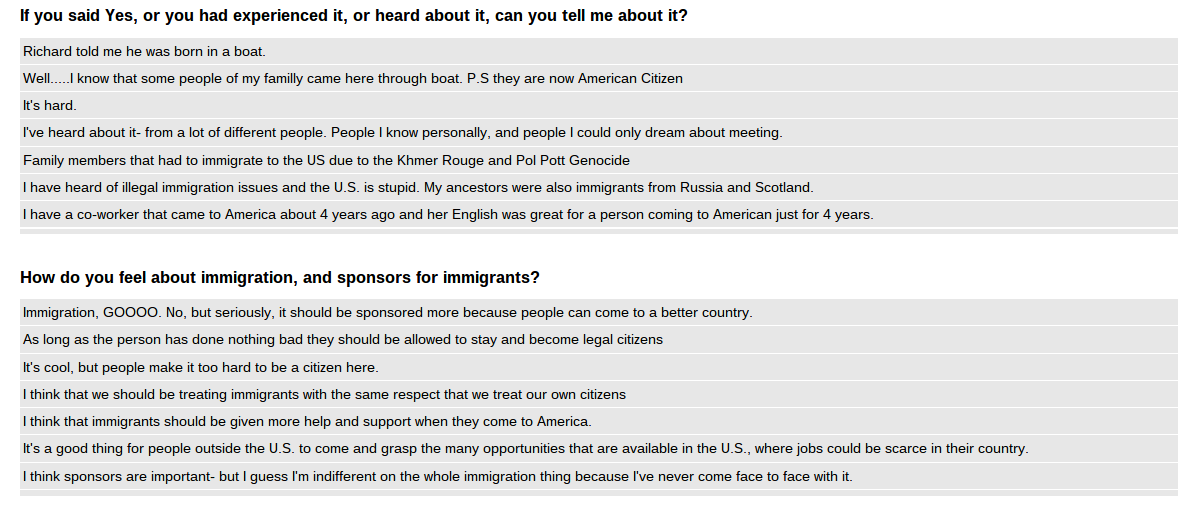
For this, I asked question about immigration, and explaining about experience, or stories, because other people can have different perspective about immigration and maybe I can get more info that I can would usually receive. Majority of the people who took my survey, had known people close or friends that was immigrants. Some say that it was hard to explain, or even heard stories from many people.

When I asked about immigration, and sponsors for immigrants. Many say they support it, although Richard Yoeung who said;

“Nothing wrong with it. In my opinion. Politics say otherwise.” That spoke out to me because it shows the fact that Politics refuses to bring immigrants.


For this, I asked about being curious of Sponsoring for Immigrants, or even how the process is.

A few say that they know about the process, Some say that they’re confused, some say that what different ways can a sponsor help an Immigrant. Most people asked for the process from back then and now. We need more information about it, and he process about it. Maybe some more videos that will, at least show how the process is. Even blogs that tells us what we don’t know, or probably give us more information about immigrants and sponsors.In conclusion, This has expanded my knowledge about Sponsoring for Immigrants. From help to those who had completed my survey. Hopefully, I can actually expand my knowledge even more with the information about immigration and their sponsors


Here is my Annotated Bibliography
Be the first to comment.

A Little More Hope For The Hopeless // Leukemia

Posted by Menduyarka Dennis in English 1 - Giknis - X on Monday, May 11, 2015 at 9:25 pm

In my previous blog post, I discussed the different probabilities, the age range, and the multiple kinds of attractions for Leukemia. I explained my reasoning behind why I wanted to focus on this topic and gave various details about what Leukemia was as a variation of cancer. I noted that not everyone who is diagnosed with Leukemia has a high survival rate, depending on the type of Leukemia that you attract.


25% of all kids who are diagnosed with cancer will die. Remember that? Well, I didn't explain that fully until now. Leukemia has an 85% survival rate for each patient. Each patient has the same chances of surviving this disease, no matter what medications/drugs they took during the time. This is one of a plethora of information that I have gotten from my time at the Children's Hospital of Philadelphia.

The Children's Hospital Of Philadelphia (CHOP)

As this second blog will continues to shed light on the topic of Leukemia, I have returned from a 3 hour tour of the Children's Hospital of Philadelphia. With the consent of Dr. Abby Green, I have acquired an abundant amount of information, learned the ins and outs of Leukemia and how it doesn't just affect the children diagnosed with it, but the families as well.


My interview and field observation was taken with Dr. Abby Green, an oncologist pediatric, who works with patients diagnosed with Leukemia frequently at the Children's Hospital of Philadelphia (CHOP). She has been admitted to this hospital once she exited medical school and has been assisting over 100 children for 8 years so far. Throughout my tour and interview, I got to see different patients and their recent statuses on how well they are taking this disease. Some were surviving and were being dismissed early. Others weren't so fortunate. It's hard to roam the halls and hear the voices of children, yelping in pain and agony. But I persevered and continued on with my tour with Dr. Green. When I first started asking Dr. Green my questions about Leukemia, it seemed like her mindset was up all night, waiting to answer these questions that would change her life forever.


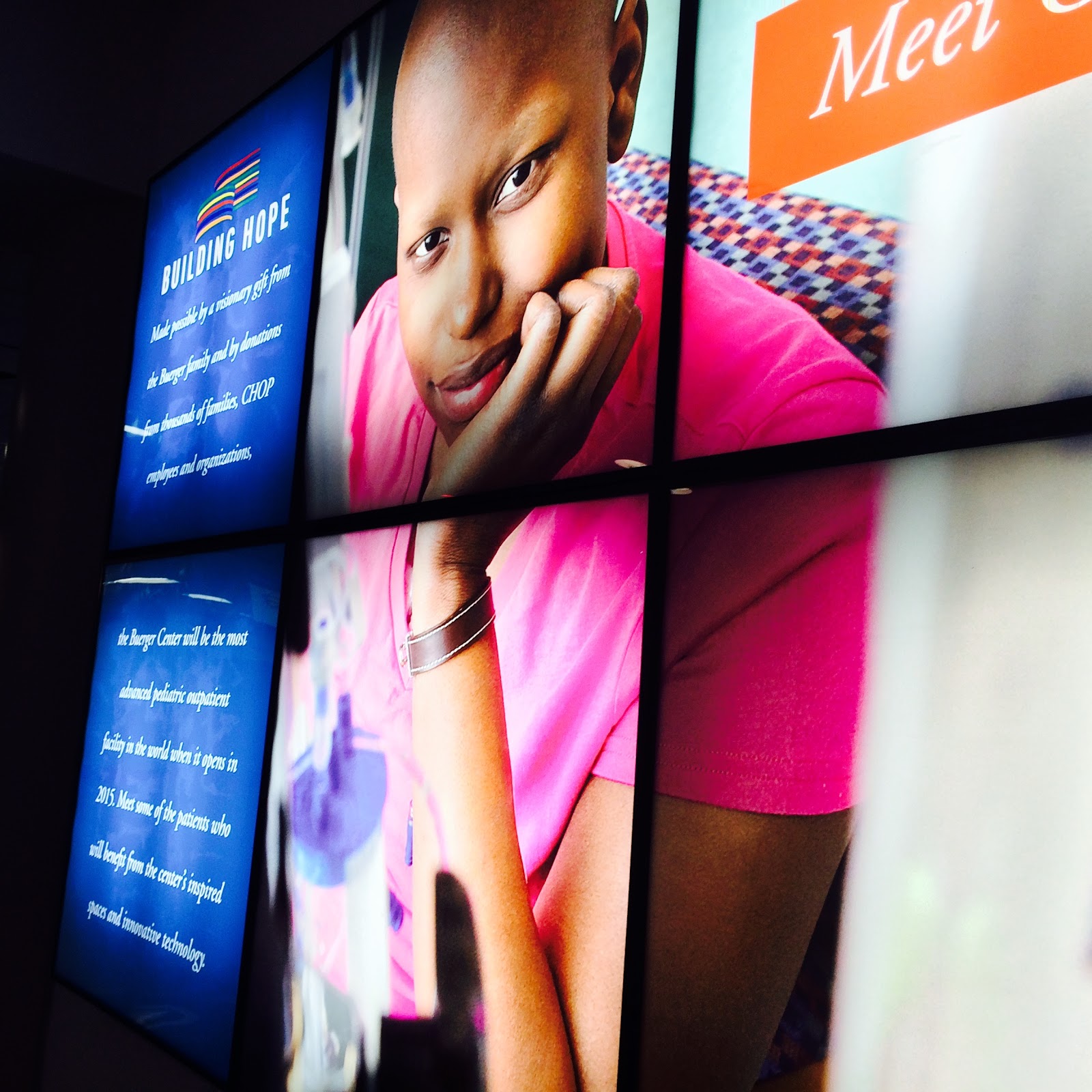
A Hallway dedicated to patients that have been released from the hospital (Left). A patient of Dr. Green that has been admitted out and placed into this hallway (Right).


With Dr. Green's assistance and her 8 years of experience, diversifying and deeming with information will be useful from here on out will be hassle-free. With the information that I gathered from Dr. Green, I can use that as a foundation for what information I can use to build off of it. This will help add on to my new information with new upgraded statistics, rather than those from about 2012. Her responses are influential to my mindset of this disease. After going in to take a tour of the hospital, my mind has not been the same ever since my trip. I've often gone back to think about the screaming children which definitely disrupts my focus often now. Getting a firsthand experiences really did open my eyes a little. And it even put a little but of tears in them as well. Going from not knowing much about Leukemia to knowing enough to keep you up and night was definitely something that I'm happy I realized.


​


(Left) A Family Room that is located on the third floor, right outside of the Oncology offices. (Right) Displayed artwork of children with Leukemia that was made within the family room.

For my "Agent of Change: Blog Post #3", I think I will plan on volunteering at Ronald McDonalds House of Charity. I will try my best to volunteer here and go back to the Children's Hospital to help with one of the Family Rooms. For those that don't know, Family Room's are selected rooms that are scattered across CHOP. They are there to give moral support to children and families by giving them different activities. For children and families alike, coping with Leukemia is a very difficult process, and by volunteering with this organization, I can try my best to explain my personal stories and also give different families that have been affected by this disease moral support and sympathy.


Samuel Dennis // Annotated Bibliography
1 Comment

It's Still Happening

Posted by Ajanae Mills in English 1 - Giknis - X on Monday, May 11, 2015 at 9:21 pm

​

In blog post #1 {Blog Post #1} I talked about how police brutality has been affecting African Americans ever since the 1900’s and is still occurring in 2015 today. Not only are black people being affected by this but many other races as well. American citizens are blind to this and believe that the citizens affected by this are only black people. Cops have killed and beaten people of many races, which gets into this second blog post. I’ve found new information that proves it’s not always black on white crime but it’s all police of all different races on the many residents of America.

Here is a case that involves a homeless man by the name of Kelly Thomas who was beaten to death by cops in Fullerton, California. Thomas was not only homeless but schizophrenic and the horrid sight was caught on tape. The outcome of the beating closely resembled the case of Emmett Till, a 14 year old boy who was beaten by white people during the Jim Crow era in the South and his offenders as well as Kelly Thomas’ offenders were pleaded as not guilty. Kelly Thomas’ case was a white on white crime but it was committed by police.


Kelly Thomas, before and after dealing with Fullerton Police.

( Before and After Picture of Kelly Thomas )

Recently there was the killing of 25 year old, Freddie Gray who died of severe injuries to the spinal cord while in custody of Baltimore Police. Unlike a lot of other cases, the 6 police officers involved were charged with murder because the death was ruled a homicide. The death of this man sparked many protests but also many riots. People of all ages in Baltimore participated in the actions of throwing rocks at cops. burning down businesses and busting windows out of police cars. People from Philadelphia protested but in a much more calmer way but some cops from Philadelphia steered it up a bit. A woman named Dianne Tzouras who is aPhiladelphia citizen expressed how she felt on the differences between Baltimore’ and Philadelphia’ protest.


( Picture of Freddie Gray)

I asked : How do you feel about the protest in Philadelphia and the protest in Baltimore?

She responded : The protests in Philadelphia were very calm and very peaceful, the citizens stood up for what they believed in and made that very clear and moved along with their night, but the riots in Baltimore were uncalled for. We didn’t need people to throw rocks at cops, or burn down other people’s businesses just to prove a point. Baltimore could have gotten their message across in a entirely different way than they did.

I also asked another question on whether or not she believes we can change the way police are treating American’s and here was her response.


I asked : Do you think you could make a change?

She responded : Yes by prayer and regular everyday respect for cops. If we do not respect cops, cops will not respect us. It all starts with communication.


I also interviewed Matthew Kay, an African American drama and reading teacher at Science Leadership Academy. Mr.Thompson runs the poetry club here as well and one of the topics happen to be police brutality and Black Lives Matter. I asked him the same questions I asked Mrs.Tzouras but the responses were completely different.


( Picture of Matthew Kay )


I asked :  How do you feel about the  black males that have been shot in Florida, Ferguson, Baltimore and Missouri ? ( Freddie Gray, Trayvon Martin, Mike Brown )


He responded : Sad but not surprised, black men have been being shot for a while now. America was born on the killing of black men.


I asked : How do you feel about the protest in Philadelphia and the protest in Baltimore?


He responded : The kids who are doing these protests do not have good intentions about what they’re doing, just because you march down the street with a bunch of signs in your hand doesn’t make it a protest.


I asked:  How do you feel about the slogan “ #BlackLivesMatter”?


He responded : Clearly catchy, not very sure when black lives mattered in this country and they sure as hell dont matter as much now. The poorer you get the less you matter. The slogan itself gives people imaginary hope.


I asked: Do you think you could make a change?


He responded: There are common sense things, language about body cameras, reviewing techniques, someone who has their mind set on killing someone, badge or not you can’t really change that.


The whole process of finding new information that you actually created yourself was hard. I ran into a lot of challenges when it came to finding people to interview. I came up against lots of walls where I couldn’t find anyone to interview. I tried to ask #BlackLivesMatter a couple of questions as well as a student from SLA but I got no response there either. Even though I only have two people which whom I interviewed I got a lot of people’s opinions and things they believed could change the world.


( Picture of Dianne Tzouras )
Annotated Bibliography }
1 Comment

But Mommy... I already have a black crayon!

Posted by Jevon Price in English 1 - Giknis - X on Monday, May 11, 2015 at 8:52 pm

The issue of affirmative action is one that has been intensely debated shortly succeeding its implement into society. My first blog post informed potential readers on the specific facts that are an effect of affirmative action as well how it's utilized in many higher education and working facilities. I explained how the use of affirmative action was to the support and disadvantage of multiple ethnic groups, while speaking on what generally happens to those who are affected by this. For my second blog post I chose to focus more on how individual people interpret this topic and its stance in our community. I also narrowed my information more on the general public and higher leveled businesses and institutions takes on this.


Since writing my last blog post, I aimed to get a better feel for how people themselves perceive affirmative action. Originally I believed that the masses were all on a similar viewpoint on this issue, but further research showed that we are split right down the middle. Both groups those being who support and are against affirmative action have strong reasons for why they feel the way they do. According to a poll done on debate.org, 57% of the population viewed affirmative action as a fraud, 70% said it was not needed to achieve equal opportunities, and 75% agreed that the United States does not need it. Prior to uncovering this, I was not aware that so many were against it. Opponents often point out that it's a reverse form of discrimination by favoring one group over another, it keeps societies aware of the barriers that divide it which would ultimately promote alienation and resentment between ethnic groups, it may be unconstitutional under the Equal Protection Clause of the fourteenth amendment. Critics have also pointed out that affirmative action is illegal under the Title VI of the Civil Rights Act of 1964 which prohibits discrimination based on color, race, national origin.


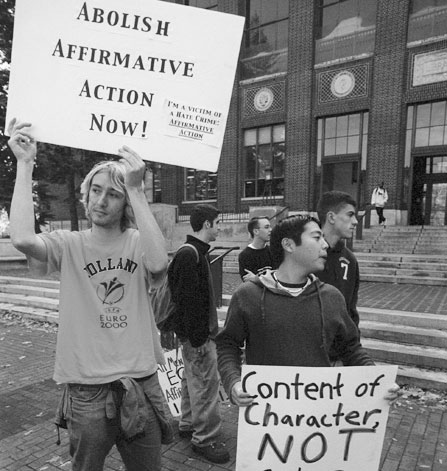
( This picture is a protest fighting for the abolishment of affirmative action, and was brought to the front line due to the case of Bakke vs. California.)


While there are many who are opposed to affirmative action, there are as many who are in complete support of it. Those who believe in it feel that without affirmative action in place the amount of space for minorities in the workplace as well as universities will increasingly drop. Statistics have shown that after the departure of affirmative action in California in 1998, the percentage of minority students admitted to the UC Berkeley fell 61% and UCLA fell 36%. Similarly, after Texas abolished affirmative action in 1996, Rice University freshman class had 46% fewer African Americans students and 22% fewer Hispanic. There have also been major universities and businesses who agree with affirmative action.

These businesses include: Coca-Cola, Intel, Microsoft, Nike, Pepsi, Reebok, Kraft Foods, and Johnson and Johnson just to name a few of more than sixty leading fortune 500 companies that believe this. Universities such as: Harvard, Brown, Dartmouth, Duke, Princeton, Yale and Upenn voiced their support of race-conscious admission programs.


For a closer inspection of how people consider affirmative action, I interviewed four people of different race, age, and gender. With these interviews, I wanted to know how the people around me felt. I asked a series of questions ranging from ¨ what is affirmative action¨ to ¨ can it be noted as racism. From my findings I liked that teacher Mark Miles believes that we need affirmative right now because there is not a better option out there. Art and technology teacher Marcie Hull believes that because women are not given and expected as much as their male counterparts, that they should have special treatment. I did not think of this as a good option for short term not long term. It wasn't something that I thought of before and made me lean further to the side that we need it. One thing I kind of agree with is women getting special treatment. I'm all for equality, but I don't know if I would necessarily say special treatment. Another thing I found interesting was that both of the students felt that affirmative actions should only be used in some cases, and it should not just be tossed around. Doing these interviews gave me insight on things that I hadn't thought about, and kind of changed my opinions on a few things. I no longer feel that it is something that predominantly affects African Americans and Hispanics and have a sound effect on many different types of people. I know understand that there should be affirmative action in some cases and that the way it is being used known may not be the best way for it to be used. If there is anything else that I want to know it is how has this gone on for such a long time with so much negative publicity onto it. Also, how does this have an effect on people after they graduate on from college. Doing blog post two as given me a better understanding of this issue as a whole instead of statistics on a page. For my blog post three, I plan to get an editorial published somewhere that will inform those in the public who aren't aware of the issue.


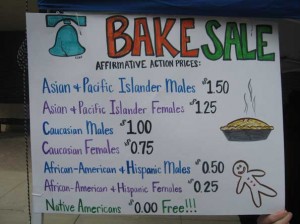
Affirmative action bake sale prices were weighted to reflect Affirmative Action polices and programs. Asian and Pacific Islander males were charged the most at $1.50 per baked good, and Native Americans were charged nothing for their bake sale sweets. Other races and sexes varied.

( This is a poster made by The Conservative Coalition for American Values, a Purdue University student organization that was made to represent the University's racial division based on their affirmative action laws.)


Annotated Bibliography
Be the first to comment.

Help The Hopeless

Posted by Alexander Gomez Torres in English 1 - Giknis - X on Monday, May 11, 2015 at 7:40 pm

      Help The Hopeless


In my previous blog post I gave some important facts on the homeless people. Such as the different causes of homelessness. One cause of homelessness as discussed in my previous blog is economic problems such as low incomes and lack of affordable housing. Also talked about the amount of people that were homeless last year. January 2014, on any given night there was at least 578,424 people experiencing homelessness in the U.S. I also talked about the different types of people who become homeless. For example, U.S military veterans who come back to find themselves homeless in a few months after they've served for the military.


I found a lot of new information after my first blog post. I've learned that their are different kinds of homelessness. One that I had researched was Chronic Homelessness. Chronic Homelessness is when someone with disabling health and behavioral health conditions is experiencing homelessness. According to researched they are trying to end it from 2015-2017. I've seen Chronic Homelessness myself. It kills me inside to see those people suffering not only from Homelessness but from other personal health issues. Another issue I've found during researching was Homelessness being restricted in some cities. Cities like Pittsburgh, Philadelphia and  Lawrence, KS has banned panhandling in some of the different parts on the city. Also the fact that the local citizens of the specific cities actually signed petitions to stop the homeless from getting any help. In addition to my previous blog post where I talked about different types of people who become homeless and I found out that the majority of the youths become homeless usually because of family divorce, neglect and abuse which is really heart breaking.


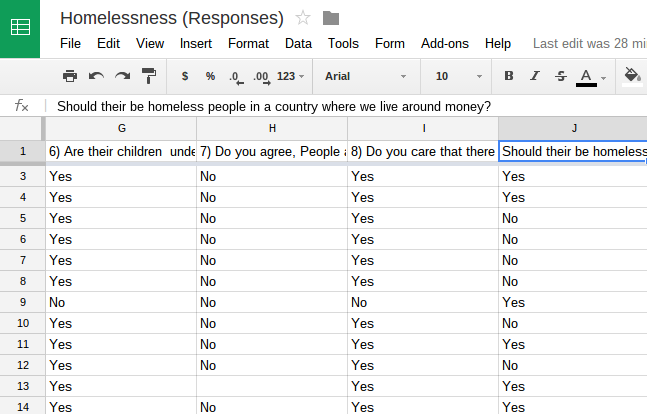
Researching about homelessness was very interesting and really heart breaking. So I took it upon myself to do a survey about people stances and opinions on Homelessness. The responses were not as surprising as I thought they would be. I expected more harsh answers after researching about Homelessness. Although, the responses on one my questions shocked me. The ninth question(¨Should there be homeless people in a country where we live around money?¨) responses shocked me after I seen that people have answered yes. Almost half of the people who answered this question said yes. This survey helped me understand more of the opinions that the people have on Homelessness. Although I was not surprised with most of the responses, I personally believe those responses was because of the community the people are in. Considering that most of the responses, well all of them were sent to people of my school, I feel like that couldve been the cause of all the answers. Somethings Im still left wondering is, what if i had sent this survey to different types of people from different money classes or depending on where these people live. Something i am looking forward to doing is, giving money to the homeless and giving them hope and to keep pushing.


Screenshot 2015-05-09 at 3.57.49 PM.png

Survey response to question #9


Homeless.jpg

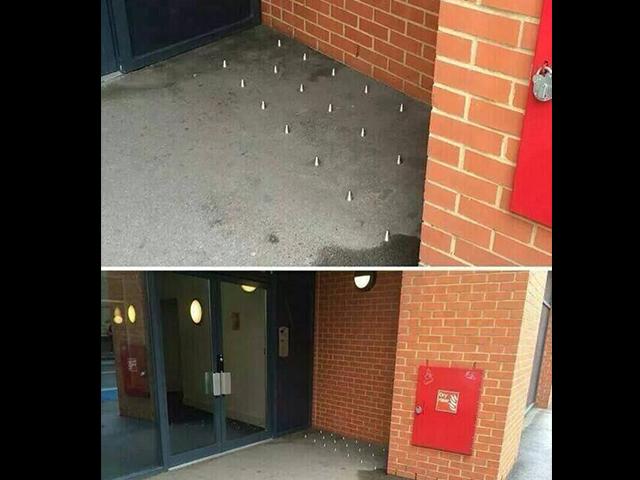
Homeless spikes to restrict homeless from staying at that place.

Heres my Annotated bibliography!


Be the first to comment.

The New Face of the Workforce

Posted by Arielle Moore in English 1 - Giknis - X on Monday, May 11, 2015 at 7:28 pm

The issue I’ve decided to tackle for my You and the World project was women’s rights within the workforce, as seen in my first post, Women make up almost 50% of the working population worldwide, and even still aren’t being given adequate pay or benefits. There’s no excuse for this injustice in the 21st century, considering that less than 100 years ago we were fighting for voting rights. What is the reason for this? Why are women still on the lesser playing field than men?

The first reason I think is the lack of education on this topic. Some women don’t realize their difference in pay between men until entering the workforce, and that discovery continues once they get pregnant and require maternity leave. I feel that education is one the biggest ways to combat this issue because women are still blinded by the fact that there is still imbalance amongst the sexes.

The second reason this issue is still prevalent in society is the ambiguity of women entering the workforce and not tapping into their full potential, which I covered a bit in my first post.  I recently interviewed reporter and journalist Ema O’connor of the popular media website Buzzfeed , and she responded to this question with: “It is not all men's responsibility to pay women more, a huge part of it is women being timid in pursuing their career, not feeling their self-worth and therefore not trying. This is a deeply ingrained societal problem that parents (future and current), schools, and employers need to work together to change for the next generation.” Gender stereotypes grow from the absence of education and also lack of female confidence, but also the ignorance of those who therefore buy into gender stereotypes. 0bc0292.jpg

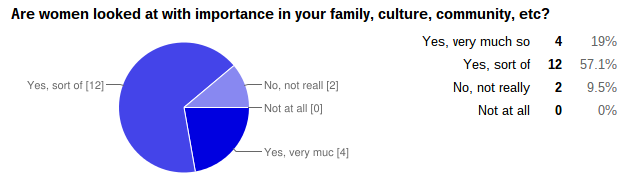
The third reason for this problem is cultural and religious views. Like I mentioned in my previous post, women are only seen as providers for the household which in some cultures is a huge part of a woman’s life. In the survey I conducted over the course of last week, I found that out of the twenty-one girls that answered, two said that women are not seen with importance in their households and cultures. Screenshot 2015-05-12 at 12.07.47 PM.png


survey results

Though the number is quite small, this is a sad reality that many face, which leads to the mindset that girls adapt which holds them back from pursuing their dreams which may involve work. We need to place the image of the modern working world of women into the minds of our young girls, thus creating a generation of fearless and powerful individuals who can undertake any career they wish to pursue. I also spoke with Buzzfeed video producer Ashly Perez who spoke a bit about how women are seen in her family and culture. “My parents are both from very male-dominated cultures (Cuban / Filipino) but my family is full of strong women, particularly on the Cuban side. Men might be in charge, but women are feared and respected.” This is the mindset we must enforce into our future generations because even though people may come from societies where women aren’t valued, girls can still believe in their potential and be brave enough to take on whatever they choose. hqdefault.jpg

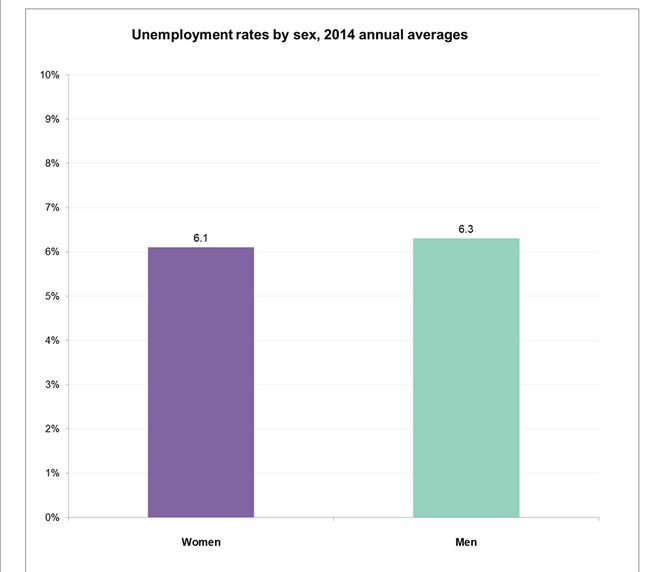
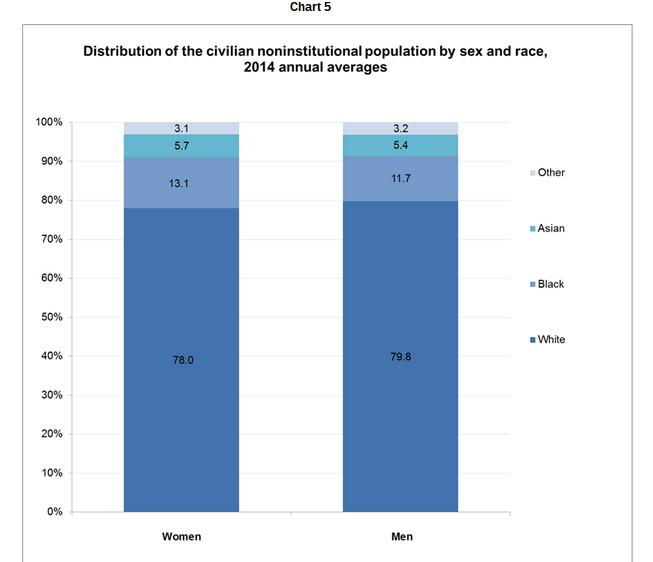
The fourth and final contributor to this topic is the beliefs that have stained our society for generations. There are still large amounts of men who believe that women have no place in the workforce, which weakens the populations of female workers. I feel as if this generation is doing a good job eliminating the issues we encountered with sexism in the past, but we have a long way to go. Both men and women need to collaborate to end this issue, so that our future workforce can be fully integrated and equally diverse. Some further questions I have about this issue are how long has equal pay affected women and what kind of sexism and gender stereotypes are still experienced in the workplace amongst women today? Below are some charts that show the participation and pay in the workplace between race and gender in the last year. Screenshot 2015-05-11 at 7.24.15 PM.png

chartsScreenshot 2015-05-11 at 7.22.15 PM.png


Annotated Bibliography


1 Comment

Educate the Uneducated!

Posted by Jamal Hampton in English 1 - Giknis - X on Monday, May 11, 2015 at 7:24 pm

For a recap the project that I chose for my PIC is the issue of animal abuse. I chose this topic than any other one because I have a lot of history with understanding animals that were abused and I want to educate the public about the topic. Also, I see animals as living creatures just like humans are living creatures.  Animal abuse is simply when an animal gets harmed, neglected, and/or a does not care for an animal responsibly by a person. In other words, to hurt or to be cruel to an animal would be against the law no matter what.  This the significance of the public being aware of the issue is really serious.

The issue of animal abuse does not only have negative impact on animals but it does a negative effect on humans. When someone abuses an animal they may be an more likely to cause violence. Also, if a child witnesses animal abuse they are at greater risk of becoming abusers themselves! Moving on, if you think that think that animals were only abuse in the one physical way you obviously never heard of the brutal acts of factory farming and Circuses. 99% of the food that come from farms are from factory farms which are focused on getting money, what is easier, spending the least amount of money at the price of the animal's’ life. Also, another example of heartless groups are circuses because the beat, whip, sometimes denied food and water, all to force them to learn their routine. This leads to diseases, damage, injuries and death of the animals.

As seen in the image above animals are forced to do tricks that there body is not meant to do.

For my original research I planned to collected data on a survey so I can  educate the public really is about animal abuse because my main goal is to educate the public. Unfortunately, according to the survey I took not that much people are informed of animal abuse. For example,

  • 10/23 people got question #1 right

  • 9/23 people got question #2 right

  • 3/23 people got question #3 right

  • 21/23 people think that animal abuse is a big issue.

  • 17/23 people are aware of factory farming.

  • 5/23 people are aware of animal testing.

Survey Results


The results helped inform me on my PIC issue because this research show how uneducated the public is about the issue of animal abuse.  The average person would fail my survey! Which brings to help out the issue of animal abuse and you have to educate the public so that they know what they are dealing with. This added to my understanding of animal abuse that a lot of people do not take animal abuse seriously.

Now that I have done my research I have some strong personal opinions on how people did on my survey. First of all, I would like to say that I am more disappointed than mad. For example, somebody really had the nerve to say that dog and cock fighting should not be banned because it has been a culture for many years and that would be horrible if it was banned. Also, the average grade for my survey is a failing grade. One thing that I am still wondering about is why my community is so uneducated about animal abuse. In addition, I still need to find more information on what drives a person to abuse an animal. I am thinking of of making a website for my as my Agent of Change part for Blog #3 because I know how to make one and it can easily educate the public. Furthermore, for my website I will be interviewing some employees at the SPCA for a page for my website.


Annotated Bibliography

Blog Post #1
Be the first to comment.

Being Accepted Is Crucial For A Teen...

Posted by Quran Riddick in English 1 - Giknis - X on Monday, May 11, 2015 at 6:30 pm


In my Blog Post #1, I discussed the issue of peer pressure surrounding teenagers. This topic stood out to me because this issue affects a lot of young boys and girls everyday. Every teen wants to be accepted by some group of peers in their teenage lives, and many will do things they usually wouldn’t do to be accepted by them group of people. As I stated in my Blog Post #1, certain activities like smoking, drinking, doing drugs, stealing, and breaking the law are mainly what teens are pressured into, which I found out from one of my sources. Activities Involving Peer Pressure  


Since my Blog Post #1, I did in fact find some new information and compelling opinions from people around the world about teen peer pressure. I read in the comment section in a site talking about Teen Peer Pressure that it seemed more people felt teenage girls were more pressured by their peers than boys. I can say myself that I agree with this statement because in every grade there is always the cool girls or ¨cute girls¨. The ones that wear make-up and attract attention from the guys. These kind of teenage girls tend to pick on the girls or talk about girls that aren't as popular as they are. In conclusion less popular girls begin to change their appearance, personality, and their view on life to be accepted by the cool group of girls. Teenage Girl Peer Pressure


                                                        Not being Accepted Can Hurt Someone's Self-Esteem

¨It can be hard on teenage girls as showed in this picture, and with the group of teens just laughing this girl doesn't help this girl's attitude towards her teenage life.¨


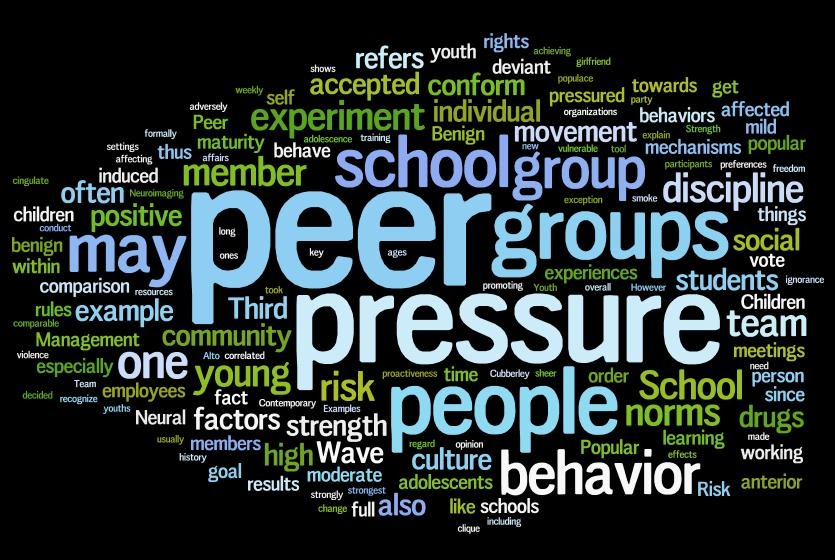
Words That Surround Teen Peer-Pressure

             ¨This image shows important words to surrounding the meaning and effect of Peer Pressure.¨


For my Original Research, I created a short survey for different teens to take and receive different perspectives on what they think peer pressure is and how it has affected their teens years. My Teen Peer-Pressure Survey I sent this survey to only people I knew had a word or two on the issue of teen-peer pressure and how it affect their life. Here are some of my survey results. My Teen-Peer Pressure Survey Results One question I wanted to reflect on is the second question. ¨What is your definition of teen peer pressure?¨ And my responses were a lot similar, when another teen pressure or influence another into doing something that the other person wouldn't usually do and the only reason why they would do it is to be approved and welcomed as a friend. These responses connect with a lot of others teens that answered that question, which gives me a thought that most teens think similar on the what peer pressure is in everyday life.   


The results I received back from different teens on this issue informed me that they all seemed to go through the same thing. Breaking the rules or smoking because of their peers doing it. Being a follower instead of being a leader, and not realizing what is right from wrong. Survey results I found on the internet brought up a good point that teens boys and girls break the rules as a group decision. If all of your friends wants to go rob a corner store, and everyone is in besides you, they will single you out to not being cool and you will be pressured into making a choice. Many times that teen will tag along because of wanting to be accepted. This survey helps add the knowledge of why some teens are affected by their peers. And once again, it comes down to being ¨cool¨, ¨down¨, and accepted by your fellow peers. Since I have done more research I feel personally the reason teens face the effects of peer pressure is because being gossiped about. Teens see on a daily basis, mainly in school, others being picked on and bullied and many teens don't want to fall victim to bullying. So what do they do, they join in with the bullies which makes them cool to the ¨cool kids¨ in school. Connection between Bullying and Peer Pressure Even after additional research on this topic, I wonder if teens believe their experiences gave them more confidence in themselves to accept themselves as who they are and never try to change for others, or do they just look at them as mistakes to learn from. Lastly, for my Agent of Change for Blog #3, I am thinking of doing a presentation in my advisory, and for any other teachers/staff that would like to watch it based on the issue of pressure. My goal is to make it as interesting as possible. I hope to be working with an Organization called Child Development Institute, which works with issues involving children and teens. Here is their website CDI Website


Annotated Bibliography

1 Comment
120 posts:
← Prev
  1. 1
  2. 2
  3. 3
  4. 4
  5. 5
  6. 6
  7. 7
  8. 8
  9. 9
  10. 10
  11. 11
  12. 12
Next →
RSS

ENG1-018

Term
2014-15

Other Websites

Launch Canvas

Teacher

  • Amal Giknis
Slate (skeleton-v3 PHP 8 prototype) · Location: 1482 Green St · Shipping: 550 N. Broad St Suite 202 · Philadelphia, PA 19130 · (215) 400-7830 (phone)
×

Log In