English 1 - Dunn Public Feed
Litter: Part 2
By Zack Hersh
“Travel and Leisure” recently named Philadelphia the sixth dirtiest city in the United States in 2012. While this is progress since being named the second dirtiest city in 2011, our city still has a long way to go.
Since my last blog post, a lot of new information on the topic of litter has emerged. Some of it confirms that we are starting to move in the right direction, but some also shows us that litter is still an ever present problem at a local and national level.
To get a more personal level on the issue of litter, I conducted a survey as original research. This also justified that while litter is still a big problem, we are starting to move in the right direction.
Out of the 52 people that took the survey, only 31% of them have never littered in some way. And only 33% of the people that took the survey said that they never litter! While this isn’t good, if you know that you litter, you can try to stop. Nobody said that they litter all of the time, but 9 people admitted to littering sometimes or often. However, what was really astounding is that only 10 of the people that took the survey didn’t know somebody who litters. That means that 42 of 52 people know at least one person who litters! Of those, 8 people know a teacher who litters! Teachers are supposed to be our role models, and if they are littering, then we have a real problem.
Probably the most important question I asked on this survey was what people thought should be done to fight against this problem. The number one response was “put in more trash cans and recycling bins”, over “organize pickups” and “raise awareness”,and I can relate to this on a personal level. On a walk to the Franklin from SLA one day, I had a piece of trash in my pocket and I was looking for a trash ca to throw it out, and for the entire walk, I saw only 1 trash can, and it was right outside the Franklin. I definitely agree that adding more trash cans and recycling bins could reduce the amount of litter in our city.
After this survey, I still don’t understand people’s motives for littering. On my survey, 12 people said they thought that raising awareness was the best way to help with the problem, and I agree here also. I think if poeple who litter knew how bad it was, they would think twice befor littering.
As for my agent of change, I have many ideas for things that I could do. I’m thinking of doing a litter pickup, but I also think that raising awareness, or raising money for organizations, or for the city could be equally effective.
But you can also do your part. Talk to people you know that litter. Pick up litter when you see it. But most importantly, don’t litter in the first place.For my bibliography, click here.
Food Deserts: Part 2
In my previous blog I talked about the concept and impact of food deserts, but now I feel the need to affirm that there is hope that this problem can be solved. And even better, I can report that several sustainable and innovative solutions are now being explored. Communities all over America that can be classified as food deserts are taking a proactive attitude toward this problem and are currently experimenting with possible solutions to ensure that everyone gets the needed nutrients. This can take many forms, from community gardens to grocery stands outside of McDonald’s. Let me describe a few of these efforts before I discuss the survey that I conducted about food deserts.
New Orleans had the problem of getting good, nutritious food to its poorer citizens for such a long time that some were ready to give up on solving it. Hurricane Katrina wrecked the fabric of the city so badly that New Orleans was considered a hopeless case, but they haven’t given up and are coming up with their own unique response to the problem. Their solution is pretty simple and sustainable for their community. They are growing vegetables in urban gardens, or as they call them, “urban farms”. In many ways this is even more convenient than the common grocery store, because everything that is being grown in these urban farms is there because of a real need. Another positive thing about this system is that it is not just about growing food, but it is also about educating others about horticulture so that people could grow their own food. It is not easy for the people to adjust to cooking from scratch. It is much simpler sticking to the fast food even though it may be unhealthful, because it fills them up quickly and is cheap. What this misses is the whole purpose of eating food - to retrieve nutrients. This truly is an essential skill that is in danger of being lost in our society and yet is one of the simplest solutions to a tiresome problem.
New York and Philadelphia have also come up with creative ideas about how to get inexpensive, nutritious food to its poorer citizens. In New York they have something called “green carts,” which are just a large food stands that sells the food that the neighborhood is lacking. This works well because the food is cheaper, the lines are shorter, and they have more variety than many of grocery stores in these areas. Many people prefer these green carts to the average inner city grocery store because they are more convenient in addition to being less expensive. It is a good system because it brings attention to the low-income local farmers who benefit from reaching more nearby costumers. And the system also provides a health benefit to the community as it motivates everyone to eat fresh. In Philadelphia we have a lot of small grocery stores in these neighborhoods that provide the community of what they are lacking and adapt to their needs.
Earlier this month I conducted a survey on my topic of research to get data I could use for my blogs. I asked five questions: would you consider food deserts to be a pressing issue in America, do you know anyone with low access to nutritious food, how do you obtain your food on a daily basis, do you live in an urban or rural setting, and what can we do to help our community with this issue. It was instructive to learn that, while over 3 out of 4 people surveyed thought of food deserts to be a prominent issue, most didn’t know anyone who had low access to nutritious food and that most in this survey group could get their food at grocery stores. Clearly, my survey group is not the group most affected by an ability get good food whether because of where they live or income status, and they, like most Americans, view this problems second hand. Now that I know that our first step must be to educate the American public as a whole and that we cannot take action before we do so.
WHAT THE FRACK?! part 2
Hello all, it had been a while. In this time I have been looking over my last blog and finding more information that I can share with you on fracking. This time around I figured I would give you some pros and cons about fracking. Although fracking is incredibly bad for the environment, there are some good aspects. Fracking requires people to run the drills, and transport the sand, chemicals and water, because of this fracking makes jods. Another pro is that there are plenty of shale wells in the U.S., so, we don't have to be dependant on foreign countries, here is a map of the shale wells if you would like a visual.
The only other pro is that natural gas is the cleanest burning gas, but seeing how it puts out more emissions than coal, it is not that big of a pro.
The list of cons seems to be fairly endless, hydraulic fracturing uses tons of water, potatoes tons of water, and the companies don’t even have to tell us what they put in the water. People have also have claimed that it creates earthquakes, but it has not been confirmed scientifically, so it is not the strongest point. I focused on cons a lot in my first blog, and I don’t think you want to read the same thing twice, so let me show you a video one of the shale companies made.
I would like to point out how they point out all the protective casing that they use to protect any chemicals from escaping and getting into the water, but the vertical part of the process is not the problem. The horizontal part of the drilling is the issue. The cracks made in the shale rock to extract the natural gas is the cause for the chemicals to get into the water. You don’t want to put casing into them, because that will block the natural gas from getting out. They also use sand to prop it open the cracks, so that gas can flow out, but they don't point out how easily chemicals flow out and into peoples drinking water.
Now I must admit that the video is very convincing. after seeing it I was curious to know if people were educated about fracking, and how they felt about it. to find this out I made a survey. if you would like to answer my three easy questions click here. Everyone who has taken my survey have heard of hydraulic fracturing, and are against it. This is good, and I can't wait to see what your opinion is!
The next part of my project is to find something I myself can do to help prevent fracking or raise awareness. Having as many people as possible take the survey will be of extreme help to me, because it will give me a sense, of what I have accomplished from my blogs, and what steps I still need to take. I am still brainstorming for what I will do for my third, and final post, but luckily, I have plenty of time, but I know that this time will fly buy. I only hope that my project can truly make a difference, and that fracking can become a thing of the past.
To see my annotated bibliography, click here
Athletes and Eating Disorders
Hi again, it’s me Naomi. If you are reading this it means you are reading my You and the World second blog post. The first one was a general background about the You and the World project and my topic, which is Athletes and the toll it takes on their mental state about their body image. If you would like to view it click here. It will give you the background on my topic along with visuals and some links to websites I think are very helpful, in understanding more about my topic.
For some first hand research I sent a survey out to Friends and Family, on both the school network and Facebook. The results I got were extremely helpful and I thank anyone that took part. In the survey I asked a series of questions about Athletes and what goes on inside their minds. With the results I realized that quite a few people that while being an athlete have had encounters with body image troubles. Some have only thought it themselves but others have actually been told by a coach (or coach figure) that they had the wrong body image for the sport. To see the results to my survey click here.
I also ask a few of the coach figures at my school. To see the results click here. I wanted to learn if they had an opinion on the topic. The athletes are the ones that are going through this but it is the coaches that have the power to change it. They are the ones that can reassure the teen that they are perfect exactly the way they are. Of course they are also the ones that have already been the athlete so they know what it feels like to be in that position, and should know how to treat the situation.
From the responses I got I realized that people in my own school have gone through this. I knew when I started this project that this was a real world topic, obviously that’s why I chose it, but I didn’t think it would be so close to me. The responses I got from the teachers reassured me that people were getting the help they needed. I think the way the second teacher handled the situation might have been the best way to handle it. When you think something may be going on confront them. There isn’t really any other way for an adult to respond to a situation like that. If it had gone any differently I don’t think I would have agreed.
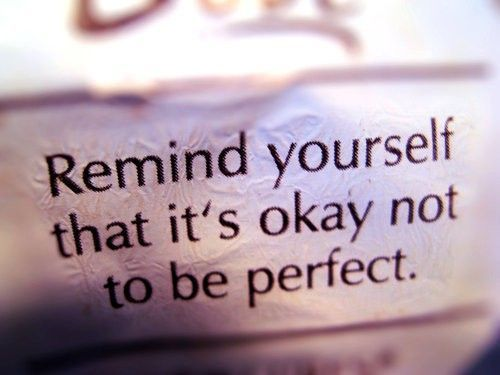
When someone has an eating disordered no matter if it is due to sports or not there are always common thoughts.
(This is just something I think speaks to anyone who has ever doubted themselves.)
Even after learning all of this I would still like to know how it has shaped these people’s lives. I think the thing people forget about when making surveys and reading them that these people are responding to the survey that they have experienced these they actually went through this. I think the way I want to make an impact on this topic is to make a presentation to my advisory about this issue. I plan to make a keynote presentation to them, I think it would consist of all the research I have gathered and my opinion. I think other people should also go out and be an agent of change for the issue.
Thank you for reading my second blog post the third is soon to come. To read my annotated bibliography click here.
Animal Vehicle Collisions blog #2 Deer
My inspiration for picking this issue was the animals I see that are killed by cars in the Wissahickon Valley Park in Philadelphia. So I decided to focus on animal vehicle collisions near the Wissahickon. Because many road kill incidents near the Wissahickon, and throughout Pennsylvania involve deer, I also decided to focus on that issue. Pennsylvania has one the highest number of deer/car collisions. This is partially due to the fact that many highways in Pennsylvania are near woodland areas and lack passages for animals to cross them. There is also an over population of White-tailed deer ( Odocoileus virginianus) in Pennsylvania, which has one of the highest White-tailed deer populations in the United States. There is an overpopulation in the state because deer have very few predators in Pennsylvania. Their main predators, wolves, and cougars were wiped out in the state due to hunting, and habitat loss, thus allowing the deer to overpopulate. In addition, deer can adapt to farms, and suburban environments. The problem with deer living so close to people is that they eat peoples crops and plants, and increase collision rates.
The population is a little more controlled in some parts of the state because of deer hunting. But hunting is a illegal in more urban areas such as Philadelphia, which has an overpopulation of deer especially in the Wissahickon. So what some cities like the Philadelphia are doing is allowing hired sharpshooters to kill local deer, thus reducing the population. The operation is safe, efficient, and effective, but it is very controversial. Many people don’t like the idea of weapons being used so close to homes and they also don’t like the idea of deer being killed. Humans killing deer is an effective way to lower the deer population, and reduce collisions. This form of death differs from car collisions because it doesn’t endanger humans. It also isn’t a wasted death because in the Wissahickon the meat from the deer goes to homeless shelters. Whereas if a deer is hit by a car, it just dies and that is a wasted death.
Deer vehicle collisions are extremely common in Pennsylvania. It is said that Pennsylvania highway drivers have a 1 in 86 chance of hitting a deer. This can not only injure and kill deer, but also injure and kill people. A full grown White-tailed deer can weigh three hundred pounds. Hitting them while going sixty mile an hour highway speeds can seriously damage a vehicle costing people a lot of money, and/or inure and sometimes kill drivers and passengers. These collisions have even killed people who weren’t even in the the vehicle that hit the animal. A woman in Butler County Pennsylvania was killed when a car going towards her hit a deer. The deer flew into her car and went through the windshield and into her car killing her.
To read article click here http://www.pennlive.com/midstate/index.ssf/2012/11/deer_hit_by_car_crashes_into_a.html
I’ve been conducting research on Pennsylvania environmental websites that have lots of information on deer car collisions to find this information. But I also talked to someone about animal car collisions. I emailed Maura McCarthy, the Executive Director at the Friends of the Wissahickon. I asked her some questions about animal car collisions in the Wissahickon Park because there are some roads that are near the park, and deer and other animals are sometimes killed on them. According to McCarthy the Parks Department is trying to prevent this by lowering speed limits and putting up crossing signs. Of leash dogs have chased deer into roads causing accidents. ( link to article about this on blog 1 ). An overpopulation of deer, means a large amount of collisions.
It is estimated that two to three deer are killed by vehicles in the Wissahickon each year. In 2011 two deer were killed just on Wissahickon Avenue alone. Just last week two deer were killed in the Wissahickon . One was a male killed on Wissahickon Avenue. Someone had cut off
To see a map of where i have seen road kill in the Wissahickon click here https://docs.google.com/a/scienceleadership.org/document/d/15hAM-UvuZKTPudPhL1rg9rMGqL3QDd4UP5m381ORGIo/edit
Male deer killed on Wissahickon Avenue Young Female deer killed on Emlen Street
the dead deer’s antlers. Another was a young female killed on Emlen street. It lay dead on the sidewalk across from the woods. A small puddle of blood lay next to its mouth.
My research helped me understand this more because I now know more about animal vehicle collisions near where I live. It makes the issue seem more relevant and effect me more. I hate seeing dead animal lying next to the road when I go into the woods. I want to know what I can do to prevent this. I want to know why crossing passages aren’t being built in areas where they could be useful. I want to know what can be done to stop animal vehicle collisions.
I’m not entirely sure what I want to do for my agent of change. I want to somehow try to make it safer for animals on roads, especially in my neighborhood. I might do something to raise awareness that this is a problem, and that people should push for lower speed limits in areas where there is a lot of wildlife. Maybe if more people are aware of this problem then they will be more careful and animal vehicle collisions won’t be quite as common.
Blog #1 http://www.scienceleadership.org/blog/Animal_Vehicle_Collisions
Bibliography https://docs.google.com/a/scienceleadership.org/document/d/1EY7F--TiUfcwTsHMtrbqUExHioAHPgTFdGHA_9vWgVE/edit
Domestic Animal Cruelty #2
According to New York Times Article, Bronx and Queens in New York do not have animal shelters since 1985 because they thought it was unnecessary to pay the amount of money they need to just for animal shelters. This resulted animals that are neglected by their owners or have been abused to be in the streets homeless. In Bronx and Queens, without anyone rescuing these homeless animals, they have to find their own food and own shelter. If animals were not abused or neglected by their owners, they wouldn’t have been on the streets in the first place. (unless of course some pets ran away from home) I know that some pets might have ran away from home and end up homeless, but not many pets run away from home that makes about 300,000 stray animals on the streets.
Bernadette Ferrara decided to bait the kitten because she was worried about it roaming around. The kitten was eventually rescued and is now safe.
Another example of why animal abuse needs to stop is in the ABC news article. In ABC News Article, Mieczyslaw Zwolinski stomped on a cat when he saw it in his yard. The consequence of this man stomping on this cat at least six times, the cat’s owner took the cat to the veterinarian to get treated for the pain in the ribs and the bleeding cut in the cat’s mouth. According to the police, this man is going to the court for the charges he will be held to. Even today, people continue to abuse animals that did no harm to anyone. This article explains a lot about our current situation about domestic animal cruelty. A lot of people like this man that abuse animals because they know that they are stronger than animals are all over the world. Every year, there are about 1,880 animal cruelty cases reported.
For more information about animals that are neglected and or abused, I went to the Morris Refuge for my self-created research and interviewed a woman named Kerri that works there. In an year, there are about 3 to 4,000 animals that come to the Morris Refuge every year and about 200,000 cats in the streets currently. She says the world needs to be more educated about animal cruelty and the consequences of abusing these animals. Kerri says, “... Because I think that a lot of people don’t understand that animals are living organism not non-living objects like shirts or pants...” During the interview, I was also able to find out that animals that usually come to the animal shelter are skinny, might have scars, or injured, or they might even be frightened to see human beings so they move away. Domestic animals are tamed to fit with human beings and the fact that they shy away from people is not usually a normal sight.
In my opinion, I think that more people needs to be aware about animal abuse and neglect. After that step, people should follow the rules and stop hurting animals because animals have feelings also. I understand a lot more about animal cruelty and more reasons why people are abusing animals. As Kerri stated, if people understand that animals are also living organisms like human beings, I think domestic animal cruelty can lessen a bit. If everyone puts effort and care into this issue, I know that there will be less domestic animal cruelty in the future. For my next blog post, I will make announcements in my school (Science Leadership Academy), go to other high schools to announce this issue if I am allowed to, and make posters to let people aware about the laws about what is illegal about domestic animal cruelty. I wish that people put more care into this issue.
This dog was abused, and you can see that this dog has scares, and is injured. This dog is very skinny and the fur cannot really be seen in some parts of his bodies either.
Click here for my bibliography. Click here for the link to my interview with Kerri from Morris Refuge.
Pay It Forward Blog #2
Advancing from my last blog, (The link to the blog is posted here http://www.scienceleadership.org/blog/You_And_The_World-YATW-Pay-It-Forward) I have been exigent to get more involved in the Pay it Forward movement while still keeping you guys versed on what is milestoning. I surmise that if I indubitably strive to make a difference then there is nothing out there desisting me from my goal. I wish to achieve global cognizance on how philanthropy and magnanimity can really shape our world for the better. I hope to be some spark that ignites the flame of truly good moral amongst the human race. To invigorate the honorableness in peoples’ hearts which will set in motion a path towards peace. Before I can even work to becoming this spark I must investigate whether or not humanity is capable of such a change. Also if I am to be confident in myself I must dive into creative research. This inquisition can help give me an idea on where I stand in my plan. Maybe if I find out where everyone else poses in this predicament I will be apt to come out stronger in my campaign. Like everything big, I must start out small. I should inaugurate in my community first. The only problem that arises is what can I possibly do?
Humility, generosity, chastity, meekness, temperance, kindness, and diligence are the seven main virtues that are instituted to students in Catholic schools everywhere. They are responsible for building teens’ personalities into righteous and forthright good samaritans. If you live your life by these seven virtues I am confident that you could really make a difference in your hometown or city. As a result I felt that my journey to making this world a better place should start around here. I attended Catholic elementary school for eleven years and each day was being educated that everything Pay it Forward stood for was the way to live, in an indirect sense. In this environment we had to constantly be kind, generous and forgiving. My friends that I knew in elementary school were the exact image of eleemosynary samaritans. They treated everyone, including strangers, like a friend. Always being willing to pay for another kid’s lunch, these people are the perfect model of exactly who you're suppose you be if you join Pay it Forward. To find out more on what it means to truly be a good person I interviewed my brother Vincent. Vince is in his freshman year at Roman Catholic High School and always has a story to tell on how teens at his school enact deeds of kindness. Roman Catholic High School is filled with courteous and debonair children who are always ready to learn. Here is the link to Roman Catholic’s website if you want to learn more about them http://www.romancatholichs.com.Thus when I conducted my interview with my brother I had the utmost confidence that he would for sure tell me tales of how students in his school love to act like christians. The interview between him and I is written down below.
Me: Vincent, Pay It Forward is the organization who performs acts of kindness that is sweeping the nation. So far Pay it Forward is responsible for influencing thousands of people to perform good deeds in the world. Soup kitchens have been donated generous amounts of money and stolen items everywhere are being returned all because of Pay It Forward. Nice isn’t it, to have people out there who actually care? Especially today where there is so much evil out in the world. Tell me, how does what the people of Pay It Forward are doing make you feel?
Vincent: It’s heartwarming to see so much compassion and generosity in our society. This is proof that there are still genuine people in the world today who actually care for others.
Me: It’s good to know that this affects you so. I’m glad to have someone like you in our community who takes the time to think about this. Now I believe that you attend a Catholic school and from past experiences I understand that Catholic schools pressure their students to be good samaritans. Some say that Christians are more felicitous to exhibit acts of goodwill in the world because of their teachings of being kind to everyone. Do you see a lot of this displayed in your school?
Vincent: I have often noticed acts of kindness shown in my school. It would seem that there is some connection between students and teachers alike because they all care for each other as if they were family. Whether it is something little like holding the door for someone in the morning or helping someone with a huge task, it is the thought that always counts.
Me: That is very inspiring, I am even more happy to see that kids our age are really trying to get out in the world and spread honorable deeds like that. I think for the most part that growing up in an environment as such can have a huge impact on one’s personality. For example, you have shown that teens being taught good samaritanism not only try to make a difference for the better, but also enjoy it. Do you agree, that if you are born surrounded by other humanitarians that you are prone to lead a life of good doing?
Vincent: If you grow up in a healthy and supportive Christian environment, there is no doubt that you will grow up to be a helpful and successful person. I myself find it satisfying to give to others in need. It is such a great feeling when you know you are truly helping someone.
Me: After thinking about this more do you think you’ll try to get out in the world, maybe? The whole point of Pay It Forward is to make a chain reaction of kindness among the world. Later in the year when I start to pursue making an actual change will you join me and move on to spread beneficence in your own school?
Vincent: I’ll do anything it takes to secure a brighter and better future.
Me: Thank you Vince for allowing me to take some of your time. I hope that talking to you has inspired you to really start thinking about making a difference. I hope you have a nice day my friend.
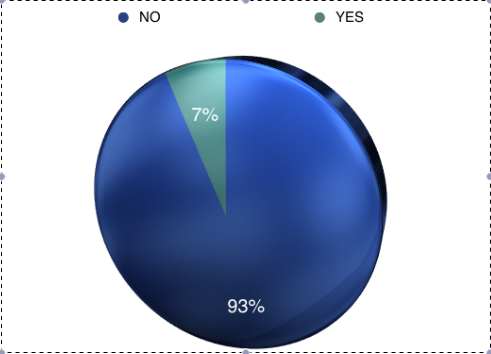
The interview between Vincent and I gave me hope that this world is ready for a change. Although thinking through the situation made me have an altered view on things. Here was a kid who lived his whole life being educated that you should be a prime person. Was there any doubts that his response would be nothing less than “A savior of humanity’s moral good”? I became concerned that what if normal people living normal lives could be the same. I needed to conduct an experiment to see how willing everyone is to put away their selfishness and actually care about someone else. After much thought I decided to transact a survey. Walking around my neighborhood seeking friends and family I depicted a situation where they supposedly found a clip of one hundred dollars lying in the street. I then asked them if they would try to bring the money to its rightful owner. The amount of persons I asked totaled to thirty. Using a pie chart to record results, I saw that the denouement was quite disturbing.
Unlike Vincent’s inspirational account on what it means to be a good samaritan, this pie chart shows that not everyone can have a truly generous heart. Out of all thirty people I used in this survey only 7% said they would try to return the clip. That is only two people! I was upset, discouraged, driven to the point of nihilism. Surely this couldn't be real. It was inconceivable for this to be real. I went over the results over and over again but to no avail. It seemed that greed persisted in people’s souls no matter what. It was time for me to change offense. Pay it Forward is routinely educating people around the world about the seven virtues and how to live by them. Did they ever think to mention the seven vices and talk about how not to live by them? Greed, lust, sloth, wrath, pride, envy, and gluttony. The tools of the devil; the 7 notorious archenemies of Pay It Forward. The ones that prevent us to fulfil our lives as right and just people. To raise knowledge on how to avoid these deadly offenders I created a chart on what to do when evil is on your doorstep.
| VICE | WHAT IT IS | WHAT YOU CAN DO TO AVOID IT |
| Pride | Pride is an inflated look on yourself and your achievements. If you are very prideful you might have a big ego. | It’s always good to be happy for yourself and to keep your head high;sometimes too much of that is a bad thing. To avoid pride you might not just want to be enthusiastic about your pros, but about other people’s too. |
| Wrath | Most definitely the most violent of the seven vices, wrath is an over amount of explosive anger towards a person or thing. | Wrath can be really dangerous to the people around you and that is why it is important to try and sidestep it. A good way to make sure you never are responsible for horrible deeds caused by anger is to think things out. If you try to put things in a different perspective, then you might see there is no real reason to be that mad. Try to see the outcome of a situation before you do anything you’ll regret. |
| Gluttony | Gluttony is the overindulgence of food or drink just for spite. If you and your friends ordered pizza and you eat the last piece not because you're hungry but because you did not want your friend to have it then that is gluttony. | Never look at food as a luxury but as nourishment. Once you feel that you eat just for pleasure then that is the first step towards gluttony. Try to only consume in an amount of food necessary to keep you alive. Remember there is people out there that don’t have the money to buy food. |
| Greed | Greed, I personally feel, is one of the worst of the seven vices. Greed is accountable for hundreds of atrocious deeds committed in history. It has started many wars and domination in the world. Greed is the need for wealth. | If you realize that you do not need money to enjoy life then you will be walking farther away from greed than you know it. See money not as a necessity but as an asset. You might not believe me but the goal to happiness does not involve wealth what-so-ever. |
| Envy | Assassinations and broken friendship can all be found in history caused by the evil of being envious. Envy is jealousy of another person’s possessions or status in life. | Envy is tremendously evil and you should always approach cautiously if you ever feel jealous of another person. If you are unable to avoid jealousy then here is a simple tip to make sure it doesn’t brew into envy. No matter who a person is and what they own you can always fulfill your dreams if you set your mind to it. |
| Sloth | Sloth is emotional, physical, and spiritual apathy. Sloth can be something as facile as not getting up to get the TV remote because you're lazy or even neglecting to socialize with people because you don't want to waste a breath. | A good way to maneuver sloth is to try to get active in the world. Make it a habit so it sticks. If you join a sports team or repeatedly do simple tasks such as holding the door for someone then you will be less tempted not to do something in the future. |
| Lust | Lust is a strong emotion of intense desire in your body. Lust takes many forms such as lust for knowledge , lust for power, and or lust for sex. | Lust is always knocking on everyone’s door. The temptation to do, say, or have whatever you want is not something you take lightly. To counteract lust you can try to think about other things when your desire for something comes up. Starting a hobby or hanging with your friends can help distract you from any desires. |
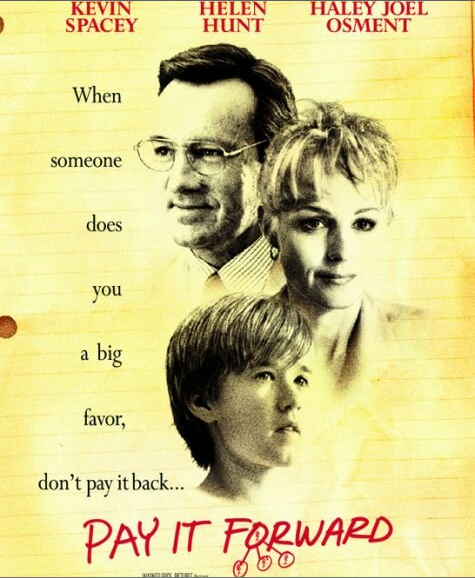
I hope you guys can take the time to look over these deadly vices and see if you are under danger of being corrupted by anyone of them. Going back Pay It Forward I wanted to see how much the organization influenced people around the world. Reading articles and consulting people I finally found out that this global phenomenon actually inspired a director to make a movie called “Pay It Forward”. The movie involves a young boy who is given the chance to do good in the world. I watched the movie and introspected it as tremendously heartening. I'm not going to say anymore ( You can learn more here http://www.imdb.com/title/tt0223897/)but the point is that if this movement that is sweeping the world can be strong enough to have a movie made about it then why can’t it do better? After watching the movie I felt better despite the horrible events of my money clip survey. It looks like some people seriously want some vicissitude for the greater good of the human race.
Pay It Forward movie cover.
It is hard to sleep at night knowing that humanity might be growing mature from some its old and ridiculous ways of life. The ways of life where people have to filch and murder to get by. You wonder why it is hard? It is hard to sit back and not join the cause. I have such a strong opinion about helping everyone around the planet that I have been boiling with enthusiasm ever since day one. The pullulating eagerness I feel to get my hands on some project that could inevitably make another person smile is inconceivable in amount. I am willing to put gargantuan volumes of devotion in my crusade to embodiment true values of justice in our country. Unfortunately reviewing the steps leading up to this second blog I realize that my research was pointless. I'm still left wondering whether or not even Philadelphia is ready for something like this. I am timorous that support might be problematic to acquire. It unsettles me not to be confident that I’ll receive reinforcement in what seems to me an epic battle of good and evil. Although I know that history repeats itself and I'm aware that throughout history it was always the will of one person that breaks and bends the turn of events. Anyone can make a difference own their own and I am determined to have my voice heard. I can’t help still being candidly moronic on what Im doing to do for my agent of change. Everytime I think of an idea it feels like it isn’t enough to create a spark herculean enough to wake people up. I will strive forward in my research until I find the ‘treasure’ of real enlightenment. If you have any ideas or are interested in service to the world then you can email me at jperaza@scienceleadership.org
This is the link to my annotated bibliography: https://docs.google.com/a/scienceleadership.org/document/d/1WHe41_DlnlJDnn1ULc7fNqNr9Tp8edR8O7Unbr8mIsU/edit
The War Of The Worlds
The War of The Worlds is about Martians who come to earth after they have faced major climate change in their own planet so they then came to earth to seek out a new home planet. Astronomers in the story take interest to the rapidly growing subject. Ogilvy (one astronomer in the story) goes to investigate the meteor form which the martians had fallen. He goes off to warn everyone of his findings. Later on there is a large crowd around the pit where the meteor had crashed. The martians are described as being about the same size as humans, with tentacles and big black eyes. The narrotor goes to tell his wife of the danger that they could possibly be faced with. The civilians who stayed around the area were killed by the Martians. As the death toll rises the military becomes involved. As the narrator attempts to gain more insight on the Martians another cylinder lands on earth with Martians in it.
The Martians begin to use heat rays which kill civilians of the surrounding area of London. So the humans in desperation to escape head for the docks which are letting people leave on ferry’s. As the narrator and his wife get away the fifth cylinder lands. Now the narrator comes across of house to take shelter in. Policeman walk from door to door to warn everyone that the Martians are basically unstoppable. After fifteen days of hiding in a coal cellar he comes out and goes to London where he is astonished to see that there are dead bodies everywhere. There was literally a war outside that no one is safe from. He looks around then he hears a strange sound and realizes that the Martians are dying. The earthly bacteria in which the Martians are not accustomed killed the Martians. Life becomes normal again, the narrator returns home.
The way my song and the story connect is in the song I explain how life is like in an inner city and how it is a war in itself. I know kids my own age who have been shot, or even killed. The story is about how no one is safe in the society at one point in which the Martians were there but it is like that everyday in Philadelphia; at any moment it could happen to anyone. One line in particular I said was “this is not opinion ; nor fact versus fiction this is my mission to make it to twenty-five not dead I don’t mean mummified, all they know is Killadelphia because that’s what surrounds us walk in to a dark room they found trust in what surrounds us.” That to me means for young men or teens who are in the street will be lucky to make it to the age of twenty five, but since ‘Killadelphia’ or Philadelphia is all they know they become used to it so they put their trust in their guns.
North Korea's Dictatorship: Blocked From the World (yatw blog post prt.2)
Since the last post I've discovered that North Korea is allowing tourists. North Korea's tourism is highly controlled and only shows the good parts of North Korea. All they show during the tour is Kim Jong Il's greatness, and how Kim Jong Il is the best at everything. That still can't completely hide the fact that the previous dictator, and father of the current dictator starved around 23 million North Korean citizens to death because of his forced seclusion of the North Korean people. The great famine that killed 23 million people subsided, however North Korea continues to go in and out of food shortages. People that are serious about human rights target North Korea. These activists and protestors try and do as much as they possibly can to make the lives of North Korean citizens better. Apparently North Korea has something against people using condoms, so one day, human rights activists droped food, misc. aid supplies, and condoms from the sky.
North Korean citizens believe that America is the reason why North Koreans can't leave their homes. They think that American soldiers on the border are the reasons they can't unite with their families in South Korea or anywhere else. This is one of the many lies the previous leader Kim Jong Il has told them, and without any form of outside communication they will never know the truth. During the dictatorship of Kim Jong Il, he has risen himself up as a Messiah of some sort. People aren't allowed to praise anything other than him. North Koreans believe everything he says... They have to at least pretend to believe and do every thing he says or they could be sent to concentration camps or shunned by other citizens.
I did a bit of research of my own on this topic. I created a survey to see how much people knew about North Korea. Exactly 28 people responded before the date of 1/20/2013. The survey consisted of questions based on how much people knew about North Korea, and about how they would feel if they were in the same situation. Here are the results.
North Korea Survey Results
- Of the 27 people that took the results 1 was Asian. The majority of the participants were Black and the second major race was Caucasian. One person was Hispanic and three where either mixed, or not one of the available races.
- When asked the question "Do you Know that North Koreans aren't allowed to step outside of North Korea?" 36% said yes, 32% said no, and 32% said I no a little bit about it.
- They were the asked the question "How would you feel if you weren't allowed to leave America?" the majority of the people said something along the lines of feeling trapped or they would feel bad.
- I also asked "How would you feel if you were trapped in America, often having shortages of food, not being able to buy any food for your family, dying from famine?". I got a mixed amount of responses varying from "I would die" to "I would go crazy and try to leave" to "This is a badly phrased question because the only responses you could get are bad and terrible"
North Korea: Yang's incredible story of pain and hope!
This is a story from a north korean who escaped North Korea. This video contains a disturbing story with disturbing images.
The Invisible Man
One of the book’s primary idiosyncrasies is that the titular character and protagonist, the invisible man, also serves as the story’s antagonist, and is shrouded in mystery for the majority of the book. Despite the narrative focusing almost entirely on him, little is known or revealed about the mysterious, bandage-clad stranger who arrives in Iping, West Sussex in the dead of night. The story follows this secretive man and hostile interactions with all others during his tenure in the town. Eventually he is shown to be a brilliant research scientist, who sought to create a race of perfect humans by making the first invisible man. In a fit of impatience, the man took the medicine he had created himself, rendering his body entirely invisible, and retreats to the quiet of the English countryside to reverse his condition.
While these events are not particularly the most relatable, considering my current visibility, I find the concept of the pursuit of invisibility to be a very human one. After all, who hasn’t wanted to disappear before? This, coupled with the charming depictions of quiet life in the English countryside made this a surprisingly easy book to relate to. It is this pairing of the mundane with the extraordinary that makes this book so unique and so much fun to read.
From start to finish, I thoroughly enjoyed this book. While there were moments when Wells went into minute detail for extended periods of time, he would pick up the pace immediately afterwards. The book was exciting and thought-provoking, without the heaviness of many similar science fiction books. It toyed with the ideas of existentialism and questioned humanity, but it was anything but dark or brooding.I can recommend this book to anyone who enjoys a thrill. It is fast paced and slow paced, funny and terrifying. It is a perfect illustration of a psychopath, and you will not regret it.
ENG1-009
- Term
- 2012-13
Blog Tags
See all See less
- English 9
- "English Dunn
- "English
- "English You and The World
- #macbeth
- "MacBeth
- "Englis 9
- "English9
- 9
- "English E/A Dunn
- A: English 1 - Dunn
- #YouandTheWorld
- Dunn English You and The world
- A: English 9
- YATW
- 2013
- English9
- blog post 3
- Dunn, English 9, You and the World
- English, 9, You and the World
- English 9 Dunn You and the World
- "2013"
- Q3 Benchmark
- "English 1"
- Homepage
- "Englis 9 Dunn
- Agent of Change
- Independent Reading