• Log In
  • Log In
Slate (skeleton-v3 PHP 8 prototype)
Slate (skeleton-v3 PHP 8 prototype) Learn · Create · Lead
  • Students
    • Mission and Vision
  • Parents
  • Community
    • Mission and Vision
  • Calendar

American Government - Laufenberg Public Feed

Create a Post

  2nd Quarter Benchmark Share Out

Posted by Diana Laufenberg in American Government - Laufenberg on Wednesday, January 19, 2011 at 8:22 am
1.  Go to D Band Voicethread.
2.  Register for an account.
3.  Add one image to the collective voicethread.
  • Choose one of your 12 items from the benchmark to highlight
  • Locate an image that best represents that item - you can use the flickr Creative Commons to find an image if you do not have one
  • Narrate your paragraph that accompanies that item from your benchmark
4.  Comment on at least two other 'pages' from the collective voicethread.  Ask a question.  Push back on their reasoning.  Affirm their position.  Be thoughtful

Be the first to comment.

WhyTuesday

Posted by Sophia Moreno in American Government - Laufenberg on Wednesday, November 24, 2010 at 6:50 am

The embed box is inconveniently small, but there are formatting issues either way.  Here is a link to the doc.  

Tags: American Government, Laufenberg
Be the first to comment.

Lobbying blog post #3

Posted by Kristina Chiev in American Government - Laufenberg on Tuesday, November 23, 2010 at 10:42 pm

Rep. Steve King, R-Iowa, chairman of the House Subcommittee on Immigration, is supporter this decision to somehow take care of these “anchor babies”. Right now many take this as a negative issue because it’s separating a child from their parents or others say that they had to struggle to even sneak in, so they should stay. Then there is also good media attention from news station saying how much these babies cost just to be born in America, and tax payers’ are responsible to pay for this bill that the hospital has for giving birth to the child. During my research, I haven’t ran into any people against this law that has power, but some people I found a while back, were professors at universities that said something like, “there is a solution, we just have to make one.” Even all the research about how much we are wasting on giving birth to “anchor babies”, there hasn’t been a policy put out, but the thing is, I don’t think a policy would really reinforce this to make it work. 

Rep. Steve King plays a big role in this because he is part of the house in some way. He can get his subcommittee to agree with this and then convince the committee to pass it on and show the legislative branch how much money we are spending on “anchor babies”

People who might care to hear about this subject are U.S. taxpayers, which is about everyone living in the States. Many people don't know that a hospital wastes about $30,000 to deliver a child and that hospital bill is paid from money from the taxpayers. If they knew that their money is going to children that technically are not supposed to be here, they might have a change of mind.

There is no time frame as of now, but I am hoping to contact a representative that agrees with my thinking to talk about where is most of the money from tax payers is going to.

Be the first to comment.

Lobbying Post #3

Posted by Kimberly Yarnall in American Government - Laufenberg on Tuesday, November 23, 2010 at 9:33 pm

 What is the status of your issue at the legislature? Is this a "good" year?

There is no local legislators currently working on doing something about the FDA, but I found someone in Arkansas who is working on the issue. It was Congressman Mike Ross. Alaska state legislators have asked the US Food & Drug Administration to withhold its approval of Aquabounty's application to bring a genetically modified salmon to market. (October 7th, 2010)

Who is essential to the outcome?

The people who are essential to the outcome are the people who are working to fix and/or change certain things involving the FDA. As of now, there aren't any local legislators working on the issue I'm working on, which is stopping the FDA from changing food names. If their were people working on this, then those would be the people who were essential to the outcome.

Who else is working on this? Can you coordinate?

Me and Alex McGrorty are working on this topic together. No one in local government is working on our topic, so it would be fairly difficult to work or talk to someone who is doing something involving our topic.

Who can you influence?

I can influence the people who aren't aware of the name changing issue. Since their aren't many people aware of this issue, it would be easy to inform and influence them to help, or consider helping.

What is the time frame?

Since there is no one local working on this topic, there wouldn't be a time frame on it, so my time for this could be long.

clock

Be the first to comment.

Lobbying Post #3: Test Optional

Posted by Kimberly Bush in American Government - Laufenberg on Tuesday, November 23, 2010 at 9:28 pm

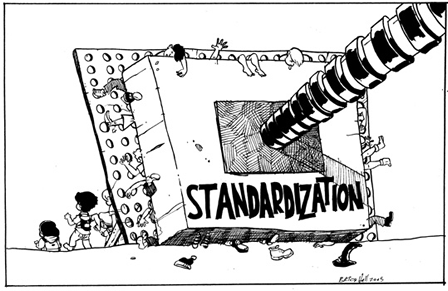
As of the year 2010, I believe that that the topic, Standardized Testing, is having a some-what good year. It seems as though many people have been informed about the non-educational practices of standardized testing.

GOOD YEAR:

October 11, 2010: James S. LiebmanAccording to this Columbia Law School professor, New York City has come up with a new idea on how to evaluate schools based on their student’s knowledge at the end of the year. Instead of focusing on “a single, arbitrary line” it looks at the process of each student across the whole scale.October 12, 2010: Monty NeillAccording to the interim executive director of FairTest, “Parents, children and taxpayers would be far better served if politicians understood the well-documented limitations of standardized exams rather than continuing to pursue misguided high-stakes testing policies that undermine real learning.”

FairTest

What is it?

- The National Center for Fair & Open Testing (FairTest) is working to end the “misuses and flaws of standardized testing” and to make sure that the assessment of students, teachers, and schools is fair and benefits the education.

Goals:
  • The Assessment Reform Network, aims to facilitate the exchange of information and ideas among teachers, parents, education reform and civil rights organizations seeking to improve student assessment practices in their communities.
  • Creating a new framework for assessment through dissemination of Principles and Indicators for Student Assessment Systems
  • Uncovering the bias, misuses and coach ability of the SAT, ACT and similar college entrance exams
  • Stopping the misuses of SAT/ACT scores to determine eligibility for college financial aid such as National Collegiate Athletic Association's initial eligibility rules (Propositions 48 and 16) and the National Merit Scholarship Competition
  • Promoting test score-optional policies for college admissions
  • Attacking the false notions that test scores equal merit

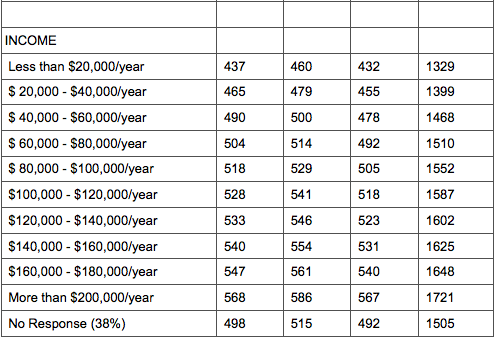
2010 College Bound Seniors Average SAT Scores

The Higher Ups:

Joe Biden

"A child is more then a test score. So how can you expect our students to build a new economy if all they are doing is filling out bubbles? How can you expect them to think critically if all we are doing is testing their ability to memorize things?"
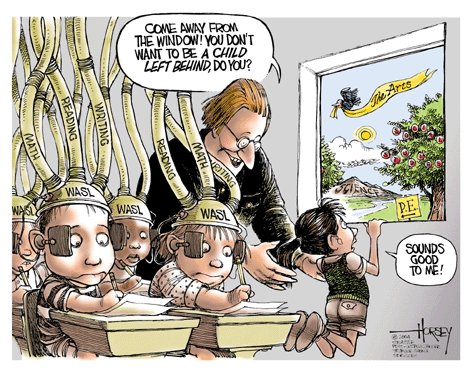
- Joe Biden


According to Joe Biden,

“We know what we need to do, and its not No Child Left Behind. We have to stop focusing on test scores, a child is more than a test score.”

At the NEA (National Education Association) Convention, Biden spoke on Standardized Testing and Education in general. He believes that many things should be changed, such as:

  • Class sizes
  • Teacher Salary
  • No Child Left Behind
  • Focus on Test Scores
  • Availability to an Education
Barack Obama

“Creativity has been drained from classrooms, as too many teachers are forced to teach to fill-in-the-bubble tests...It just can’t dominate the curriculum to an extent where we are pushing aside those things that will actually allow children to improve and accurately assess the quality of the teaching that is taking place in the classroom.”

-Barack Obama

Obama doesn’t support the No Child Left Behind Law because he believes that it’s all talk but no action. The No Child Left Behind Law “leaves the money behind”. It takes away the creativity and the individuality of students and their teachers.

Obama states that teachers should be able to teach instead of spending majority of the year preparing students to fill out bubbles on a test. Instead of just standard testing on Math, Reading, and Writing he will fund states to apply a broader variety of assessments such as:

  • using technology
  • conducting research
  • engaging in scientific investigations
  • solving problems
  • presenting
  • defending their ideas.

Who Does This Problem Most Relate To?

Students:

The link above is a video of four high school students performing poetry about standardized testing. In it they state how standardized testing has conformed the minds of students and that it doesn’t educate you on “the things we need to know to live.”

I believe that students feel more singled out by standardized test than anyone else because they are the ones who are taking them and these tests “determine” their future. However, some colleges and universities are becoming test optional.

Upcoming Meetings on Education:

The Compact meets on the first Thursday of every month to share perspectives on reform initiatives in the Philadelphia schools, and to support policies and strategies that hold the best promise for improving the culture and outcomes of local schools.

Friday, December 3, 2010; 8:00 AM–10:00 AM

Thursday, January 6, 2011; 8:00 AM–10:00 AM

Thursday, February 3, 2011; 8:00 AM–10:00 AM

Thursday, March 3, 2011; 8:00 AM–10:00 AM

Thursday, April 7, 2011; 8:00 AM–10:00 AM

Thursday, May 5, 2011; 8:00 AM–10:00 AM

Thursday, June 2, 2011; 8:00 AM–10:00 AM

Sources:

http://www.nytimes.com/2010/10/18/opinion/l18schools.html

http://www.fairtest.org/

http://www.fairtest.org/2010-collegebound-seniors-average-sat-scores

http://glassbooth.org/explore/index/joe-biden/2/education/14/

http://www.youtube.com/watch?v=cg4PbJs6N3k&feature=player_embedded#!

http://www.education.com/magazine/article/Barack_Obama/

http://www.youtube.com/watch?v=ktC_C7Z-wWE&feature=player_embedded

http://www.youtube.com/watch?v=J9EkX_gX6R8&feature=player_embedded

http://www.youtube.com/watch?v=z4A6e8Rk8Oo

http://www.thedailyriff.com/2010/10/saying-no-to-standardized-testing-for-college-entry.php

http://philaedfund.org/programs/engaging-citizens/education-first-compact/upcoming-meetings

Be the first to comment.

Lobbying Blog #2: Yes or No

Posted by Kimberly Bush in American Government - Laufenberg on Tuesday, November 23, 2010 at 9:25 pm

Kimberly BushOctober 22, 2010Joe Biden"A child is more then a test score. So how can you expect our students to build a new economy if all they are doing is filling out bubbles? How can you expect them to think critically if all we are doing is testing their ability to memorize things?"

- Joe Biden


According to Joe Biden,

“We know what we need to do, and its not No Child Left Behind. We have to stop focusing on test scores, a child is more than a test score.”

At the NEA (National Education Association) Convention, Biden spoke on Standardized Testing and Education in general. He believes that many things should be changed, such as:

  • Class sizes
  • Teacher Salary
  • No Child Left Behind
  • Focus on Test Scores
  • Availability to an Education
Barack Obama“Creativity has been drained from classrooms, as too many teachers are forced to teach to fill-in-the-bubble tests...It just can’t dominate the curriculum to an extent where we are pushing aside those things that will actually allow children to improve and accurately assess the quality of the teaching that is taking place in the classroom.”

-Barack Obama

Obama doesn’t support the No Child Left Behind Law because he believes that it’s all talk but no action. The No Child Left Behind Law “leaves the money behind”. It takes away the creativity and the individuality of students and their teachers. Obama states that teachers should be able to teach instead of spending majority of the year preparing students to fill out bubbles on a test. Instead of just standard testing on Math, Reading, and Writing he will fund states to apply a broader variety of assessments such as:
  • using technology
  • conducting research
  • engaging in scientific investigations
  • solving problems
  • presenting
  • defending their ideas.
Chaka FattahFattah, when asked if he supported standardized testing, gave two perspectives. He believed that tests were needed to “analyze how students were doing in relation to other students,” however, he also believes that, “students should not be merely taught to pass examinations or given tests prematurely before they have been taught the information.”

According to Chaka Fattah, the No Child Left Behind Law is, “intellectually dishonest because it holds children accountable for test scores when their schools lack resources.”

My Views:

I guess you could say that I agree with those who believe that standardized testing is needed in schools. However, it should not be heavily weighed as a resource to test a student’s intelligence. How can you measure someone’s mind and abilities through a test? You can’t because memorizing and learning are two different things. There’s a distinction between understanding and remembering what you are told. You can be told one thing but this doesn’t mean that you actually understand the meaning behind that thing. Being a Senior in high school, I have a biased view against the Scholastic Aptitude Test because my GPA shows a higher degree of learning than the scores on that test. To get into a college, you should not be based off of how many bubbles you’ve filled out correctly but by the actual grades you get in high school.  Either way, there needs to be a change on how we assess the future of our world.

If we don’t change today, than what will we learn tomorrow?

Sources:

http://glassbooth.org/explore/index/joe-biden/2/education/14/

http://www.youtube.com/watch?v=cg4PbJs6N3k&feature=player_embedded#!

http://www.education.com/magazine/article/Barack_Obama/

http://www.youtube.com/watch?v=ktC_C7Z-wWE&feature=player_embedded

http://www.youtube.com/watch?v=J9EkX_gX6R8&feature=player_embedded

http://www.votesmart.org/npat.php?can_id=21850#Result

http://www.ucc.org/justice/public-education/transforming-no-child-left.html

Be the first to comment.

Lobbying Post #1: Standardized Testing

Posted by Kimberly Bush in American Government - Laufenberg on Tuesday, November 23, 2010 at 9:24 pm

Kimberly Bush
October 6, 2010
Science Leadership Academy

I’m lobbying against any federal financial aid giving college that’s using Standardized Testing as criteria for admissions.

All throughout my childhood I’ve been told that I am a smart young woman who is capable of many things. However, it was brought to my attention that when taking tests, my intelligence wouldn’t really reveal itself on this piece of paper. Looking into it, I realized that in reality tests can’t be accountable for every young adults smartness because there are those who aren’t good at test taking, one of them being me. This is the main reason on why I wanted to go to Science Leadership Academy. After hearing about this project based school, I felt as though they understood that there are those who are very intellectual and therefore found a way to surface their creativity. As a Senior, I’m looking back at all the projects I did and wondering if I could have shown this type of creativity and individual uniqueness through tests. The answer would be no. However, now I’m trying to get prepared for college which involves finding the colleges, visiting them, and determining if my SAT scores are high enough for any of them. Not only are the SATs one of the things that can determine if you get the education you want but it also causes a lot of unnecessary stress that builds up until you’re done the whole college application process. This whole process made me wonder what SATs are really about and whether they determined how bright a person is based on the answers to a multiple choice question and their view on a topic. To me, a person can be very insightful and wise even if a test says otherwise because they may have different views and different knowledge that we have never been introduced to.

    The main supporters of my lobbying topic would probably be high school students, parents of those high school students, and those who took the SATs and didn’t get a good enough test score to get into their desired college. Those who probably would not support my lobbying topic would be the colleges with high expectations (i.e. Ivy League Colleges...), those who have very strong test taking skills, and possibly educators.      There is not any type of bill or legislation on my topic that I know of. If there was one to be made, I would like to see what both sides of the topic would propose for the benefit of our youth today. However, I would want to get the opinions of actual high school students too, to see their point of view on this topic. I feel as though you can’t really make a bill without actual concrete evidence. Therefore, if I were in charge of choosing whether or not financial aid giving colleges should use Standardized Testing as criteria for admissions, I would bring together high school students from all around the world with different views and have a big discussion about it. After gathering up data from that event, I would bring together different Representatives from colleges ranging from Ivy League Schools to Community Colleges and have the same discussion with them. Based on the information gathered and the points given I would from there conclude on whether or not Standardized Testing is a good way to represent the intellectual being of a student.

This article states many key factors and details on why Standardized Testing isn’t an effective way on judging the smartness of a student. The writer gives his opinion and backs up his statements with evidence from the actual test itself and those who judge the tests as well.

Here are a few things that he stated in his article:
  • “Rather than learning anything of consequence, students are taught how to beat the test.”
  • “The essays written on these tests are frequently not scored by educators, but by temp workers, who are paid minimum wage, and who generally spend no more than two minutes on each exam.  According to one former scorer, "There were times I'd be reading a paper every ten seconds.  I know this sounds very bizarre, but you could put a number on these things without actually reading the paper." Furthermore, the scorer added that he and his coworkers were offered a "two hundred dollar bonus that kicked in after eight thousand papers."’
  • “Quoting Roger Farr, a professor of education at Indiana University, "I don't think there's any way to build a multiple-choice question that allows students to show what they can do with what they know."’
These are just a few examples in this text that sheds light on the flaws of Standardized Testing.     In conclusion, as a high school senior, I view Standardized Testing as unnecessary and a defective way to represent the intelligence of our youth. Hopefully, later on, this topic will be brought to the attention of those higher up who will realize that there needs to be a change on how we assess our youth. These faulty assessments should not be the criteria that colleges base the future of this world on.

Sources:

http://www.standardizedtesting.net/worst.htm

Be the first to comment.

lobbying post #2

Posted by Bethany Knibbe in American Government - Laufenberg on Tuesday, November 23, 2010 at 9:02 pm

Sunday, October 24, 2010


        So, part two of the lobbying project has come up. This time, I researched about specific legislators and/or bills that are involved with my topic. I spent a lot of time searching for bills that had been passed or are in the works, and came up empty. Well, except for the National Drug and Alcohol Addiction Recovery month. So I decided to direct my research towards specific places that have holistic recovery programs and the people who run them.


        The first organization that I found is called the Public Health Management Corporation, or PHMC and, mainly through their affiliate organization, The Bridge, runs many recovery centers in the philadelphia area. The people who run these centers would be good contact points for me to find out what the needs of these programs are, and what the government can do to help promote the growth of these centers and the creation of new ones.


        Another organization I can contact is the Whosoever Gospel Mission in Philadelphia. This is a religious organization, so they don’t recieve federal or state funding, but it would be interesting to think about what the government can do to help out all recovery centers, for example, tax breaks. It’s something to think about.

Be the first to comment.

Lobbying post #1

Posted by Bethany Knibbe in American Government - Laufenberg on Tuesday, November 23, 2010 at 8:13 pm

Friday, October 8 2010
I'm lobbying for support of holistic drug and alcohol recovery programs in the city of Philadelphia. I read an article in the Inquirer about how Philly has a lot of great programs and I'd like to see that grow and help to make our city a better place. These programs treat addictions as a chronic illness, and support the people in the long-term.

Addictions are unbelievably hard, and you can't get out of them on your own. When I read about these programs, I got so excited because there is a huge number of people in our city living with addictions, and dying of them. These kind of programs really work and our city needs them. The more support the government gives to these organizations, the more successful they can be. I want to see these organizations grow and transform our city into a place where people with addictions know they can get the help they need to get rid of their addictions, and the support systems they need to leave them behind for good.


Thomas McLellan, deputy director of the White House Office of National Drug Control Policy is a big supporter of holistic recovery. Here’s a Philadelphia Inquirer article about him. Also, there are 6 city council members that, in 2009, passed a resolution for September to be proclaimed in Philadelphia as “National Drug and Alcohol Addiction Recovery Month”. These people may be a good starting point for lobbying because they are aware of the issue and have shown that they believe it to be important.

Now that I have an idea of the issue and some people in government that are involved, I’m ready to take the next step!

1 Comment

Lobbying blogposts

Posted by Robert Glynn in American Government - Laufenberg on Tuesday, November 23, 2010 at 5:54 pm

Until i can figure out  how to make my blog not post in this tiny box. Click Here.

Be the first to comment.

Lobbying Blog Alex McGrorty

Posted by Alexandra McGrorty in American Government - Laufenberg on Tuesday, November 23, 2010 at 10:11 am

Lobbying Blog

Entry #2

Who Represents Me?


The Congressman for my area is Chaka Fattah.

Who is he?

A Democrat, representing the 2nd Congressional District of Pennsylvania


The district is pretty expansive, with Fattah representing the majority of Philadelphia


The Second District spans from Wynnefield into West Philadelphia, which includes  Spruce Hill  and University City As well as Center City Philadelphia, and it also includes North and Northwest Philadelphia, the home of East and  West Mt. Airy,  Chestnut Hill,  East Falls, Germantown, Manayunk and Roxborough.


A bit about the man himself


Chaka Fattah is a Democratic member of the United States House of Representatives

He is a Philadelphia native, born November 21, 1956.

He attended the Community College of Philadelphia and went on to earn his MA at Pennsylvania Sate University


Before his election to Congress, Fattah served as a member of the Pennsylvania House of Representatives and of the Pennsylvania Senate.


Some of his political views include:

  • Transform America Transaction Fee to bring more funding to schools
  • the clean energy act
  • paperless enrollment for school meals act
  • debt-free America act

While he has not had an opinion on anything directly relating to the FDA and food labeling regulations, he has made his opinions regarding health care issues clear

and they are documented


Lobbying Blog

Entry #3

Researching the Issue


It’s hard to say whether it’s a “good year” for my issue. There has been a lot of publicity over the issue lately


And there’s been an interesting mixture of public outcry against the issue, as well as public support of it. This generally tends to happen when the FDA is petitioned to change the name of a food product.


As far as government legislation goes, several legislative officials are against corn syrup, and believe it to have negative heath risks.


“Calling high-fructose corn syrup the “crack of sweeteners,” Florida state Rep. Juan Zapata wants to ban the state’s school districts from selling or using products containing the sweetener. Zapata, a Republican, is joined in this effort by state Sen. Gwen Margolis, a Democrat. Both maintain that students who consume foods and drinks made with high-fructose corn syrup are more likely to become obese and develop Type-2 diabetes.”


The main opponent in this issue is, of course, the corn growers and corn refiners. Corn, in the United States anyway, is a cash crop. More than is traditionally consumed is grown, leaving a margin for a large profit. There has been a lot of propaganda on both sides of the argument, which has gotten the debate a lot of media attention.


The stakeholders in this issue are just about every American consumer. If the FDA is not going to be clear about food labeling in this country, then it will affect everyone who eats any form of American food. Label transparency is an important issue.


The FDA has a transparency initiative in the works


No local legislature is currently working specifically on the corn syrup v. corn sugar issue, or about the safety or controversy regarding corn syrup. However, several out of state officials are.


Hopefully I can influence anyone who was unaware of this issue specifically, or the issue of food label transparency in general.


As there is no pending legislature regarding this yet, there is no definitive timeline.


Tags: Lobbying, blog, amcgrorty, Laufenberg, government, 2010
Be the first to comment.
214 posts:
← Prev
  1. 1
  2. 2
  3. 3
  4. 4
  5. 5
  6. 6
  7. 7
  8. 8
  9. 9
  10. 10
  11. 11
  12. 12
  13. 13
  14. 14
  15. 15
  16. 16
  17. 17
  18. 18
  19. 19
  20. 20
  21. 21
  22. 22
Next →
RSS

AMGOV-002

Term
2010-11

Blog Tags

  • Laufenberg 20
  • American Government 18
  • Lobbying 9
  • Taylor Tomasco 9
  • Cody Nichols 7
See all See less
  • Education
  • lnguyen
  • AM GOV
  • american Gov
  • AMGOV
  • FAFSA
  • 2010
  • benchmark
  • Q1 BM
  • sla
  • NCLB
  • QTR1BM
  • law
  • kbush
  • government
  • amcgrorty
  • blog
  • SEPTA
  • Sinnea Douglas
  • Bureaucracy
  • Bureacracy
  • animal cruelty
  • Executive
  • Legislative
  • Judicial

Teacher

  • Diana Laufenberg
Slate (skeleton-v3 PHP 8 prototype) · Location: 1482 Green St · Shipping: 550 N. Broad St Suite 202 · Philadelphia, PA 19130 · (215) 400-7830 (phone)
×

Log In